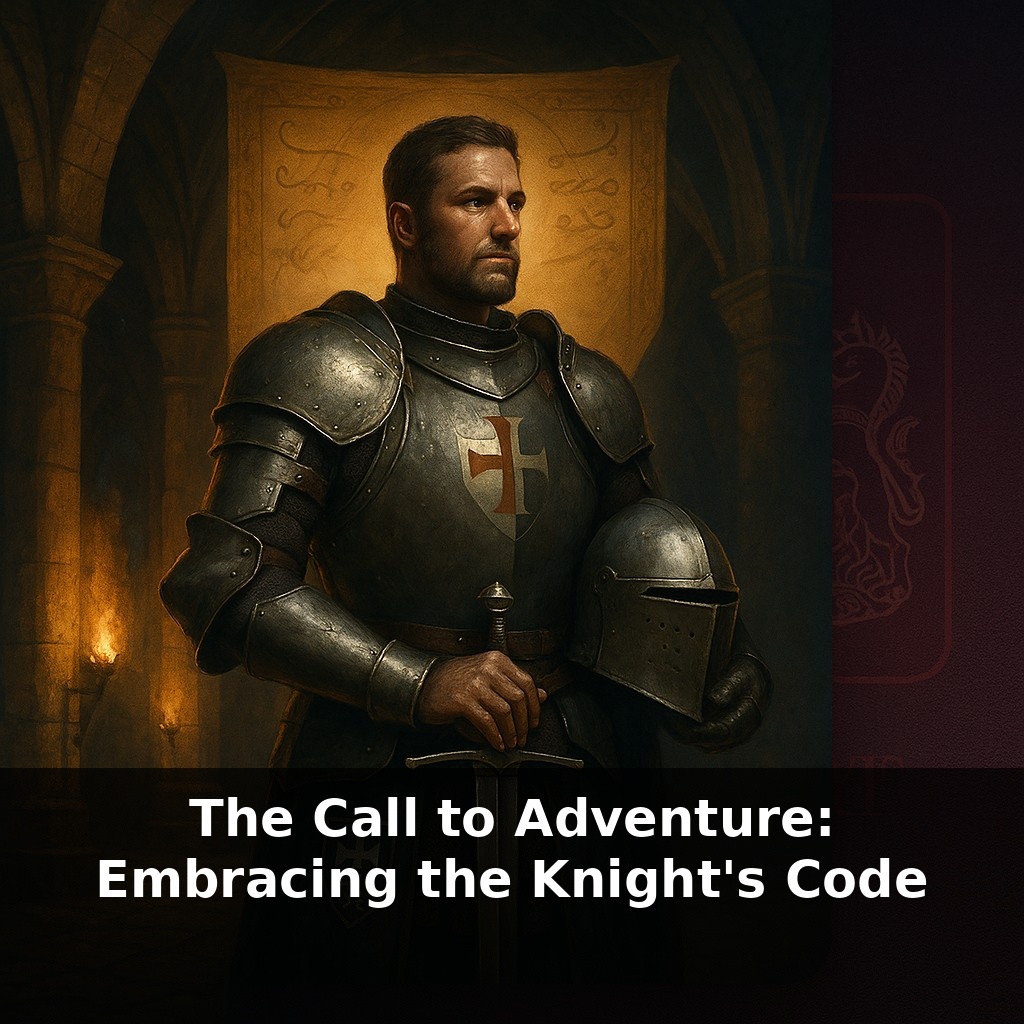
The Call to Adventure: Embracing the Knight's Code
📝 Transcript
A single line of medieval French—“Shame on him who thinks evil of it”—is printed on every British passport, yet almost no one can explain why. Now, step into a torch-lit hall where that forgotten motto once meant the difference between glory, disgrace… or death.
The strange part isn’t that a medieval phrase survived on modern documents; it’s that the world that birthed it ran on rules most of us have never truly examined. Knights weren’t just swinging swords—they were running a demanding, always‑on “software” of courage, restraint, and public accountability. Break the code, lose your honor; keep it, and doors opened in war councils, royal courts, and whispered legends alike.
Today we inherit a different problem: unlimited choice, but almost no shared script for how to live well. You can swipe, scroll, and “opt out” of nearly everything—except the need for a spine of values. That’s where the knight’s code becomes more than costume drama. It offers something we quietly crave: a clear, demanding story about who we are, what we stand for, and what we will not do, even when no one is watching.
Chivalry, in its own time, was less a romantic ideal and more a gritty contract between power and responsibility. A knight could devastate a village or defend it; the code tried to decide which. Geoffroi de Charny didn’t just praise brave fighters—he insisted on “largesse” toward the poor and “pitié” for the defeated, binding strength to mercy. And the price of entry was steep: a warhorse alone could swallow years of a peasant’s earnings. You weren’t just buying armor; you were buying into a lifelong role, like accepting a demanding job description that followed you everywhere, from battlefield to banquet.
When you strip away the banners and ballads, what you find underneath is surprisingly practical: someone in the 13th century sat down and tried to answer the same question you quietly wrestle with now—“How do I live in a way that I can respect when things get hard?”
Geoffroi de Charny’s list of virtues reads like a brutal checklist for people with real power and real temptations: fight bravely, yes, but also give when it costs you, forgive when you’re angry, tell the truth when lying would be safer. Notice what’s missing: there’s no clause that says, “Only when convenient.” The expectations were embarrassingly public. Oaths were spoken aloud, witnessed, remembered. Failures were not “personal growth moments”; they could mean exile, disgrace, or formal shaming in front of the same peers who had watched you swear you’d never do that.
Modern psychology quietly confirms why that harsh clarity worked. When you commit to explicit values, you give your brain a script to reach for under pressure. Researchers call it “self-affirmation”: you write, speak, or reflect on the kind of person you claim to be, and—over time—you start making choices that avoid contradicting that story. In 88 studies across health and academics, that simple act moved real outcomes. Not because people became saints, but because they became slightly less willing to betray their own declared identity.
Look at places that still dare to have a code. West Point’s Honor Code is blunt: “A cadet will not lie, cheat, steal, or tolerate those who do.” They track violations, enforce consequences, and accept that a tiny percentage will leave rather than live inside that story. Leadership programs that borrow from older martial traditions do something similar: they ritualize commitment. You speak the words. You sign your name. You stand up in front of others and say, “Hold me to this.”
This is the deeper “call to adventure” the old narratives hinted at. Not “go fight dragons,” but “go become someone whose word can be trusted when the dragon is your fear, your ambition, or your craving for approval.” The dragons are mostly internal now, but the mechanism is the same: a demanding script, publicly owned, that you either inhabit or abandon.
Your challenge this week: design and test a “mini code” for just one arena of your life where you feel adrift or reactive—work meetings, online interactions, family conflict, physical health, anything. Then deliberately put that code under stress and watch what happens.
Step 1 – Choose your battlefield Pick a context that reliably triggers you. Be concrete: “project status meetings,” “social media after 9 p.m.,” “talking to my sibling about money,” not just “work” or “relationships.”
Step 2 – Draft 3–5 non‑negotiables Write short, behavior‑level lines that start with “I will…” or “I will not…”. They must be specific enough that a stranger could tell if you did them. For example, for tense meetings:
- “I will speak once to contribute, not just to defend myself.” - “I will not interrupt, even when I feel attacked.” - “I will ask at least one clarifying question before I disagree.” - “I will own my mistakes without adding excuses.”
Avoid vague ideals like “be respectful” or “stay calm.” Translate them into visible actions.
Step 3 – Make it public in a small, deliberate way You don’t need a fanfare, but you do need witnesses. Options:
- Tell one trusted colleague or friend: “Here’s how I’m going to handle X this week. If you see me drift, call it out.” - Put the code where it can “stare back” at you: sticky note on your laptop, lock‑screen wallpaper, top line of your meeting agenda. - If appropriate, open a meeting or message with one line from your code—e.g., “I’m committed to asking more clarifying questions than usual today.”
The point is mild social pressure, not grandstanding.
Step 4 – Schedule a post‑battle debrief Before the week begins, block 20 minutes on your calendar for a quick review. When the time comes, ask:
- Where did I keep the code under fire? - Where did I quietly step around it? - What emotion showed up right before I broke it—fear, shame, anger, boredom? - What one line needs adjusting to be both demanding and realistic?
Don’t turn this into a guilt exercise. Knights rewrote and re‑interpreted their codes across centuries; you’re allowed to refine yours across a week.
Step 5 – Add one inch of difficulty If the mini code mostly held, raise the bar slightly: add a tougher line, or extend it to a broader context (from “status meetings” to “any meeting where I feel defensive”). If it mostly collapsed, narrow the scope, not the ambition: keep the same lines but apply them to just one recurring situation.
You’re not trying to become flawless. You’re trying to become someone whose behavior starts to feel predictably aligned with stated values—a person who, under pressure, already knows the script they’ve chosen to live by.
Think of your mini code as custom firmware you’re flashing onto one very specific part of your life. You’re not rebuilding the whole machine—you’re upgrading how one circuit behaves under load. For example, say your “buggy” area is late‑night scrolling that leaves you wired and empty. A simple code might read: “I will plug my phone to charge outside my bedroom by 10:30,” and, “I will open a book before I open any app.” It’s not about morality points; it’s about running a different script at the exact moment you usually default to autopilot.
Or take conflict with a partner who “never listens.” Your code could include: “I will summarize their point before I argue mine,” and, “If my voice rises, I will pause and drink water.” These are tiny, testable commitments. Over a few reps, you start to notice a subtle shift: instead of debating who’s “right,” you’re training your nervous system to follow a prepared pattern. The adventure isn’t out there; it’s in becoming the kind of person whose small, repeatable moves gradually rewrite the story of who you are in that arena.
As our lives move further online, these personal “mini codes” may quietly become the social glue that laws and algorithms can’t provide. In virtual teams, shared commitments could work like lane markings on a highway, keeping remote collaborators from drifting into blame or burnout. Youth programs are already testing story‑driven value training; future versions might track how often players choose courage or restraint in a game and then coach them on mirroring those choices in real‑world stress.
Your “mini code” won’t stay mini for long. As you iterate, it can branch into domains you haven’t touched yet—how you handle money, power, or even rest. Think of it as slowly sketching a personal constellation: each new star is a tested promise, and over time, the pattern they form starts guiding you when the sky looks empty.
Start with this tiny habit: When you first sit down with your morning drink, whisper one line of your own “Knight’s Code” for the day that starts with “Today, I protect…” and name one specific person or value (like “my focus during meetings” or “my kid’s bedtime”). Then, as you stand up from that chair, tap your hand lightly over your heart once, as your “armor on” signal.

Unlock all episodes
Full access to 5 episodes and everything on OwlUp.
Subscribe — $1.99/monthLess than a coffee ☕ · Cancel anytime