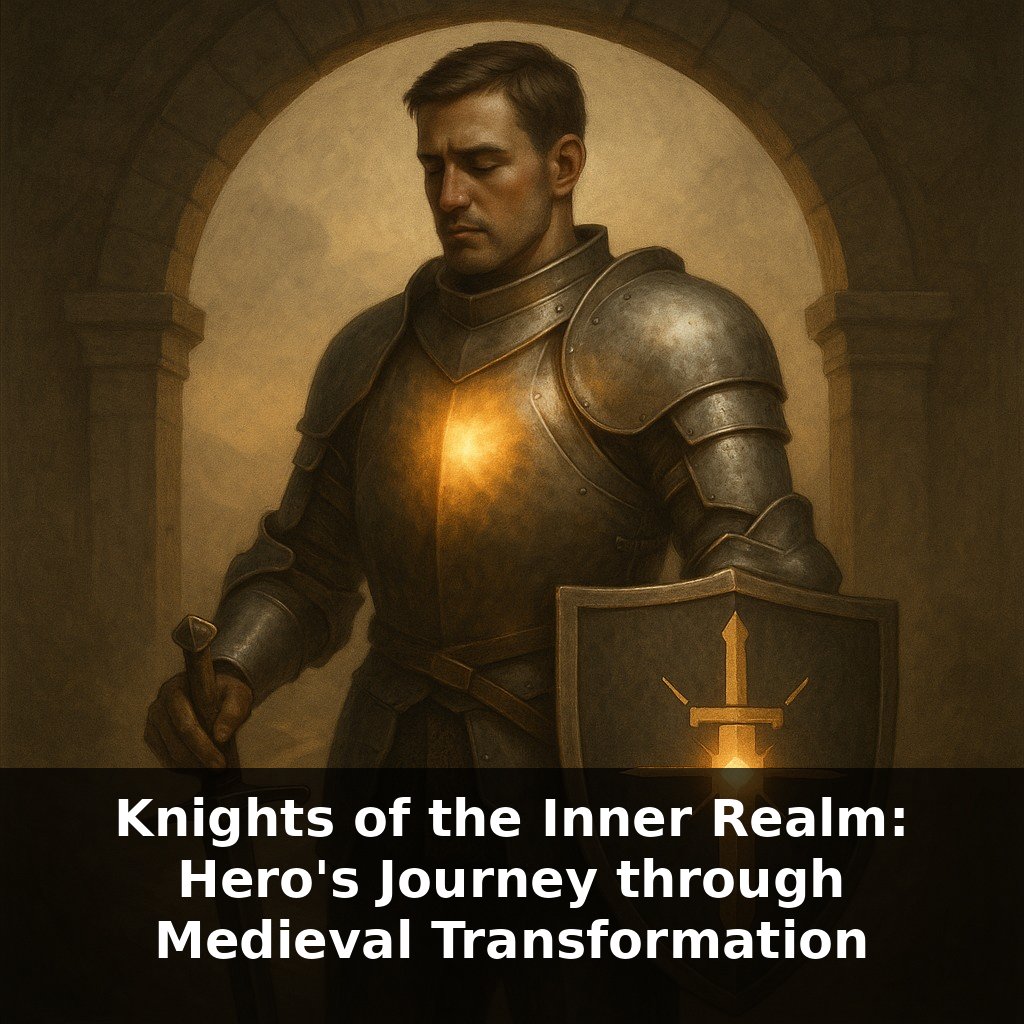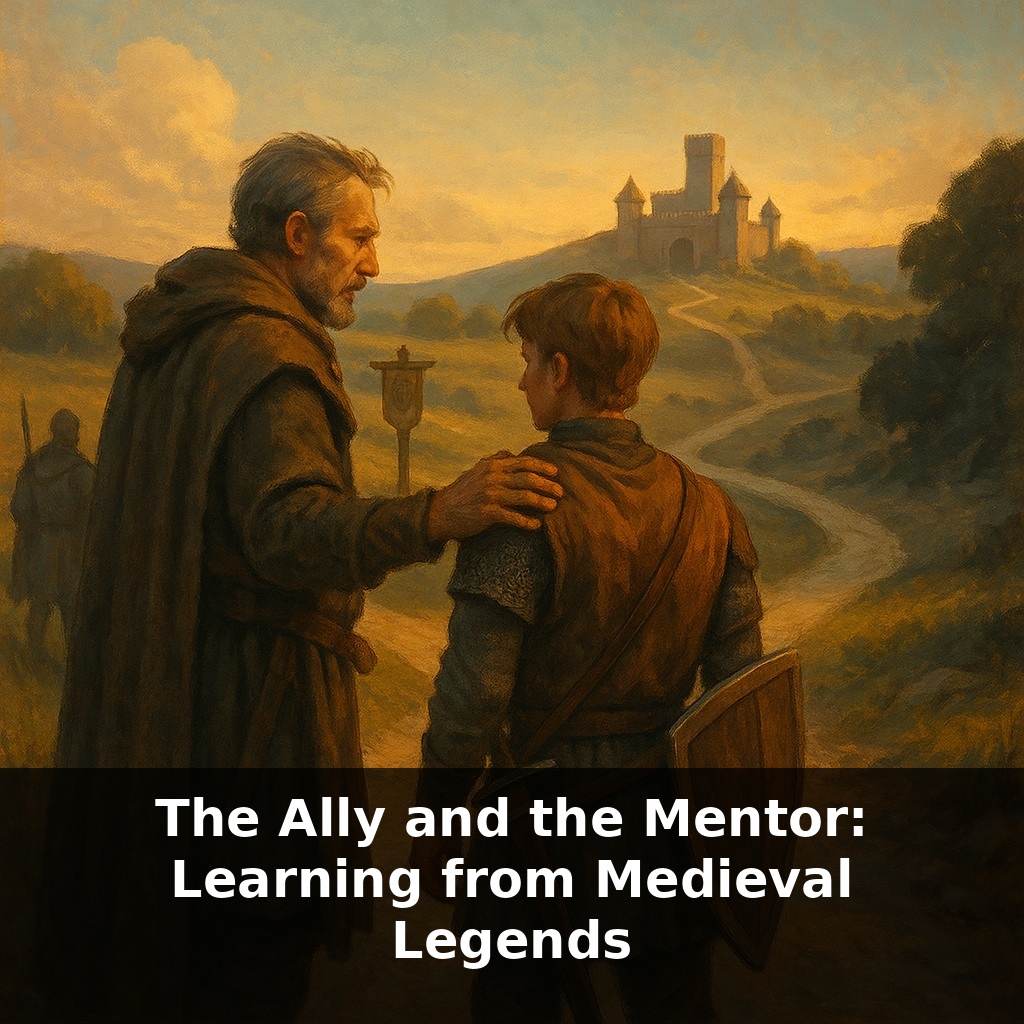
A medieval knight trained longer than many modern doctors—yet the stories rarely show them fighting alone. A young warrior hesitates at a castle gate; an old campaigner at his side, comrades at his back. If legends love heroes, why do they keep surrounding them with guides and allies?
The legends quietly slip in a pattern we often overlook: the most dangerous moments are not the battles, but the crossroads. The knight stands where three roads meet: one path leads to glory, one to ruin, and one straight back to the life he already knows. At those forks, the stories almost always introduce two figures: a voice of experience and a shoulder at his side. Modern research quietly agrees. Career data shows your odds of reaching an ambitious goal jump not simply with talent or grit, but when you deliberately place a mentor and an ally at your own crossroads. Think of a startup founder: one advisor who has already survived three market crashes, and one cofounder whose strengths cover their blind spots. Legends aren’t worshipping hierarchy here; they’re mapping how humans actually grow under pressure.
In medieval tales, the turning point often isn’t the dragon, but the moment before the quest begins: who the knight dares to ask for help, and who dares to stand beside him. The manuscripts hint at a quiet practicality. Geoffroi de Charny spends more ink on how you serve and are served by others than on how you swing a sword. Modern teams aren’t so different. Look at successful product launches or research labs: the pattern repeats. When pressure spikes, outcomes trace back to earlier choices about guidance and support, like architectural blueprints silently determining how a building handles its first real storm.
In the legends, the first real test is rarely glamorous. It’s the moment a young fighter admits, “I don’t know how to do this,” to someone who’s already survived their own disasters. Chroniclers describe older knights not just drilling techniques, but recounting failures—botched negotiations, misread allegiances, lost friends. That storytelling is itself a training ground: the apprentice borrows scars instead of earning every one the hard way.
Modern research backs this pattern in quiet, measurable ways. At Sun Microsystems, the mentored employees who stayed longer weren’t just coddled; they were getting a faster feedback loop. Someone who had already navigated promotions, politics, and plateaus could narrow options from ten possible moves to the two most promising. Over 14 years of guided training, that kind of repeated narrowing compounds into mastery.
Yet in both tales and offices, there’s a second layer: the horizontal bond. Geoffroi de Charny’s emphasis on duties to comrades wasn’t medieval sentimentality; it was systems design. Your peer sees what your mentor can’t: how you freeze in real time, how you talk when you’re tired, where your courage leaks. In Arthurian stories, it’s often the fellow knight—not the king—who calls out reckless pride or quiet despair. Allies aren’t just backup; they’re mirrors that move with you.
The folktale pattern cataloged in ATU 302 goes even deeper: when a nearly universal archetype keeps placing an older guide beside the hero, it suggests something structural about how humans face the unknown. The mentor appears right when the task exceeds inherited scripts—when rote training is no longer enough. In modern terms, that’s the stretch assignment, the new market, the leadership role you secretly fear you can’t fill.
Look at high-performing research teams or elite sports squads and the structure rhymes with those manuscripts: senior figures who translate chaos into choices, and tight-knit peers who keep one another honest under stress. The lone genius narrative is tidy, but the data and the legends both point to a messier truth: whoever deliberately engineers a circle of guidance above and candor beside tends to get further, stay longer, and break fewer things on the way.
In a modern lab, the closest thing to a “quest” might be a risky project no one’s sure will work. Watch who thrives: the postdoc who quietly meets every Friday with a retired PI, then spends late nights debugging experiments with two trusted peers. One offers brutal honesty on the data; the other notices when burnout is creeping in. Their names won’t appear in the same grant headline, but the pattern is there: guidance that compresses decades into weeks, and camaraderie that keeps you from walking away when the work gets weird.
The same structure shows up in open‑source software. A newcomer submits a clumsy pull request. A maintainer leaves detailed, patient comments—pointing to patterns, not just fixes—while another first‑timer pairs with them to implement the changes. Across time zones, strangers form something like a micro‑order: one person holding the long memory of the project, another sharing the frustration and small wins of learning in public.
As work scatters across time zones, guild‑style learning has to be rebuilt on purpose. Digital platforms can flag who’s quietly leveling up others, much like sensors mapping airflow in a smart building, revealing hidden “support beams” in your org. The risk: efficient but isolated freelancers with no one to reality‑check hard choices. The opportunity: cross‑company circles where a designer in Lagos and an engineer in Lisbon trade playbooks in real time.
Your challenge this week: map your current “hall.” For five days, note where you actually learn most: a Slack channel, a group chat, a weekly call, a comment thread. Don’t judge, just track. On day six, choose one person in that space and ask a specific question you’ve been hesitating to voice. On day seven, decide: is this someone you want as a guide, a peer ally, or neither—and what’s the very next small step to deepen the right one of those ties?
The legends hint at a quiet craft: arranging people, not just sharpening swords. Today that might look like curating a “support roster” the way a coach sets a lineup—different roles for different moments. Instead of chasing one perfect guide, you can assemble a small, shifting circle tuned to your next risk, like choosing the right tools for a project, not one tool for life.
Before next week, ask yourself: 1) “If I treated my current challenge like a medieval quest, what exactly is my ‘dragon’ (the real problem), and what concrete ‘artifact’ (skill, resource, or habit) do I need to seek out to face it?” 2) “Looking at my life right now, who is already playing the role of quiet ally (like the loyal companion in the legends), and what is one very specific request for support or feedback I could make to them this week?” 3) “If I had to choose a living mentor in the next 48 hours—someone whose story echoes the wise guides from the episode—who would that be, and what’s one practical step (DM, email, coffee invite, or question in a community space) I can take to initiate that connection?”