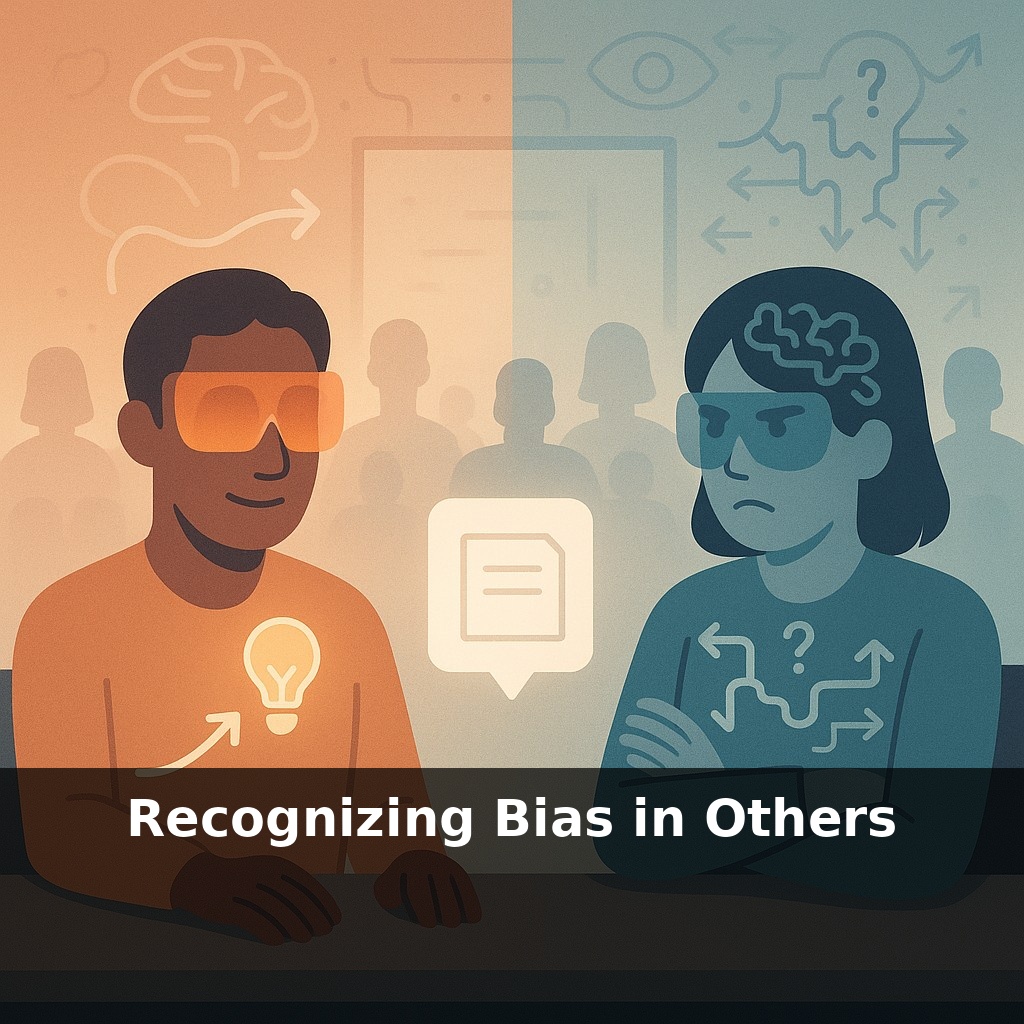
In a crowded meeting, two people hear the same proposal. One is nodding, already convinced. The other has shut down, arms crossed. The facts haven’t changed—only their mental shortcuts have. Here’s the twist: they can’t see those shortcuts. But with practice, you can.
Roughly 70% of more than 4.8 million people who took an implicit bias test show a preference for White faces over Black faces—even when many of them consciously endorse equality. That gap between what people believe about themselves and what their behavior quietly reveals is where this episode lives. We’re focusing on recognizing bias not in theory, but in motion: in the words people choose, the jokes that land flat, the “gut feelings” that steer decisions. Think of a team conversation as a complex painting: most viewers see the main subject, but only a trained eye catches the subtle color shifts that change the whole mood. As you learn to notice those shifts in others—hesitations, repeated narratives, patterns in who gets interrupted—you’re not just getting better at persuasion; you’re gaining a clearer window into how their worldview was built.
You’re not looking for a grand confession of bias; you’re collecting tiny, consistent clues. Listen for how people frame causes and blame: “Those people always…” versus “In this situation, it seems…”. Notice who gets the benefit of the doubt and who has to “prove” themselves. Watch decision patterns: whose ideas get fast-tracked without data, whose are stalled with “we need more proof.” Bias often hides in defaults—who’s called “a natural leader,” whose name is forgotten, whose concerns become “emotional” instead of “strategic.” The goal isn’t to catch villains; it’s to decode invisible rules shaping the room.
Bias in others often shows up in three layers: language, attention, and outcomes. Start with language. Listen for absolutes and shortcuts: “always,” “never,” “everyone knows,” “the kind of person who…”. These aren’t just dramatic flourishes; they’re clues that someone’s brain is compressing complexity into a simple story. When stakes rise—hiring, safety, money—notice whether the language tightens around stereotypes: “We need someone more ‘polished’ for clients,” “This neighborhood is getting sketchy,” “He doesn’t really ‘seem’ executive material.” The surface topic might be skills or risk; underneath, categories and assumptions are doing quiet work.
Next, track attention. Who gets eye contact, follow‑up questions, space to clarify? Who gets cut off, redirected to logistics, or only asked about execution, not vision? Bias can surface when two people make the same point, but only one is treated as insightful. Watch what happens when a junior person shares an idea that’s ignored, then a senior person rephrases it and suddenly it’s “brilliant.” That gap is not just hierarchy; often it reflects whose voice the group unconsciously tags as credible.
Then, look at outcomes over time. One decision can be a fluke; ten decisions form a pattern. Who’s consistently labeled “high potential” versus “a solid worker” despite similar results? Which risks are forgiven as “learning,” and which become permanent marks? If someone’s errors are explained by circumstance (“She had a tough client”), while another’s are tied to character (“He’s careless”), you’re seeing attribution bias in action.
Social dynamics add another layer. Notice laughter at a joke that targets one group, then sudden quiet when a similar joke targets another. Or discomfort when a person from a marginalized group raises a concern that’s heard as “complaining,” while the same concern from a majority‑group member is “important feedback.” People rarely name this as bias; they feel it as “tone,” “fit,” or “being professional.”
Importantly, spotting bias in others isn’t a license to diagnose them; it’s an invitation to get curious. Instead of “You’re biased,” try “What makes this feel riskier than the last three similar decisions we made?” Precise, situational questions pull the conversation back from assumptions to evidence—and often reveal which hidden rules are steering the room.
In practice, this can look surprisingly ordinary. A hiring panel reviews two candidates with similar achievements. One is described as “hungry, willing to take risks,” the other as “a bit aggressive, might rub people the wrong way.” The words differ, but the résumé gaps don’t. Or in a product meeting, a concern raised by a quieter engineer is logged as “edge case, low priority,” then later, when voiced by a senior manager, is reframed as “critical user insight.” No one set out to discount the first voice; the pattern emerges only when you line comments up side by side.
Spotting these micro‑contrasts is less about catching a single slip and more like bird‑watching: you start to notice which “species” of comment appear around certain people, roles, or identities. Over weeks, you see that some are consistently granted nuance and benefit of the doubt, while others are flattened into one‑word labels: “difficult,” “solid,” “emotional,” “rockstar.” That’s your cue that something other than evidence is steering the narrative—and an opening to gently ask for clearer criteria.
As tools evolve, bias‑spotting may shift from private skill to shared infrastructure. NLP systems could flag skewed phrasing in live chats, while VR might let you “walk through” a meeting from another seat at the table, revealing who fades into the background. Like a city installing more streetlights, each layer of visibility changes how people move, what risks they take, and which shortcuts they abandon once they’re no longer hidden.
When you start to notice bias in others, the goal isn’t to “win” debates, but to widen the path for better choices. Treat each odd phrase, uneven reaction, or lopsided result like a trail marker: not proof of bad intent, but a clue about where assumptions might be steering the group—and where a better route could be cleared.
Start with this tiny habit: When you hear someone make a quick judgment about a person or group (for example, “People like that are always late” or “She doesn’t seem like leadership material”), silently whisper to yourself, “What else could be true?” Then, in your head, come up with just one alternative explanation that doesn’t blame the person (like “Maybe her workload is huge” or “Maybe he wasn’t given clear instructions”). If you’re in a conversation and it feels safe, add one gentle question out loud, such as, “Do we know what their situation is?” or “Could there be another reason for that?”