About half the time a hiring manager says “best fit,” they’re really describing their own blind spots. A résumé lands, a voice speaks up in a meeting, a name pops up in promotion talks—and bias quietly tips the scales long before anyone says the word “fair.”
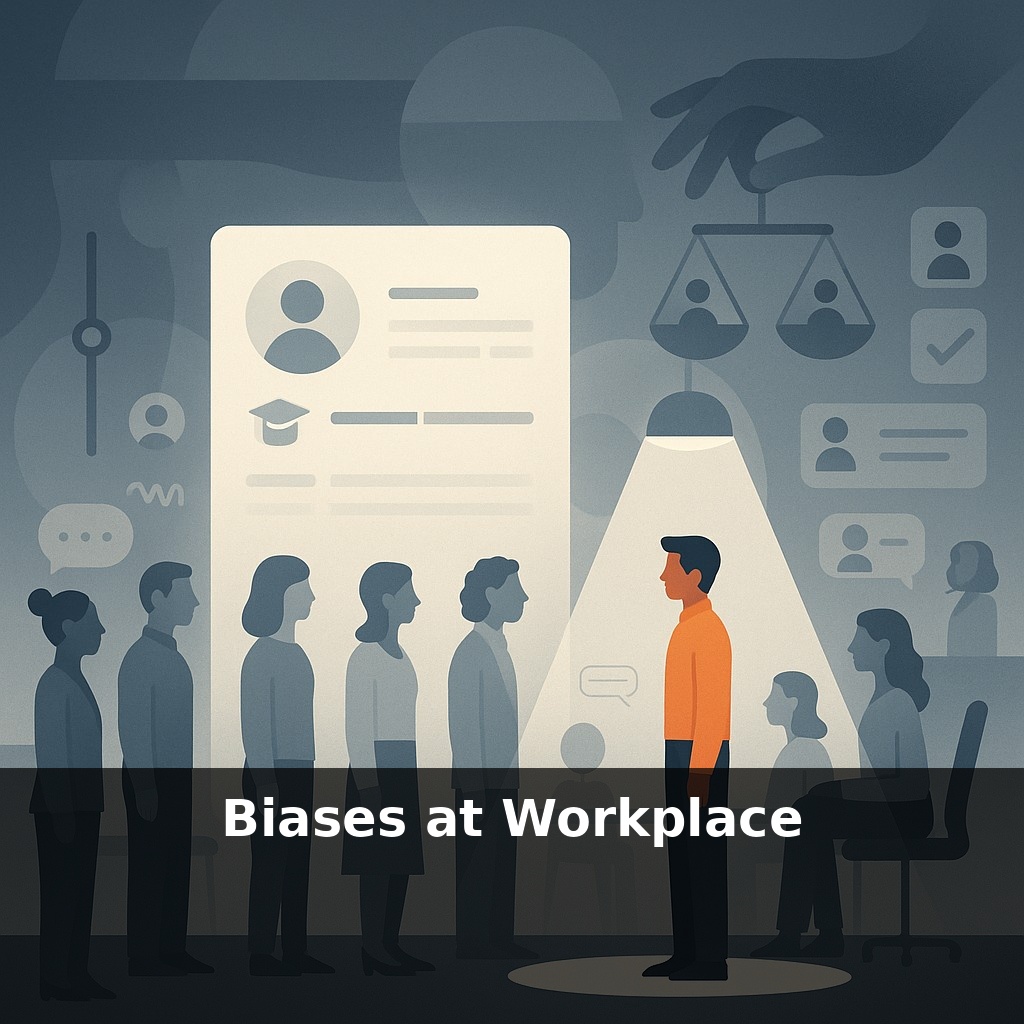
Names, accents, schools, career gaps—tiny details most people scroll past in seconds—quietly steer who gets hired, coached, or fast-tracked. A single résumé gap after caregiving, a non-“top tier” university, or a nonlocal accent in a video interview can change how “potential” is perceived, even when performance is identical. Across a whole organization, those micro-moments stack like layers of sediment, slowly reshaping who ends up in the room where decisions get made. Research now tracks these patterns across the employee life-cycle: who gets stretch assignments, who receives actionable feedback, whose mistakes are framed as “learning opportunities” versus “red flags.” The story isn’t only who gets in the door—it’s how doors keep opening, or quietly closing, at every step of a career.
Zoom out from individual decisions and patterns start to look less like isolated glitches and more like a system with grooves worn into it. Job descriptions quietly discourage some applicants with “rockstar” or “digital native.” Referral programs funnel candidates who look like whoever’s already inside. Performance ratings cluster higher for people who happen to work on visible projects or match a leader’s communication style. Over time, these grooves harden into policies, norms, and “how we do things here,” making it hard to tell where personal judgment ends and structure begins.
Start with the numbers, and a pattern appears: identical résumés get treated differently depending on the name at the top; executive teams with more women don’t just “look” fairer, they outperform their peers; teams that mix backgrounds and perspectives generate more revenue from new ideas. These aren’t soft culture wins—they show up in profit-and-loss statements.
What’s going on isn’t just a few people making unfair calls. Cognitive shortcuts are getting amplified by structural choices. A hiring manager feels a “gut sense” of who seems promising; an algorithm trained on past hires quietly learns to copy yesterday’s preferences; a promotion committee leans on who “seems ready.” Each decision feels defensible in the moment. In aggregate, the pattern is unmistakable: some groups keep getting nudged forward, others keep getting stalled.
This is where “meritocracy” often becomes a story we tell ourselves. Criteria like “executive presence,” “culture fit,” or “high potential” sound objective, but underneath, they’re often proxies for familiarity—communication styles, hobbies, schools, networks that feel known and therefore “safe.” Without realizing it, leaders can end up rewarding comfort over contribution.
Meanwhile, people on the receiving end of these patterns adjust their behavior. Talented employees who sense they’re being evaluated more harshly may stop volunteering ideas, decline visible projects, or quietly look elsewhere. The cost isn’t only moral; it’s deeply practical: less innovation, slower problem-solving, and a steady drain of people who could have led the next big initiative.
The encouraging part: when organizations deliberately change the “defaults,” outcomes shift. Structuring interviews so every candidate gets comparable questions and rubrics makes it harder for first impressions to dominate. Rotating who sits on promotion panels broadens what “leadership” looks like. Using data to regularly review who’s being hired, rated highly, or leaving—and then acting on the gaps—turns vague concerns into concrete, fixable problems.
Bias in the workplace is like walking a familiar forest trail that slowly deepens with each step; without noticing, you end up in the same clearing every time. New routes only appear when you’re willing to leave the groove, mark the terrain, and cut a different path on purpose.
A tech firm mapped who got staffed on high-visibility projects over two years. On paper, roles were “open to all.” In practice, 80 % of prime assignments flowed to people who’d worked with the same two senior leaders before. No one set out to exclude; the path of least resistance kept being reused. After the data review, they piloted a simple rotation: once a quarter, each director had to nominate one person they’d never led before for a visible project. Within a year, more junior women and people from satellite offices started showing up as project leads—and patent filings rose.
Elsewhere, a regional bank color-coded its promotion pipeline by team and location. One branch glowed green at entry level but faded to gray higher up. Digging in, they found its managers relied heavily on informal “tap on the shoulder” opportunities. They didn’t ban those taps; they paired them with a quarterly “open slate” process where anyone could raise their hand for upcoming roles. Turnover among mid-career staff dropped sharply once paths upward were easier to see.
Regulation will likely move from asking “Do you have a policy?” to “Can you prove your process is fair over time?” Leaders may need dashboards that show patterns as clearly as a weather map: who gets key projects, who advances, who stalls. As virtual offices and avatars spread, signals like voice, timezone, and even background noise may become new fault lines. The edge will belong to teams that treat fairness like cybersecurity—continuously monitored, tested, and stress‑checked, not “set and forget.”
Treat each hiring choice, project invite, and promotion discussion as a prototype, not a verdict. Ask, “If we had to defend this call with data, could we?” Over time, those questions work like steady rain on packed earth, softening old ruts so new paths can form—paths where opportunity follows contribution, not comfort or convenience.
Here’s your challenge this week: In your next three meetings, deliberately give the floor first to someone who usually gets talked over or stays quiet, and then back them up if they’re interrupted by saying, “I’d like to hear them finish their thought.” Before Friday, run one concrete decision (like assigning a project or choosing a presenter) through a quick bias check: ask yourself out loud, “If this person had a different gender, race, or accent, would I still make the same choice?” Finally, ask two colleagues from different backgrounds than you, “Is there a way bias shows up here that I might be missing?” and listen without defending or explaining—just thank them and write down one behavior you’ll change next week.