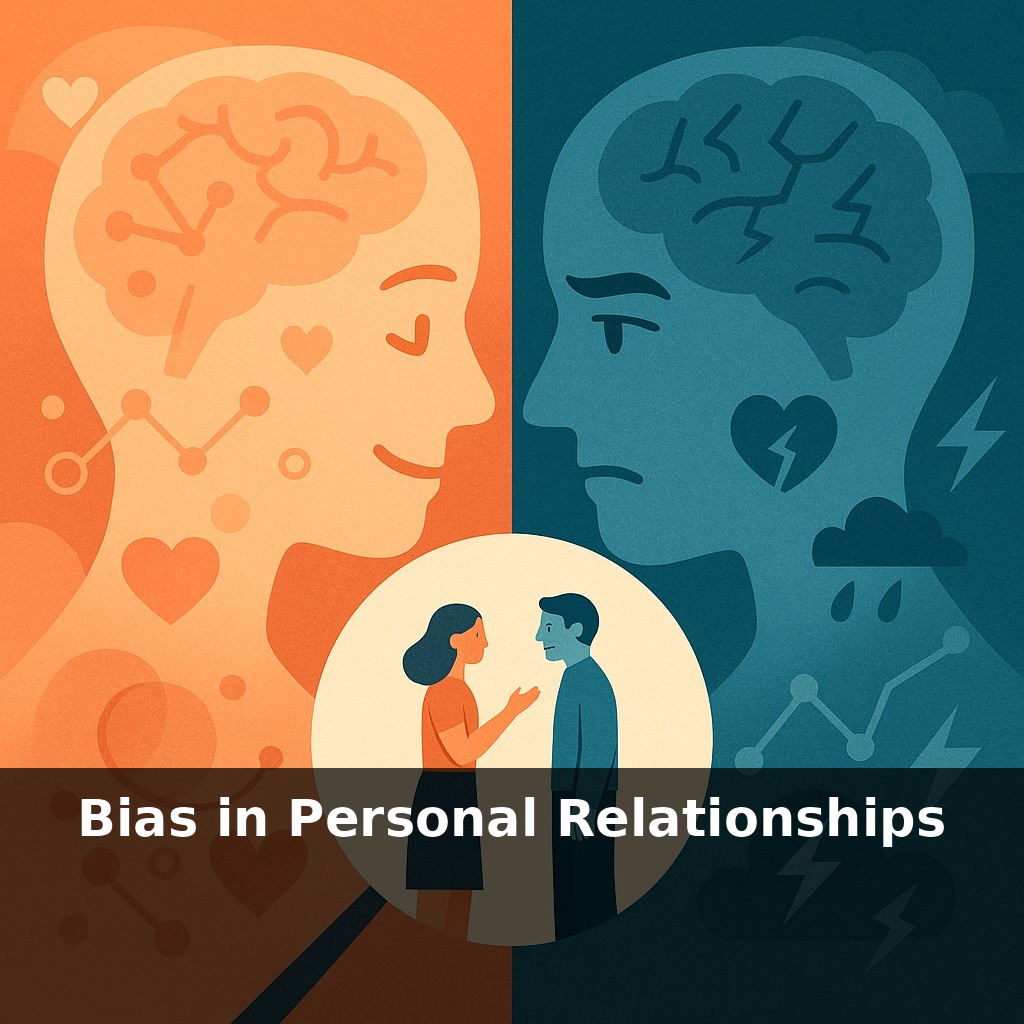
Two people can watch the same tiny argument and predict opposite futures: one sees “they’re solid,” the other sees “they’re doomed.” Today, we’re stepping into that split-screen moment and asking: what hidden mental shortcuts are rewriting your partner’s story in your head?
Your brain is running a silent commentary on your partner all day long. “She’s late again—she doesn’t respect my time.” “He’s quiet tonight—he must be annoyed.” Most of these conclusions feel like simple observations, but they’re really quick edits your mind makes before you’re even aware of them. Over time, those edits can turn a small misunderstanding into a running story: one where you’re the underappreciated one, or the one always walking on eggshells.
Now add stress, money worries, kids, or disapproving family into the mix, and those quick edits get even more dramatic. Under pressure, your brain is more likely to assume criticism, rejection, or danger, even in neutral moments. This is where emotional intelligence becomes more than a buzzword: it’s the skill that lets you pause the automatic storyline, re-read the scene, and sometimes choose a completely different ending.
Research backs up how high the stakes really are. John Gottman’s lab work showed that it’s not grand gestures but the tiny, everyday exchanges that predict divorce with eerie accuracy: too many small jabs, eye-rolls, or cold silences, and the relationship’s foundation starts to crack. Layer on negativity bias—your brain’s tendency to cling to the one sharp comment and gloss over five kind ones—and those cracks widen fast. Add in family disapproval or cultural tension, and biases don’t just live in your head; they’re reinforced at every holiday, group chat, and dinner table.
“Couples don’t break up because of conflict,” Gottman likes to point out. “They break up because of the way they fight.” Bias is a big part of that “way.” It doesn’t just color big blow-ups; it quietly shapes how you read everyday moments: a text with no emoji, a sigh after work, who reached for whose hand first.
Several classic biases show up here:
Confirmation bias whispers, “See? This always happens.” Once you’ve decided “she’s selfish” or “he doesn’t care,” your mind starts collecting evidence for the story and discarding what doesn’t fit. A warm gesture becomes a fluke; a neutral one feels cold.
The fundamental attribution error pushes you to explain your own bad days with context (“I barely slept”) but your partner’s with character (“he’s lazy,” “she’s dramatic”). Same behavior, different verdicts. Over time, this turns misunderstandings into moral judgments.
The halo effect does the opposite of nitpicking: in the early stages of love, one glowing trait (“she’s so kind”) spills over onto everything else (“so she must also be right about this”). Later, it can flip into a “horn effect,” where one painful trait eclipses everything good.
And then there’s in-group/out-group bias. If your partner is from a different culture, race, or family background, tiny differences in manners or conflict style can get overinterpreted. Research on interracial couples and family disapproval shows how outside voices can amplify this: your brain hears a biased comment at dinner, then starts scanning your partner for “evidence” it’s true.
Here’s where emotional awareness changes the game. Instead of trying to “delete” bias (you can’t), you learn to catch the moment it starts steering the wheel. Noticing “I’m already making this about his character” gives you a narrow window to ask a different question: “What else could this mean?” It’s less about forcing yourself to be “fair” and more about gently widening the frame, the way stepping back from a painting lets you see the whole scene instead of one dark brushstroke.
Leah texts, “Can we talk later?” and puts her phone away during a meeting. By the time she gets home, her brain has already filled in the missing scenes: “He’s upset… I must have done something… this is going to be a fight.” When Mark finally says, “I’m just exhausted from work,” she hears it as withdrawal, not information, and answers the story in her head instead of the words in front of her. Bias often hides in that gap between what was said and what we assume it meant.
Think of three tiny moments: a delayed reply, a forgotten chore, a shorter hug than usual. In one version of the day, they’re “proof” of distance; in another, they’re background noise in a stressful week. Same events, different storyline. The shift isn’t pretending everything is fine; it’s noticing how fast your mind labels the scene—and experimenting with pausing before you accept the first title it offers.
A single heated exchange can steer a couple’s future more than a dozen pleasant evenings. As tools like AI matchmakers and AR calls spread, that imbalance could grow: apps might quietly prioritize partners who mirror your views, while digital filters smooth over micro‑signals you’d normally use to repair tension. The risk isn’t just breakups—it’s brittle, homogenous bonds. But the same tech could prompt early “course corrections,” like a hiking trail marker nudging you away from a cliff.
So the real experiment isn’t “can we avoid bias?” but “can we notice its fingerprints quickly enough to choose a different move?” Like adjusting your route mid‑walk when you spot storm clouds, you can revise the story mid‑conversation. Over time, those small rewrites stack, turning repeated skirmishes into chances to learn each other more precisely.
Here’s your challenge this week: Choose one close relationship where you suspect you might have a “confirmation bias” (seeing only what fits your existing story about them) and, for the next 3 conversations, deliberately look for and verbalize at least one way they *don’t* fit your usual narrative (e.g., “I always think you’re late, but you’ve actually been on time all week”). During one of those conversations, practice “perspective checking” by asking them directly, “How did you see that situation?” and repeat back their view before sharing your own. Finally, notice any snap judgments you make about their intentions (e.g., “they’re ignoring me on purpose”) and, at least once a day, state out loud one alternative explanation that could also be true.