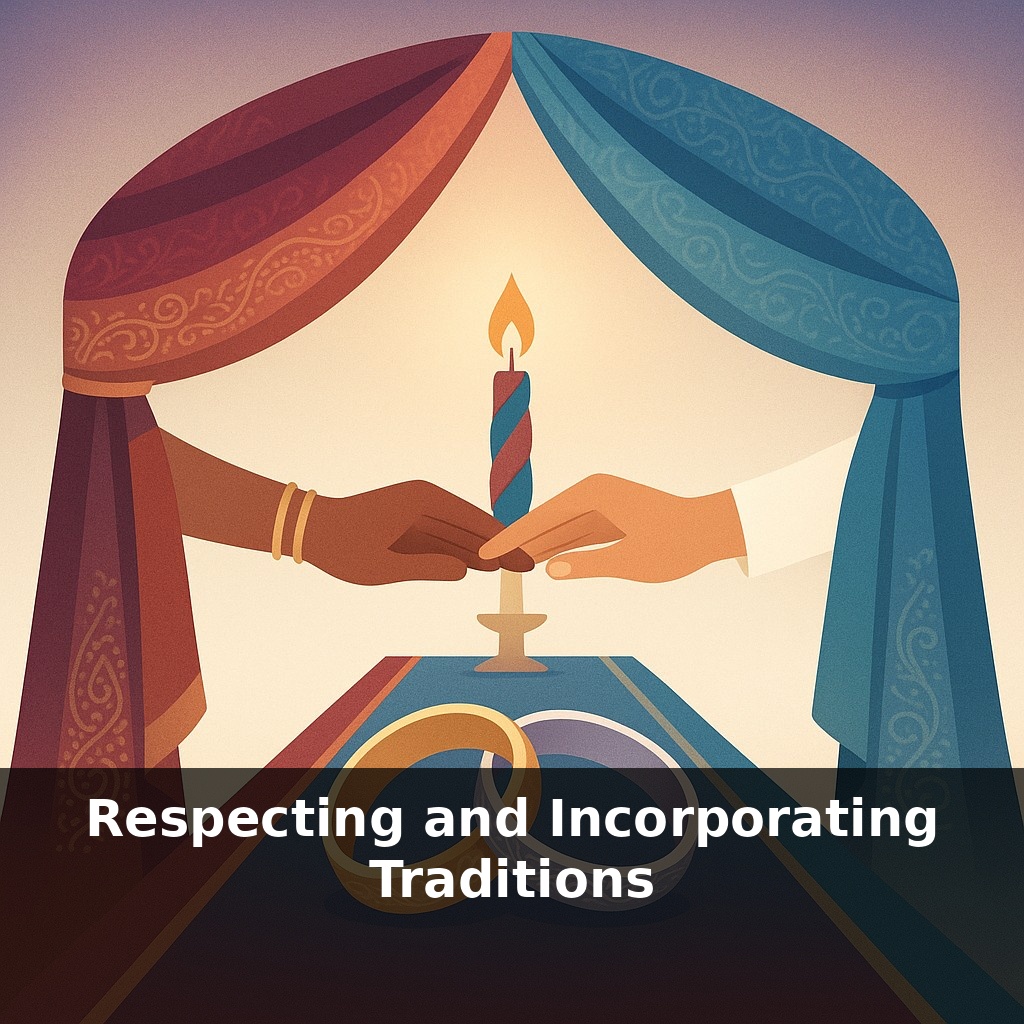
Right now, about half of new marriages in the U.S. cross religious or cultural lines—yet many wedding scripts still assume one single tradition. You’re standing at the altar, two families, two histories, one ceremony. Whose rituals survive, whose bend, and who gets to decide?
Traditions aren’t just “nice touches” on a ceremony; they’re compressed stories about power, gender, duty, and belonging. Light a specific candle, walk in a certain order, cover or uncover your hair—each small act quietly answers big questions: Who leads? Who follows? Who is “in” the family, and who stays at the edge? In modern matchmaking and events, this is where friction starts. Apps and planners promise personalization, but elders often expect continuity. One side sends Pinterest boards, the other sends a list of non‑negotiables. Between them sits a planner or matchmaker translating not just languages, but worldviews. The real work isn’t picking rituals from a menu; it’s decoding what they *mean* to each person, then rebuilding a shared script that feels honest, not hollow.
A planner in Mumbai once described her workday as “moving between centuries every 15 minutes.” A morning call with grandparents insisting on auspicious dates from the lunar calendar; an afternoon Zoom with a couple optimizing for visa timelines and budget. Scale that up, and you see a global industry built on this tension: India’s US$56‑billion matrimonial market, 630‑plus UNESCO‑recognized living practices, and a fast‑growing web of interfaith centers quietly prototyping hybrid ceremonies. The question is shifting from “Which tradition is right?” to “How do we host multiple timezones of meaning in one event?”
Sociologists talk about three layers of tradition that show up in matchmaking and events: the visible, the negotiated, and the invisible.
The visible layer is what everyone argues about first: clothes, music, seating charts, ceremony order. It looks superficial, but it’s the safest battlefield. Couples fight over colors because it’s easier than saying, “I’m scared my grandparents won’t recognize this as a ‘real’ wedding.” Planners who treat visible elements as mere aesthetics miss the emotional load they’re carrying.
The negotiated layer sits underneath: roles, obligations, whose side “gives” and whose side “receives.” This is where questions of gender, class, caste, migration, and family hierarchy quietly shape decisions. Who walks in first? Who pays for what? Who speaks, and in what language? In many interfaith or intercultural pairings, these negotiations expose asymmetries—one family may have a fully codified ritual playbook, the other a looser set of customs that are easier to sideline. Without care, “compromise” becomes “default to the more rigid side.”
The invisible layer is the hardest: fears, hopes, and unspoken conditions of belonging. For some elders, a specific blessing isn’t about religion; it’s about proof that their lineage continues. For some couples, excluding a ritual isn’t defiance; it’s self‑protection from past harm. When this layer isn’t surfaced, people weaponize the others: “If you loved us, you’d wear this,” “If you respected us, you’d agree to that priest.”
Culturally‑responsive design in this space starts with mapping all three layers for each stakeholder, not just the couple. Matchmakers and planners who excel tend to do three things consistently:
They ask “meaning questions” instead of preference questions (“What would it *feel like* to not have this ritual?”).
They prototype sequences instead of locking in scripts—testing orders of events, blends of languages, or parallel rituals to see where tension rises or falls.
They formalize consent. Rather than vague nods, they establish clear “opt‑in” and “opt‑out” zones: moments where full participation is expected, and moments where silent presence or alternative actions are explicitly allowed.
This is where tradition stops being a checklist and becomes a design material: structured, constrained, but pliable enough to be re‑shaped without snapping.
A Sikh–Jewish couple in Toronto started by mapping those three layers on a whiteboard with their planner. At the visible level, they listed artifacts they each cared about; at the negotiated level, they flagged moments where one family expected to “host” and the other to “arrive”; at the invisible level, they wrote fears on sticky notes, anonymously, then traded boards. Only then did they design two entry sequences: one where both families processed together, and another where each side entered with its own music but met in the middle. They literally rehearsed both with parents on Zoom, watching for micro‑tensions—who fell silent, who lit up, who asked logistical questions to hide discomfort. It turned out the grandparents’ real non‑negotiable wasn’t the order at all, but hearing a single line of blessing in their first language. From there, remixing choreography became easier; the core “function” was now explicit, so everything around it could be re‑wired without panic.
Ritual “modules” will likely become as editable as playlists: couples, HR teams, even product designers dragging elements into timelines, previewing emotional impact before anything is public. AI could flag when a sequence quietly sidelines one side’s practices, or suggest gentler transitions—like a lighting change before a major vow—to help elders and newcomers stay with the moment. The frontier skill won’t be knowing every custom, but knowing how to ask, test, and revise in real time.
Your challenge this week: observe one real gathering—wedding, festival, even a team offsite—as if you’re an anthropologist. Note who initiates each key moment, who follows, and where tension or ease appears. Then sketch an “alternate cut” of the same event, keeping the emotional peaks but rearranging who leads them.