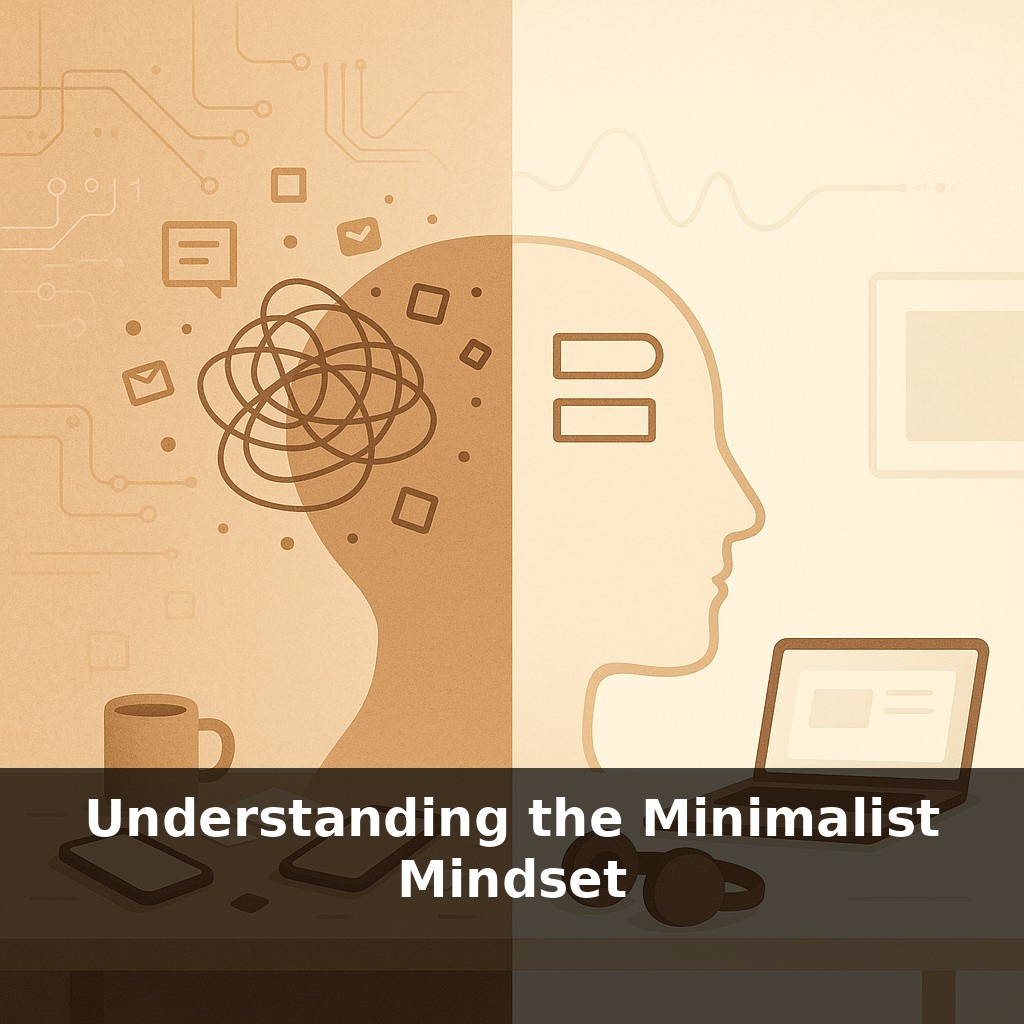
Understanding the Minimalist Mindset
📝 Transcript
A UCLA study found that cluttered homes can spike stress hormones dramatically—yet many of those homes belong to people who don’t think they own “that much.” You walk room to room, not drowning in stuff, but feeling oddly restless. Why does “enough” still feel like too much?
Minimalism often gets mistaken for a counting game—33 items in a closet, 100 things in a house, a perfect white desk—and then judged as unrealistic or joyless. But the real shift happens long before anything leaves your shelves: it starts with how you decide what deserves space in your life at all. Think of the moments when you hesitate over a purchase or scroll past another “must‑have” gadget; those tiny pauses are where a minimalist mindset can quietly rewrite your default settings. Instead of asking, “Can I afford this?” or “Do I have room for it?” the question becomes, “What is this crowding out?” Time, attention, savings, sleep, creative energy—something always trades places. Minimalism isn’t about living with less for its own sake; it’s about clearing enough room that your real priorities can finally step into the spotlight.
Think of the mental habits behind what you keep, not just the objects themselves. Every time you add something—another streaming service, a “productivity” app, a hobby you’re only half‑interested in—you quietly sign up for future decisions, maintenance, and background worry. That’s the real weight. Research on decision fatigue shows that the more micro‑choices you juggle, the more your brain defaults to autopilot and impulse. A minimalist mindset treats your attention like a scarce budget: not “How do I fit more in?” but “What earns the right to stay, and what no longer deserves a line in my life’s ledger?”
If you strip away trends and aesthetics, what’s left is a simple question: “What am I *actually* optimizing my life for?” More comfort? Status? Security? Freedom? Once you answer that honestly, the minimalist mindset becomes a filter rather than a rulebook. You stop asking, “Is this bad?” and start asking, “Is this aligned?”
That filter works across three layers: objects, obligations, and inputs.
At the object level, the point isn’t to slash randomly; it’s to notice when ownership turns into low‑grade background management. The guitar you play weekly probably “earns rent.” The third backup charger you keep “just in case” mostly earns dust. Minimalist thinkers often run small experiments: boxing items for 30 days to see what gets missed, or enforcing a “one in, one out” rule for specific categories like jackets or mugs. The goal is to surface reality, not to meet an abstract number.
Obligations are trickier because they come wrapped in identity: the committee you joined because “someone had to,” the group chat you mute but never leave, the side project that stopped being fun months ago. A minimalist approach treats each commitment like a subscription with a renewal date. Instead of assuming everything continues by default, you assume everything expires unless it still serves who you’re becoming.
Then there’s input: information, notifications, advice, opinions. These rarely feel heavy in isolation, but together they tilt your inner compass. You can’t explore your own values if your attention is constantly rented out to other people’s priorities. Many people find that reducing inputs (fewer apps, fewer feeds, fewer “urgent” channels) doesn’t create a vacuum; it creates a signal. What you’re genuinely curious about starts to surface when you’re not constantly being told what to care about.
Here’s where the mindset quietly shifts your sense of “cost.” The price of keeping something isn’t just money or storage; it’s also the opportunities you don’t notice because your view is crowded. That hobby you “don’t have time for” may be competing with three shows you don’t even like that much. The calm you wish you had may be hiding under the dozen tiny frictions you’ve normalized.
Minimalism, at this level, is less about sacrifice and more about trade‑offs you’re finally awake enough to make on purpose.
A designer in Amsterdam keeps one clean shelf in her studio as “prime real estate.” Only current, live projects are allowed there; everything else goes in flat files or gets archived digitally. When the shelf starts to crowd, she doesn’t ask, “What can I cram in?” but, “What no longer deserves front‑row status?” That same logic scales to your calendar and your phone.
Try this with your week: highlight only the few activities that directly move a goal, deepen a relationship, or restore you. Those are your “prime shelf” items. Everything else is either support or clutter.
You can see it in tech companies that deliberately ship *fewer* features. Basecamp, for instance, cuts options that add complexity without adding clarity, even when users request them. The bet: a calmer product creates With that foundation, let's consider specific actions you can take to embrace mWith that foundation, let's consider how to apply minimalism in your daily life. In your own life, that might look like three messaging channels instead of nine, or one “home base” app where your most important tasks live—so your attention always knows where to land first.
40% of food in the U.S. is never eaten. That’s not just waste in landfills; it’s wasted money, energy, and attention upstream—menus, shopping, storage, guilt. As more people apply the same “keep what’s used and valued” lens to schedules and screens, small private choices start to reshape public systems. Think fewer default notifications, smaller homes that are easier to heat, even cities designed around access, not accumulation—more libraries and tool‑shares than storage units.
When you start editing what gets your energy, life becomes less like juggling and more like playing a focused game: fewer balls, clearer moves. You might notice conversations deepen, projects actually finish, and free evenings feel earned, not empty. The experiment never really ends; you just keep tuning what stays “on the field” as who you are keeps changing.
Start with this tiny habit: When you put your phone down at night, tap and hold on just ONE app you didn’t use today and move it to a folder called “Maybe Later.” Don’t delete it yet, just park it there. Do this once a day for a week and notice which apps never make it back out of that folder. This way you’re gently decluttering your digital space in line with a minimalist mindset, without anything feeling drastic or scary.
From this course
Minimalism: Own Less, Live More
8 episodesUnlock all episodes
Full access to 8 episodes and everything on OwlUp.
Subscribe — $1.99/monthLess than a coffee ☕ · Cancel anytime

