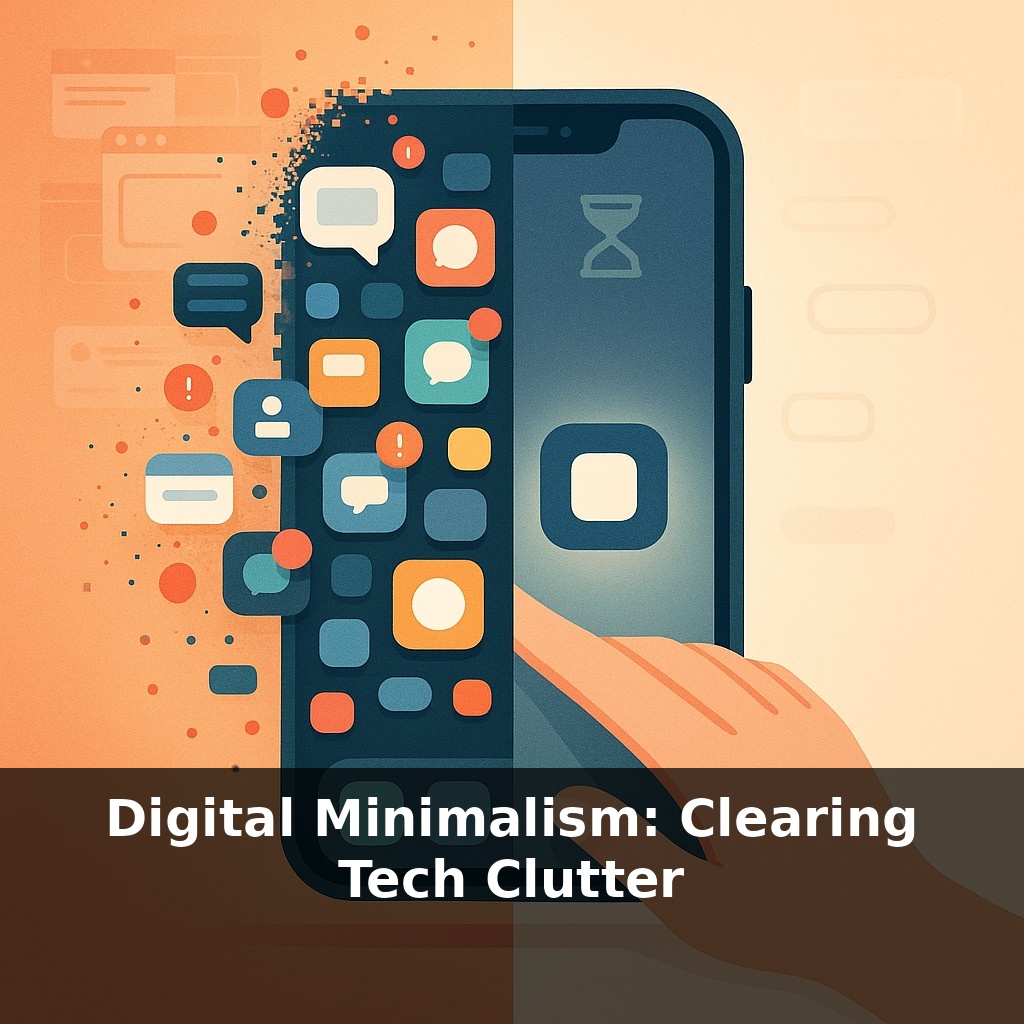
The average office worker checks email about 70 times a day—yet most can’t remember a single message that truly mattered. You’re walking to lunch, standing in line, brushing your teeth… and your phone wins every stare. If your tech feels endless, this episode is your reset button.
Your devices probably aren’t “too much” because of one big problem, but because of a thousand tiny ones: half-finished folders, mystery screenshots, apps you don’t remember installing, tabs breeding like fruit flies. None of these feel serious in isolation, yet together they create a constant low-grade mental buzz. Research on digital hoarding shows that simply *having* piles of unused files can raise stress, even when you’re not actively looking at them. The brain reads all that clutter as postponed decisions: keep or delete, reply or ignore, read or save for later. Today’s focus is reclaiming that decision space. Instead of trying to “use your phone less” in some vague way, you’ll design a lighter, more intentional digital environment—one where the tools you keep actually earn their place and everything else quietly disappears.
You don’t need a personality makeover to change how tech feels—you need better defaults. Right now, many devices arrive tuned for maximum interruption: every app assumes it deserves a banner, a ping, a red badge. That’s not a character flaw; it’s a design choice you’re allowed to renegotiate. Studies on “digital diets” show that even short, structured breaks from feeds and alerts can shrink stress and restore focus surprisingly fast. Think of today’s session as re‑writing your operating manual: we’ll quietly downgrade what drains you and upgrade what supports you, so your screen time starts to match the life you actually want.
Digital minimalism starts with one blunt question: *What is this helping me do that I actually care about?* Not “could it be useful someday?” but “does it regularly move the needle on work, relationships, health, or genuine rest?” That’s your new filter for everything with a screen.
Researchers who study attention talk about “cognitive load”: every extra stream of information—even if you’re ignoring it—claims a slice of your mental bandwidth. A dock full of apps, a desktop full of icons, thirty tiny badges on your home screen: each is a soft tug on your working memory. You don’t experience it as a scream, more like a room where everyone is whispering your name at once.
Instead of trying to wrestle with willpower (“I should check my phone less”), digital minimalism changes the environment so the path of least resistance is also the one you want. That might mean:
- **Tool consolidation.** One notes app you truly trust instead of five you half‑use. One primary messaging channel with clear expectations, instead of being reachable everywhere, all the time. - **Streamlining inputs.** You probably don’t need breaking news from twelve outlets or newsletters from every conference you ever registered for. Curate a tiny set of high‑signal sources and let the rest go. - **Time‑bounded usage.** Research on “attention residue” shows that when you glance at a different task—like a social feed—part of your mind stays stuck there. Setting specific windows for email, messaging, or scrolling protects long, uninterrupted stretches for deep work or real rest.
A single notification rule change can cascade: if email only refreshes when you open it, you stop living in reactive mode. If only humans (not algorithms) are allowed to interrupt you—calls, calendar alerts, chosen chats—you suddenly experience pockets of quiet that used to be carved up into 30‑second slices.
Think of an elite runner editing their training plan: they don’t add random workouts just because they’re available. They strip away anything that doesn’t support speed, recovery, or durability. Your digital life works the same way. When every app, feed, and file has to justify its place, what remains is lighter, faster, and strangely calming.
You can treat this like editing a playlist instead of your entire life. Start by choosing *one* arena where friction shows up daily: maybe your photo gallery, your notes, or your browser. If photos feel overwhelming, for example, your “minimalist rule” might be: keep only shots you’d be happy to see in a small printed album. That gives you a clear yes/no filter as you swipe, instead of agonizing over every blurry sunset.
Or try it with tabs: declare a three‑tab maximum for one week. When you open a new one, something else has to close. You’ll notice quickly which sites actually deserve a permanent place and which were just reflex clicks.
Many people find that once a single area feels cleaner, their standards quietly rise elsewhere. A tidy notes app makes a chaotic desktop less tolerable; a calm home screen makes noisy group chats easier to mute. You’re not chasing perfection—you’re testing how little you need before things start working *better* than before.
A future shaped by digital minimalism may feel less like a constant broadcast and more like a studio you walk into on purpose. Interfaces could dim when your stress markers spike, feeds might pause instead of autoplaying, and work tools may surface only what’s needed for the current task—like a stagehand passing a single prop to an actor. The open question: will we demand these calmer defaults, or will they stay “pro” options for a small group who opts out early?
Digital minimalism isn’t about becoming a monk with Wi‑Fi; it’s about making space for things you didn’t realize were crowded out—slow walks, deeper projects, unhurried conversations. As you strip away excess pings and pixels, notice what grows in the gaps. The experiment isn’t “can I use less tech?” but “what returns when my screen stops shouting?”
Before next week, ask yourself: Which 3 apps or sites on my phone drain my energy the most, and what would happen this week if I deleted them or moved them off my home screen for just seven days? If I limited my “online time” to two intentional blocks per day (for example, 30 minutes at lunch and 30 minutes at night), what would I choose to do during those windows—and what would I finally have time for in the spaces I free up? Tonight, when I plug in my devices, where could I physically put my phone (a drawer, another room, a bag) so it’s out of reach, and what’s one offline activity I’ll do instead during that time?