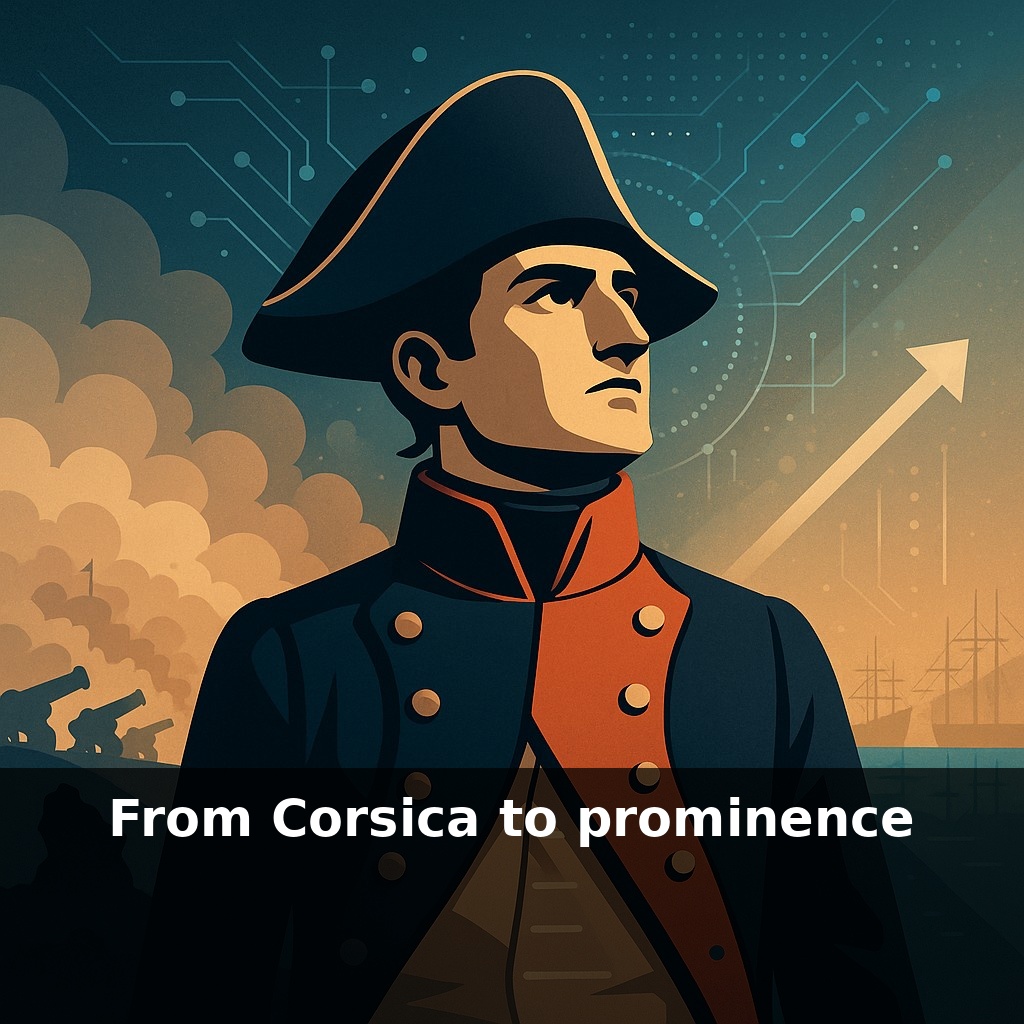
Cannons thunder over a harbor. Smoke, chaos—and a young, little-known artillery officer calmly repositions a few guns. By nightfall, he’s the name on everyone’s lips in Paris. How does someone from a poor, rocky island turn one lucky break into a path to ruling France?
Napoleon didn’t start life looking like a future mastermind. As a teenager in France, he was the awkward outsider: Corsican accent mocked, clothes unfashionable, family nearly broke. Yet inside that uncomfortable student was a ruthless calculator of advantage. While others chased status, he chased competence—especially in math, strategy, and how institutions really worked. At the École Militaire, he finished years of study in barely more than a single school term, not because anyone favored him, but because financial pressure forced the system to move faster, and he adapted instead of breaking. Think of a musician who learns to play on a battered secondhand instrument; the constraints sharpen attention. For Napoleon, that meant long nights with geometry, gunnery tables, and history books—quiet preparation for noisy future opportunities.
When the Revolution erupted, that quiet grind met a world suddenly stripped of fixed ladders. Old nobles vanished from the officer lists; new committees in Paris demanded results, not pedigrees. For someone with technical skill and a stomach for risk, this wasn’t chaos—it was a vacancy sign. Napoleon started writing sharp political pamphlets, arguing fiercely for causes that made him useful to powerful patrons. Think of a commuter who knows every side street when traffic lights fail; while others sit honking in confusion, he’s already three turns ahead, threading routes that didn’t exist on yesterday’s map.
Promotion didn’t fall into Napoleon’s lap; he went out and manufactured moments where his specific strengths became impossible to ignore. The first big test came at Toulon in 1793, when Royalists and British forces held a crucial Mediterranean port. France had generals, but what it really needed was someone who could turn a maze of hills and batteries into a solvable equation. Napoleon walked the terrain, sketched positions, and proposed a plan that treated the harbor like a geometry problem: seize a few key heights, place guns precisely, and the enemy fleet would be forced to leave.
Plenty of officers had courage; what set him apart was the way he fused calculation with nerve. He personally supervised gun placements under fire, adjusted ranges, and shifted resources quickly when conditions changed. The result was decisive: Toulon fell, and Paris noticed the young man who had turned a politically embarrassing siege into a textbook victory. Within months, he jumped from relative obscurity into the rank of brigadier general—an ascent that, in peacetime, might have taken decades or never happened at all.
But battlefield success alone doesn’t explain his trajectory. Napoleon was equally aggressive with information. He wrote detailed battle reports that highlighted results in numbers—enemy guns captured, prisoners taken, speed of operations. In a government terrified of failure, those figures functioned like hard performance metrics. He also cultivated allies who could read these reports aloud in the right rooms in Paris, translating his field improvisations into political capital.
The Italian Campaign of 1796–97 amplified this pattern. Given a half-starved army and a secondary theater, he moved with startling speed, punching through Austrian forces, cutting supply lines, and forcing repeated surrenders. The staggering quantity of captured men and cannon wasn’t only a military windfall; it patched France’s finances and fed hungry newspapers with tales of a general who seemed to conjure victories from thin air. In a Europe still used to slow, formal wars, his rapid marches and concentrated blows felt like a new operating system: lean, opportunistic, and relentlessly focused on leverage.
Napoleon’s rise wasn’t just about knowing math or moving troops; it was about sensing when the “rules of the game” had silently changed and acting before others noticed. During the Revolution, officers around him kept waiting for clear orders, afraid of missteps in a paranoid climate. He did the opposite: he proposed concrete plans with timelines and clear payoffs, then moved first, forcing hesitant superiors to catch up or be left behind.
Think of a touring musician who arrives in an unfamiliar city and finds the main venue double‑booked. Most bands grumble and stall. The sharp one immediately hunts down a smaller club, negotiates a late‑night set, and gets posters up before anyone else reacts. It’s not that their guitar skills are better that night; it’s that they turn disruption into a vacuum they can fill. Napoleon treated political crises and underfunded armies that way—as unexpected stages where initiative itself was the scarce resource. His real edge was noticing those empty stages faster than rivals and stepping onto them before anyone quite realized there was a show to be played.
Napoleon’s surge from Corsica hints at a broader pattern: systems in flux often over‑reward those who can turn volatility into focus. For modern states or startups, that suggests designing “productive chaos” on purpose—short windows where hierarchy loosens and sharp execution can rewrite the org chart. It’s risky: the same opening that surfaces hidden talent can also elevate reckless opportunists, like a storm that lifts both sturdy ships and barely‑seaworthy rafts.
Napoleon’s leap from island obscurity also warns how fast momentum can narrow your vision. Each win made risk feel normal, like a climber stepping onto thinner ledges for a better view. In your own projects, notice when success starts to mute dissent. Genius often peaks right where feedback grows quiet—and that’s where missteps turn into cliffs.
Start with this tiny habit: When you hear or read Napoleon’s name during your day, pause and whisper one specific decision he made in Corsica (like “he chose France over Corsica”) and ask yourself, “What’s my version of that hard choice?” Then, before you move on, nudge one concrete thing in your life 1% toward your “France” — for example, send a single email, message, or text that aligns you more with the path you actually want.