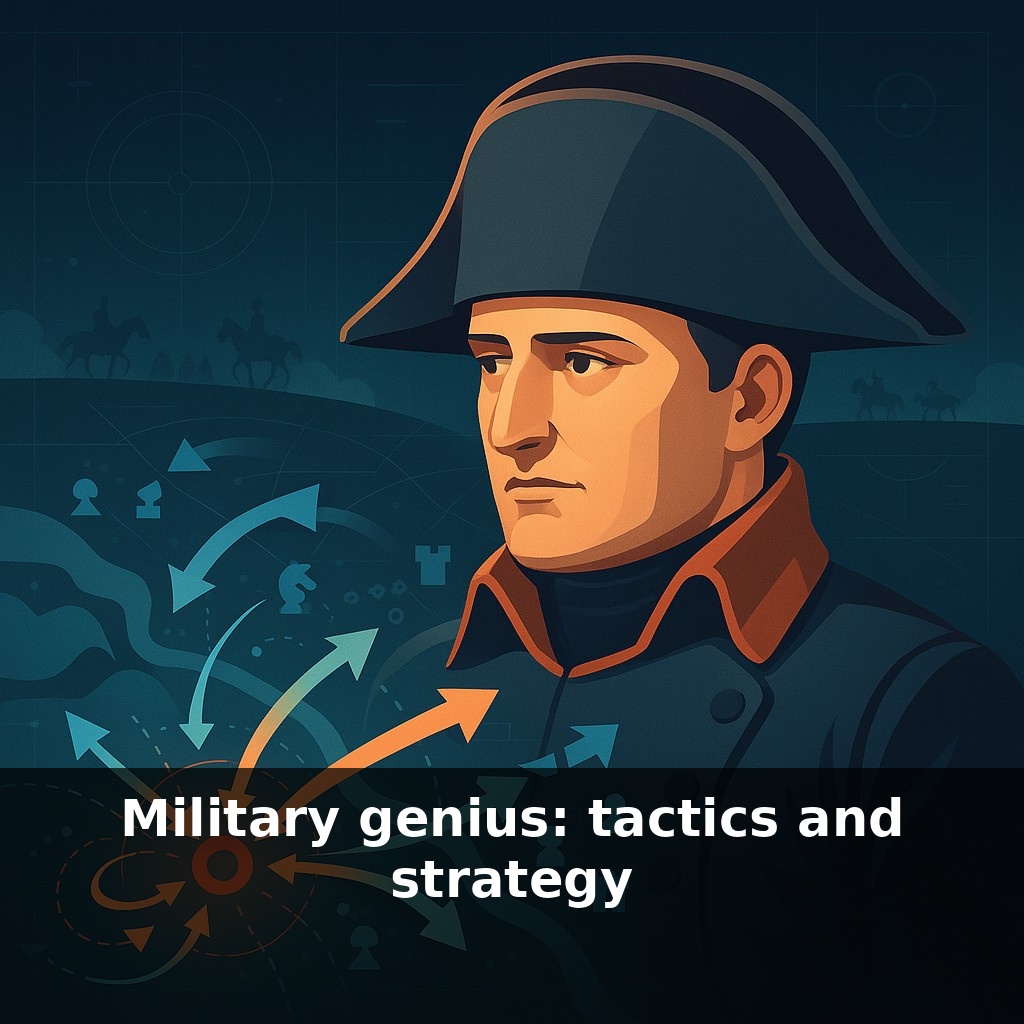
Cavalry charges, shouted orders—and the general commanding it all is nowhere near the gun smoke. Napoleon often won battles days before the first shot, by how he moved his forces. In this episode, we’ll step into those decisions and ask: what does “military genius” really look like?
Napoleon won roughly 90% of his major battles, but the real story isn’t the win–loss record—it’s *how* he kept turning bad positions into winning ones. To his enemies, his armies seemed to be in two places at once: scattered and vulnerable on the map one day, suddenly massed and overwhelming at a single point the next. That wasn’t luck or magic; it was structure plus speed.
In this episode, we’ll zoom in on three things: how the corps system let him break his army into semi‑independent “mini‑armies”; how forced marches and clever use of roads turned distance into an ally; and how he combined artillery, infantry, and cavalry into a single hitting mechanism. Instead of memorizing battles, we’ll treat each campaign as a laboratory: what did he see, how fast could he move, and why did his opponents keep realizing what was happening only a day too late?
Napoleon wasn’t just moving pieces on a map; he was rewriting the timetable of war. Most coalitions still thought in slow, linear advances: assemble, march together, fight where the enemy stands. He treated Europe like a three‑dimensional puzzle of time, space, and uncertainty. Crucially, he assumed his opponents would misread his intentions and *planned* around their delays and bad guesses. That’s our focus now: not just what structures he used, but how he exploited enemy psychology, weather, supply limits, and terrain friction to turn calculated risk into repeated surprise.
Napoleon’s edge started *before* armies met, in how he stacked the odds at the operational level. One underappreciated element: how he managed *uncertainty*. He rarely knew exact enemy numbers or positions, but he knew their *likely* reactions. So he designed plans with built‑in “branches”: if the enemy retreats, pursue this way; if they stand, pivot there; if they split, crush the nearest half. His orders often contained alternative routes and rendezvous points, allowing each corps to adapt without waiting for fresh instructions.
This mattered because he frequently accepted numerical inferiority at the point of first contact. At Marengo in 1800, his army was initially beaten back; the late arrival of Desaix’s corps turned defeat into a narrow win. Instead of concluding “never risk that again,” Napoleon doubled down on the principle: engage with part, strike decisively with the rest at the right hour. He turned “being slightly late” into a weapon—*for the other side*. They’d commit under partial information, then his reinforcements would appear.
Artillery showcases the same logic at a different scale. With more guns per man than most rivals, he could form “grand batteries” that didn’t simply soften lines but *reshaped* the battlefield: blasting gaps for infantry, masking cavalry movements, forcing commanders to shift reserves away from where he intended to attack. He thought in terms of sequences: bombard here, draw their attention, then hit the real target somewhere else minutes later.
His reading of terrain went beyond heights and rivers. He asked: where will fog linger longest, where will columns slow, where will a retreat choke? At Austerlitz, he knowingly left his right flank looking weak near the lakes, betting the Allies would pile in. When they did, French attacks against their center and left cut their army in two; broken units fled onto frozen ponds under artillery fire.
If this sounds almost clinical, his opponents’ experience was anything but. They often believed they had him cornered, only to discover that what looked like a vulnerable wing was bait, what seemed dispersion was prelude to sudden mass, and what felt like a straightforward advance had quietly become a trap.
Napoleon’s hallmark wasn’t just *having* options; it was arranging them so that whichever way events broke, *he* got the tempo advantage. Look at Ulm (1805): he never fought a grand set‑piece there. Instead, separate columns slid around the Austrian army, closing roads and crossings until Mack’s force found every exit blocked and surrendered en masse. No “decisive battle,” yet the campaign was effectively won.
Or consider Jena–Auerstädt (1806): two battles on the same day, against different halves of the Prussian army, each fought by a separate French force that *believed* it faced the main enemy body. Napoleon built his system so local commanders could act aggressively on imperfect information—and still serve the larger design.
Think of a touring orchestra that can split into chamber groups in nearby cities, then reunite for a single major concert on short notice. The value isn’t just flexibility; it’s that audiences (and rivals) can’t be sure where the main performance will actually happen until it’s already underway.
Modern command systems are edging toward something Napoleon never had: live data. When sensors, satellites, and small autonomous units feed constant updates, “branches” and contingencies can be explored in software before troops move. Yet there’s a twist: too much information can paralyze. Future commanders may need filters as much as feeds—tools that highlight only decisions that truly shift the odds, like a doctor focusing on key vital signs amid a flood of lab results.
Your challenge this week: treat your calendar like a campaign map. Pick one complex project and sketch 3 concrete “branches” for the next month—what you’ll do if resources shrink, if a partner drops out, or if a sudden opportunity appears. Don’t aim for perfect prediction; aim for moves that keep your options open while still pushing toward a decisive result.
Napoleon’s real legacy may be a habit of mind: treating time like a weapon and plans like living organisms. Rather than chasing perfect foresight, he tuned his system to bend when struck and snap back harder. In today’s terms, it’s closer to jazz than sheet music—loosely scored, tightly rehearsed, and ready to seize the unexpected solo when it appears.
Before next week, ask yourself: 1) “Where in my current project am I ‘fighting on too many fronts’ like a scattered commander, and what would it look like to concentrate my efforts on one decisive objective instead?” 2) “If I apply ‘reconnaissance before engagement’ to my week, what specific information (from customers, teammates, data, or competitors) do I need to gather before committing to my next big move?” 3) “Looking at my calendar like a campaign map, which recurring commitments are actually ‘supply lines’ that support my main objective, and which are just draining resources I could redeploy more strategically?”