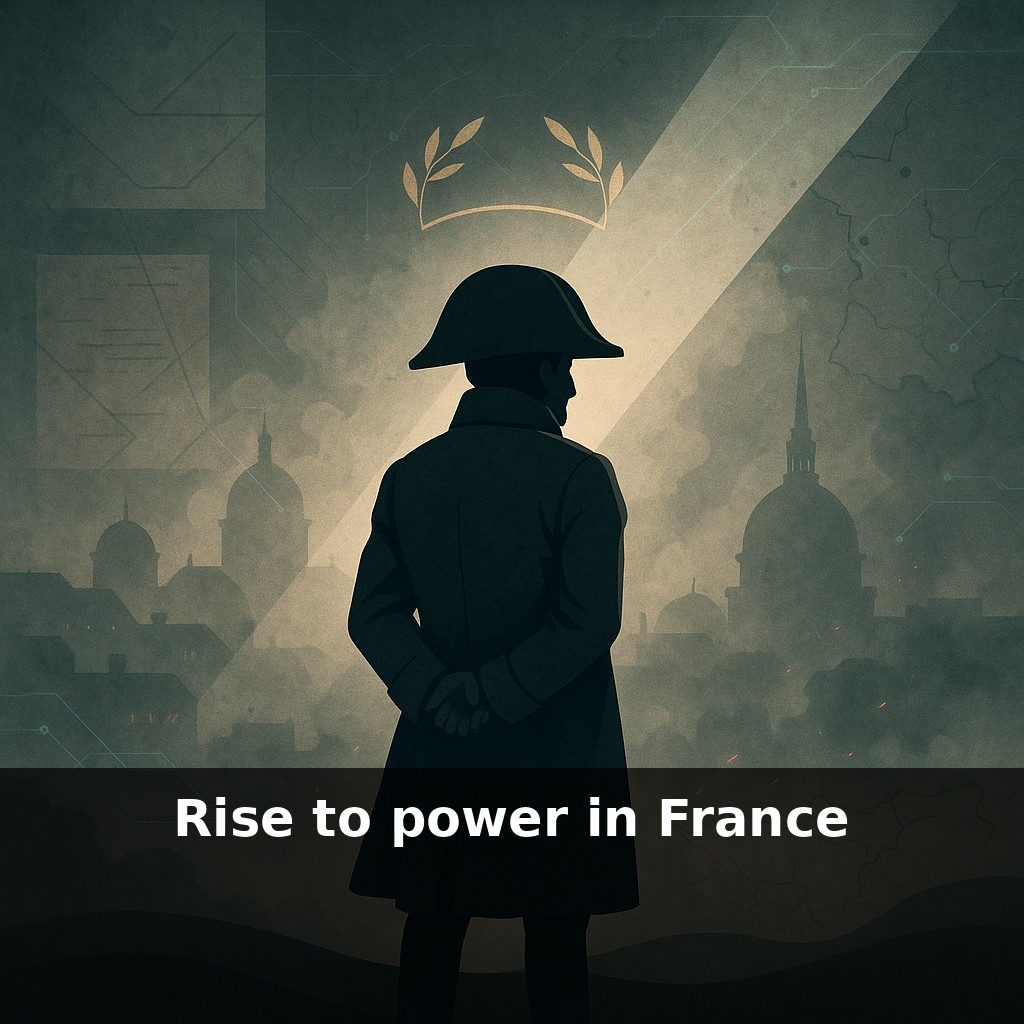
Gunfire rattles in Paris, but the revolution is… tired. No king, no clear future, just exhaustion. Out of this confusion steps a short Corsican general in a plain gray coat. Within five years, he’ll crown himself emperor. The mystery is: how did almost no one see it coming?
The answer begins on a foggy November morning in 1799, inside a failing government nobody trusted. France wasn’t collapsing dramatically; it was drifting, like a ship whose crew keeps arguing over the map while the hull quietly leaks. Politicians in the Directory squabbled, corruption scandals piled up, and the public—exhausted by years of drama—stopped listening. That boredom was dangerous. It created a space where someone decisive, or merely confident, could walk in and start giving orders. Napoleon understood this mood better than most of the men actually in power. While they played by old rules of speeches and committees, he was already thinking in terms of speed, image, and control—more like a modern campaign strategist than a traditional general. To see how he rose, we need to watch how he turned this drift into a launchpad.
Napoleon’s advantage wasn’t just talent; it was timing. By 1795 he had already proved he could deliver something the politicians couldn’t: clear results under pressure. He saved the new regime by crushing a royalist uprising in Paris with brutal efficiency, then turned a struggling army in Italy into a headline-generating success story. Each victory worked like a spotlight, pulling attention away from the talking heads in Paris and onto the young general who “made things happen.” To understand his rise, we have to trace how he converted battlefield success into political credit—and then into formal power.
Napoleon’s real breakthrough came when he discovered how fragile the men above him actually were.
In 1797, after the Italian campaign, he was the celebrity general of the Republic—but still technically an employee. The Directors feared him, but they needed his victories. He used that leverage carefully. Visiting Paris, he didn’t storm into politics; he watched. He cultivated journalists, funded friendly newspapers, and made sure engravings and plays turned his battles into legend. While older generals relied on dispatches, Napoleon curated a public version of himself.
Then came Egypt in 1798—both a gamble and a rehearsal. Militarily, it was mixed at best: initial land victories, a fleet destroyed by Nelson, isolation. But politically, Napoleon learned something crucial: news could be shaped. By the time most French citizens heard about Egypt, the disasters were softened, the triumphs amplified. He realized that in an age of slow communication, whoever wrote the first compelling story often “won,” regardless of messy facts.
Back in France, the timing aligned. The Directory was broke, unpopular, and at war again. Key insiders—like Emmanuel Sieyès—weren’t dreaming of a military regime; they wanted a controlled reset of the constitution. They approached Napoleon thinking he’d be the sword to protect their carefully drafted plan.
Instead, he rewrote the script mid-performance.
The coup of 18 Brumaire wasn’t a single dramatic night of soldiers seizing buildings. It unfolded over days of legal maneuvers: moving the legislature out of Paris “for safety,” arranging resignations, surrounding hesitant deputies with loyal troops. When Napoleon stumbled in a tense speech and was shouted down as a would‑be dictator, the operation nearly collapsed. His brother Lucien, presiding over the assembly, had to claim the deputies were under physical threat and call in guards to clear the hall.
What emerged afterward looked, on paper, like a shared arrangement: three consuls, a new constitution, checks and balances. In practice, the document of Year VIII funneled decision‑making to one desk. Napoleon made sure the “first consul” controlled military command, appointments, and the initiative for laws.
He wasn’t grabbing a throne in one motion; he was tightening a series of belts, each one slightly harder to undo than the last.
Think of his next moves less as a single grab for power and more as a carefully layered score in music. The opening theme: legality. Every step came wrapped in rules—decrees, oaths, new councils—so opponents had to argue paperwork, not principle. That slowed resistance.
Then he added the rhythm section: institutions that seemed technical but shifted loyalties. The Bank of France, created in 1800, wasn’t just about currency; it tied merchants and financiers to his success. Prefects in each département reported up a clear chain, turning a patchwork of local powers into a coordinated network that answered to him.
Over this, he laid a melody the public could hum: victories. Marengo in June 1800 turned anxiety about renewed war into relief and pride. Each success abroad quieted questions at home.
Finally, he tested how loud he could turn the volume. Plebiscites—like the 1802 vote making him Consul for Life—let people endorse “stability” rather than admit they were endorsing one man. Bit by bit, the arrangement made any alternative feel risky, even unimaginable.
Napoleon’s rise also shows how “emergency fixes” can harden into the default system. Once people adjust to a faster, more centralized way of deciding things, going back can feel like trading a fast train for a slow bus, even if the train only runs when one driver is in charge. For modern democracies, the warning is subtle: the real tipping point isn’t one big power grab, but the quiet moment when shortcuts start to look like common sense rather than exceptions.
Napoleon’s climb reminds us that power often grows like a snowball: small, plausible steps that quietly gather weight. Enough of those, and resistance feels like trying to stop a rolling boulder with your hands. Your challenge this week: notice where “temporary” measures in your own world are quietly becoming the new normal.