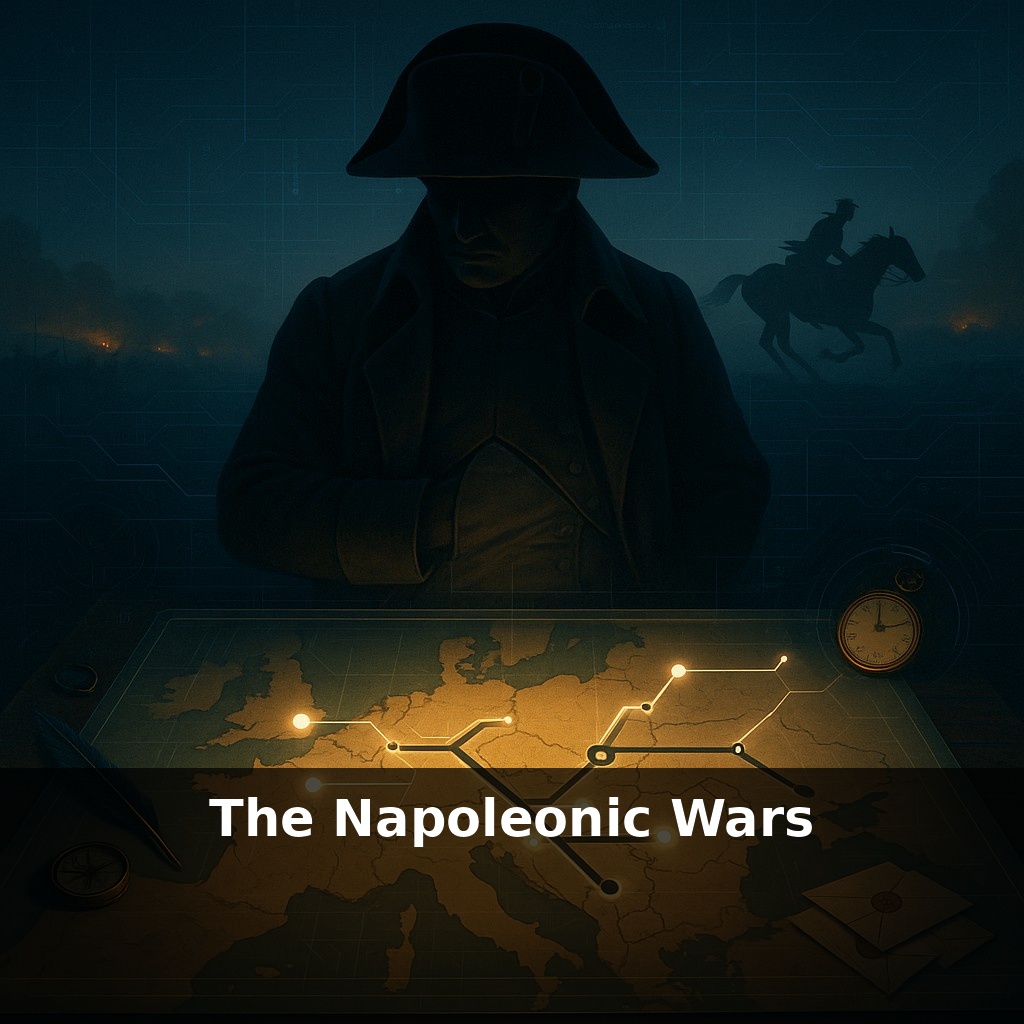
Napoleon fought battles from Portugal to Poland without a smartphone, radio, or railways—yet moved armies faster than many modern bureaucracies. A courier rides through the night, a marshal hesitates at dawn, a map lies open on a camp table—and Europe holds its breath.
Three to six million people may have died in the Napoleonic Wars—yet for many years, historians argued mainly about Napoleon’s “genius” rather than the scale of the human cost. Those twelve years from 1803 to 1815 didn’t just redraw borders; they quietly rewired how states thought about law, loyalty, and lethal force. The same man who crowned himself Emperor spread a legal code promising equality before the law. The same armies that marched under tricolor flags of “liberty” crushed uprisings in Spain and Russia. And as we’ve seen with movement and messaging on the battlefield, technology and organization were only half the story. The other half was ideological: new ideas about who should rule, who should fight, and what a state could demand from its people—all forged in a war that felt, to many contemporaries, less like a sequence of campaigns and more like a permanent state of emergency.
Napoleon’s wars didn’t unfold on an empty canvas; they crashed into old monarchies, fragile new republics, and empires already under strain. Local elites, merchants, peasants, and priests all had to decide—often quickly—whether French troops meant liberation, occupation, or an opportunity to settle old scores. Think of a crowded neighborhood when a sudden blackout hits: some people share candles, others barricade doors, a few start looting. In places like Spain, Germany, and Italy, the same French reform that opened careers to talent also threatened church lands, noble privileges, and regional identities, provoking resistance that spread faster than decrees.
Seventy million people found themselves, willingly or not, inside Napoleon’s political experiment. What that meant on the ground varied wildly from Warsaw to Lisbon.
In much of Germany and Italy, French-backed rulers abolished internal tolls, standardized weights and measures, and opened careers to men who, a decade earlier, would have been blocked by birth. A lawyer’s son in the Rhineland could suddenly imagine becoming a judge or minister; Jewish communities saw civil barriers fall in territories where local princes had stalled for centuries. For merchants, a customs-free bloc stretching from the Low Countries to the Elbe felt like turbo‑charged opportunity—until it crashed into Britain.
Unable to crush the Royal Navy, Napoleon tried to cut Britain off from European markets. The Continental System turned coastlines from Denmark to Naples into an economic front line. Ports that had thrived on re‑exports and smuggling now faced ruin if they obeyed, invasion if they disobeyed. Local officials learned to juggle imperial decrees with quiet exceptions: a license here, a blind eye there, as whole regions survived on what one historian calls “organized hypocrisy.”
Nationalism didn’t explode everywhere at once; it flickered up in different forms. In Spain, resistance wrapped itself in Catholic and royalist language, but it also taught villagers to think of “Spain” as something worth defending beyond a particular dynasty. In Prussia, humiliation after defeat in 1806 pushed reformers to recast subjects as citizens in arms, linking schooling, conscription, and a new sense of “the nation” that would outlast Napoleon and later feed German unification.
Meanwhile, older empires watched and adapted. In Vienna and St. Petersburg, statesmen realized that beating France required more than dynastic alliances; it demanded tapping popular energy without losing control of it. That balancing act—mobilize people, then demobilize their expectations—would haunt European politics long after 1815.
Your challenge this week: pick one modern country involved in the Napoleonic Wars, and trace a single institution—like conscription, civil marriage, or a commercial code—back to this era. Notice not just what changed, but who benefited, who lost, and who resisted in between.
A curious detail: some of Napoleon’s fiercest enemies quietly copied his paperwork. Prussian officials, who loathed French domination, studied French civil registers the way a rival chef studies a competitor’s menu—not for the slogans on the door, but for the efficient way orders moved from table to kitchen to bill. In parts of Italy and the Rhineland, village mayors who disliked French taxes still admitted that standardized contracts made it harder for local notables to twist rules in their favor. One analogy helps here: a medical trial that starts as a risky experiment on a few patients, then—because it works—quietly becomes the hospital’s standard protocol. Even after 1815, when thrones were restored and tricolors hauled down, rulers found themselves keeping the “paper skeleton” of the Napoleonic era: cadastral maps, population counts, uniform court procedures. These tools outlived their maker, giving later governments new ways to see, tax, and discipline their societies.
Scholars and planners now mine this era less for battles than for patterns. Coalition flip‑flops help today’s diplomats stress‑test alliance loyalty. Blockade data feed models of sanctions: how long port cities endure, when black markets harden into parallel economies. Like jazz musicians sampling an old riff, AI labs train on Napoleonic decision chains to see how leaders improvise under fragmentary intel—then ask whether future commanders, human or machine, will repeat the same blind spots.
Napoleon’s world is gone, but its aftershocks keep humming—like a bass line under today’s headlines. Border disputes, draft debates, even arguments over which law applies online still echo those early experiments in power. Following those faint vibrations forward is less about praise or blame, and more about seeing how fragile our “normal” really is.
Before next week, ask yourself: Where in my own life am I more like Napoleon at Russia—overconfident and overextended—and what would my “orderly retreat” look like today (fewer commitments, clearer priorities, or a deliberate pause)? If I treated one current conflict (at work, home, or online) the way the coalition treated Napoleon—building alliances instead of going it alone—who would I actually reach out to this week, and what’s the first conversation I’d start? Looking at how the Congress of Vienna tried to reset Europe after years of chaos, what’s one area of my life that needs a similar “post‑war settlement,” and what boundary, routine, or agreement could I put in place in the next few days to prevent the same “war” from breaking out again?