Identifying Common Workplace Dilemmas
📝 Transcript
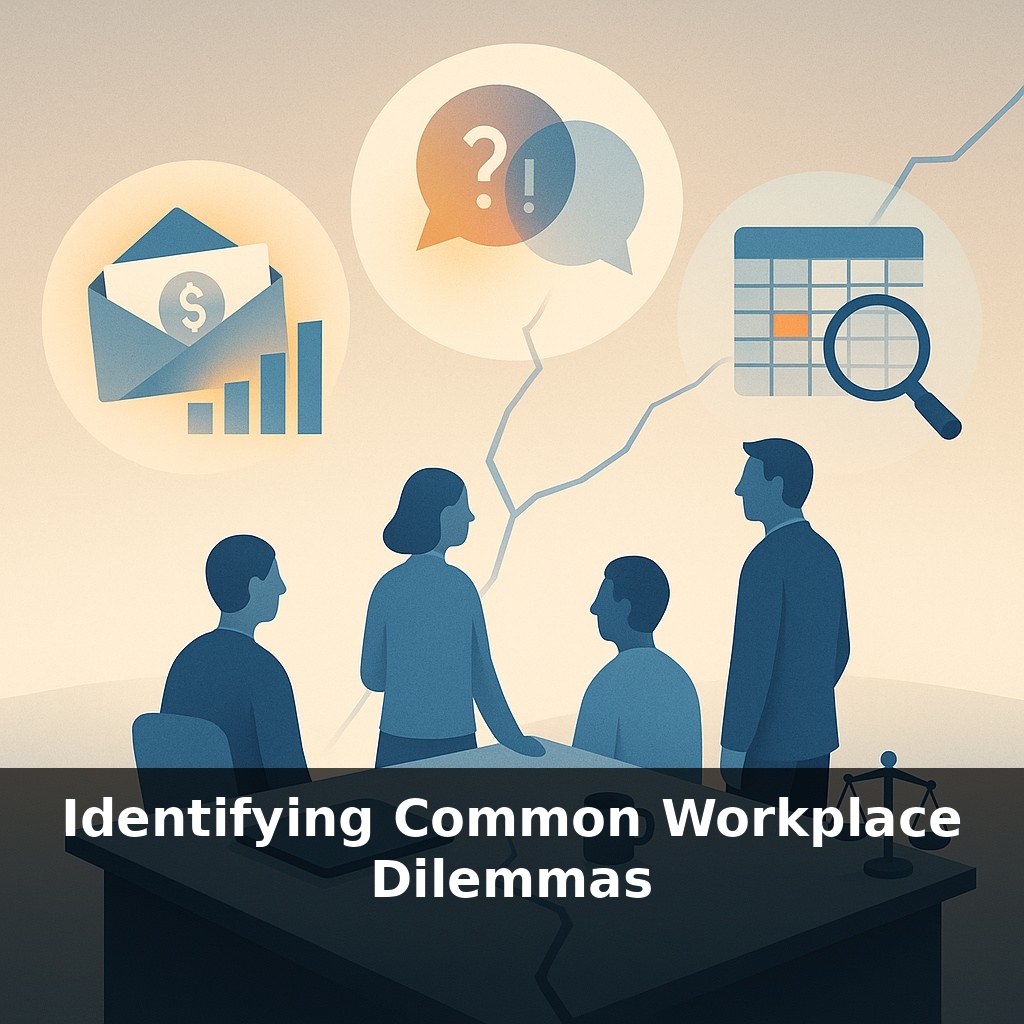
“Almost half of workers say they’ve watched something at the office that felt wrong—but many only realize it *was* wrong months later. In this episode, we drop into three everyday moments: a team bonus meeting, a casual joke, and a quiet spreadsheet tweak that changes everything.”
Those three moments—bonus talk, a joke, a “small” data change—are not random glitches. They sit on well‑mapped fault lines where trouble repeatedly appears: conflicts of interest, fairness and equity, respect and diversity, and truthfulness and transparency. Most workplace dilemmas are just familiar problems wearing new outfits. A manager who nudges credit toward a favorite employee lives on the same fault line as a procurement officer steering contracts to a cousin. Both are conflicts of interest, even if one looks friendlier.
The real skill is pattern recognition: learning to tag what you’re seeing *while* it’s happening. Think of these four categories as the structural beams in a building; once you know where they are, you can tell when something is putting dangerous pressure on them—even if the wallpaper looks perfectly normal.
Here’s the twist: most dilemmas don’t appear with a dramatic soundtrack or an email marked “ethical issue.” They arrive as calendar invites, friendly favors, or “quick fixes” that seem harmless in the moment. That’s why research keeps finding the same pattern: people *see* something off but don’t name it until much later—often after harm, burnout, or retaliation has already occurred. Early recognition isn’t about being paranoid; it’s about having a mental “label maker” ready, so when a request tugs at your conscience, you can quickly sort it: Is this about fairness, respect, divided loyalties, or bending the truth?
Start with the collision points, not the people. Instead of asking, “Is my boss unethical?” ask, “Which pressure is actually showing up here—equity, loyalty, or honesty?” That shift moves you from judging character to mapping forces, which is much safer and much more accurate.
A practical way to do this is to notice *what* feels at risk in the moment something seems off:
- When you feel a tug between your role and your relationships, you’re likely near a loyalty problem: hiring a friend, steering work to a favorite vendor, soft‑pedaling a review for someone who “really needs the bonus.” - When your stomach drops because someone is being sidelined, under‑credited, or over‑penalized, the fault line is usually equity: how opportunities, information, and burdens are distributed. - When you notice people being reduced to “types” (“engineers are terrible communicators,” “clients from that region always haggle”), you’re brushing up against respect and diversity. - When you’re asked to “clean up” numbers, “reframe” a result, or “keep this between us,” integrity of information is on the table.
You don’t need to nail the category perfectly in real time. Labeling is about getting *close enough* to trigger better questions: “If this is an honesty issue, what would full transparency look like?” “If this is about equity, who’s affected that isn’t in the room?”
One analogy from tech can help here: think of these four themes as filters in an email client. Misconduct rarely arrives as pure “spam”; it’s a messy mix of pressures. But if you’ve set up filters—equity, loyalty, respect, honesty—you can quickly sort the message and decide whether to archive, respond, or escalate.
To make this concrete, watch for three early warning signs that often precede serious trouble:
1. **Language drift**: “Everyone does it,” “This is how we hit numbers,” “Don’t overthink it.” 2. **Process shortcuts**: decisions made off the record, undocumented exceptions, “special cases.” 3. **Isolation**: being told not to loop in compliance, HR, or a colleague who’d normally be involved.
When two or more of those show up together, there’s a good chance you’re not just dealing with a tough personality—you’re standing on one of those four fault lines, and it’s time to pause before you move.
Think of a few ordinary scenes. You’re asked to “sit in” on an interview—not on your team—and notice the hiring manager only asking hard questions to candidates with caregiving gaps on their résumés. That’s your equity beam taking strain. Or you see a vendor selection call where one option is dismissed with, “They’re based in a difficult country; let’s not bother,” and no one challenges it. Respect is wobbling there, even if no slur is spoken.
Now shift to truthfulness. You join a late‑night slide‑review where a senior leader says, “Legal said no, but let’s present this version to the client and fix the paperwork later.” No numbers are changed, yet the story is being bent. Or you’re copied on an email thread where a manager proposes, “Let’s not mention that outage unless they ask directly.” Silence can be as misleading as a false claim.
Your goal isn’t to prosecute every moment, but to quietly flag: “Something important is under pressure here—do I need to slow this down, ask one more question, or document what I’m seeing?”
Soon, spotting dilemmas won’t be optional “extra credit” for thoughtful employees; it will be a core job skill, like reading a balance sheet or writing a clear brief. Algorithmic tools will quietly amplify small biases into big outcomes, and leaders will be judged not just on profit but on how they handle those pressure points. The upshot: those who can calmly name what’s at stake will be trusted to steer teams through messy grey zones instead of dodging them.
Over time, you may notice your attention sharpening in small, quiet ways: the pause before agreeing to “fix” a slide, the second look at who isn’t on an invite, the extra question when a shortcut is framed as “urgent.” Those micro‑hesitations aren’t paranoia; they’re like tapping a bridge before you cross, testing how much weight it can safely hold.
Start with this tiny habit: When you open your email in the morning, quietly say to yourself, “What’s the real dilemma here—values, workload, or relationships?” and then put a single asterisk (*) in the subject line of just one email that feels like a dilemma (e.g., unclear priorities, conflicting requests, or tension with a coworker). That asterisk is your tiny flag: you don’t have to solve it yet, just notice it. Do this once a day for a week so you start spotting patterns in the kinds of workplace dilemmas you actually face, instead of letting them blur together.
From this course
Navigating Ethical Dilemmas at Work
7 episodesUnlock all episodes
Full access to 7 episodes and everything on OwlUp.
Subscribe — $1.99/monthLess than a coffee ☕ · Cancel anytime