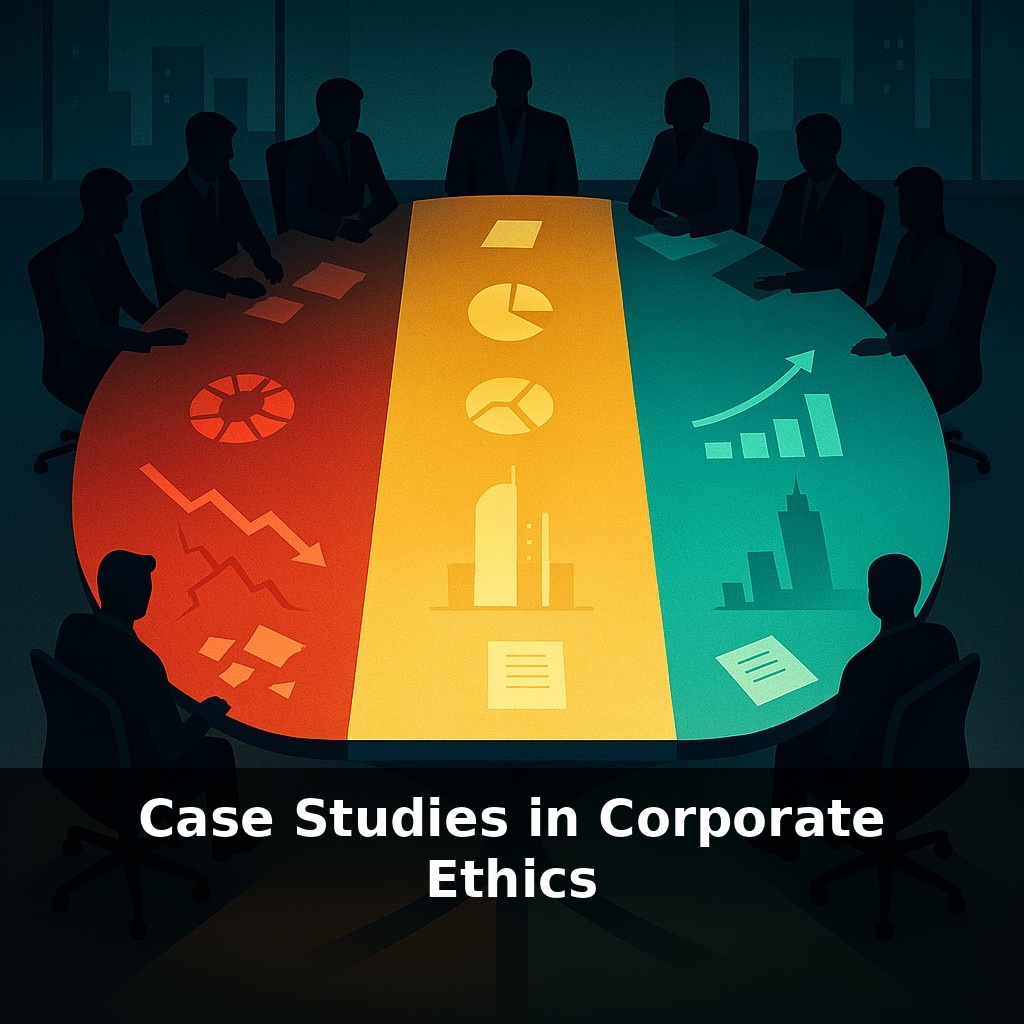
About half of younger consumers say they’d drop a favorite brand if its ethics felt off. Now hear three boardrooms, same crisis: one gambles with a cover‑up, another delays and spins, a third acts fast and transparent. Only one keeps the trust it needs to survive.
Johnson & Johnson, Volkswagen, Wells Fargo—three names, three radically different ethical trajectories. Same basic pressure in the background: hit targets, satisfy investors, beat competitors. But watch what changes when leaders treat ethics as a core business system rather than a public-relations feature. In some firms, decisions pass through structured tests: Who is affected? What outcomes follow? What kind of organization are we becoming if we choose this path? In others, those questions are skipped in the rush for quarterly wins, and the “cost” of a shortcut is only counted after a scandal breaks. In this episode, we’ll step inside real corporate decisions and see how formal ethical frameworks quietly shape (or fail to shape) incentives, culture, and ultimately which companies survive serious moral stress.
In board minutes and glossy value statements, most companies sound similar. The real difference appears in the “gray-zone” decisions that never hit the press: a borderline sales tactic, a quietly risky product tweak, a country manager cutting corners to make numbers. Here, leadership choices, incentive plans, and informal norms do the heavy lifting. Some firms wire ethics into bonus formulas, promotion criteria, and product design reviews. Others bolt it on as a training slide. Over time, one culture becomes like a well‑tuned operating system; the other runs on quick patches and workarounds that eventually crash under pressure.
“Do the right thing” sounds straightforward—until you’re in a product meeting with a launch deadline, a billion‑dollar forecast, and a test result that’s…uncomfortable. This is where abstract values quietly turn into concrete practices like who gets invited to the room, what data is allowed on the slide, and which questions you’re rewarded for asking.
Look at how three ethics tools show up when they’re taken seriously instead of treated as slogans.
A utilitarian lens doesn’t just ask, “Will this boost earnings?” but, “Across all affected groups, do benefits meaningfully outweigh harms—and by how much, and to whom?” In a pricing decision, that might mean modeling not only revenue but also customer debt burdens, complaints, and regulatory risk, then documenting why certain trade‑offs are acceptable or not.
Stakeholder thinking changes whose voice gets built into the process. Some companies hard‑wire this by requiring explicit sign‑offs from people who represent different interests: safety, customers, frontline staff, communities, even future employees. When a proposal would hit one group especially hard, it triggers a deeper review instead of sliding through on pure financial logic.
Virtue‑based reasoning focuses on character over time: “If we make this choice repeatedly, what kind of organization are we training ourselves to be?” That question shows up in hiring profiles, performance reviews, and promotion cases. It turns “gets results at any cost” from a secret advantage into a visible liability.
Now layer in incentives. If a manager’s bonus depends 80% on short‑term volume, don’t be surprised when they chase borderline sales schemes. When firms rebalance metrics—mixing financial targets with safety, customer outcomes, and people‑development indicators—they quietly rewrite what counts as winning.
Culture then amplifies or dampens all of this. In some places, surfacing a risk earns respect; in others, it marks you as “not commercial.” One environment becomes like a well‑coached team that expects tough calls and practices them; the other relies on star players winging it until someone fouls out on the front page.
Across cases, the pattern is less about isolated villains and more about systems that either catch small ethical slips early—or convert them into full‑blown scandals.
A tech company weighing whether to quietly log more user data faces a choice that looks abstract on a slide but concrete in people’s lives. A strict utilitarian review might force it to quantify not just ad revenue but potential identity theft, harassment risks, and loss of user autonomy—and show its work in an internal memo that can be audited later. Stakeholder thinking could mean inviting an engineer, a privacy lawyer, and a user‑advocacy lead into the product meeting, each with the power to pause the launch. A virtue‑focused lens asks whether shipping this feature trains teams to see users as partners or raw material. When these lenses are built into product templates, code‑review checklists, and incident postmortems, they function less like theory and more like an architecture blueprint: every “pillar” decision must rest on at least two ethical supports, or the design is sent back for reinforcement before it’s allowed to stand.
Regulators and investors are starting to read a firm’s ethical track record the way scouts study an athlete’s stats: not just the big wins, but how they handle pressure, fouls, and course‑corrections. Emerging tools—AI audits, supply‑chain tracing, real‑time whistleblowing channels—turn past “blind spots” into searchable data. That means future leaders won’t just be judged on what they delivered, but on how clean their decision “highlight reel” looks under replay.
When scandals surface, outsiders see a single crash; insiders know it was built like layers in bad code—tiny shortcuts, never refactored. The emerging edge in business ethics isn’t perfection, but debug‑ability: clear logs of who raised concerns, which options were tested, and why a path was chosen. That record can steady a firm when pressure spikes again.
Here’s your challenge this week: Pick one real decision currently on your plate (a vendor contract, a customer discount exception, or a hiring/promotion choice) and run it fully through the “headline test” and the “grandma test” from the episode—would you be comfortable seeing the details on the front page or explaining them to someone you deeply respect? Before you finalize that decision, schedule a 15‑minute huddle with at least two colleagues from different functions and explicitly walk through the four questions the episode highlighted: Who is helped? Who is harmed? What conflicts of interest exist? What would happen if everyone at our company did this? Close the loop by sending a short summary of the decision and your reasoning to your manager and one peer, explicitly stating which company values (by name) your choice supports and which ethical risk you’re intentionally accepting.