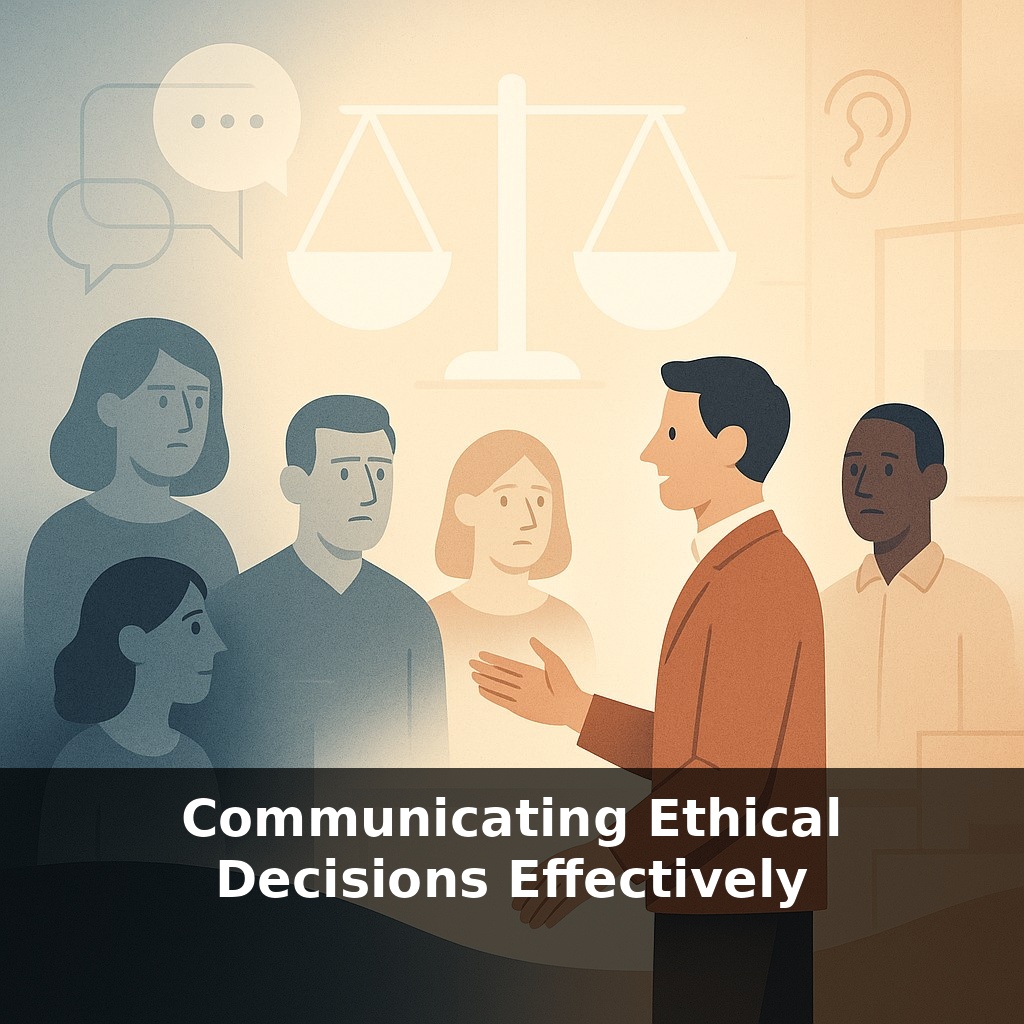
Only about a third of employees believe their company sticks to its values when the pressure is on. You've just witnessed a decision unfold; it's ethically defensible, but has ignited fury among the crowd. How do you explain it so trust doesn’t crumble? The real test starts here—how do you explain it so trust doesn’t crumble?
Only 30% of employees think their company actually lives its values when things get tough—and your audience is constantly, quietly, running that test on you. The twist is that they’re not only judging *what* you decided, but *how* you talk about it. An ethically sound choice delivered in a clumsy, defensive, or opaque way can feel like a breach of integrity, while a hard, even painful decision can be accepted when people feel informed and respected.
So in this episode, we shift from “Was this the right call?” to “Can people see the rightness of this call?” We’ll explore how to translate a decision into language different groups can hear, how much detail is enough, and how to communicate when you’re still missing pieces—and know that everyone is watching your every word.
Here’s the harder layer: different groups don’t just want different *details*—they’re often listening for different *proofs* that you took ethics seriously. A board member may scan for evidence and risk logic; frontline staff may listen for fairness and shared sacrifice; community members may care most about long‑term impact and whether they were heard at all. Miss that nuance, and even a careful decision can sound tone‑deaf, like broadcasting one radio station while everyone’s tuned to another frequency and turning up the volume only makes it worse.
Now we get practical: when a tough call is made, you’re really doing three things at once—explaining the **WHY**, the **HOW**, and the **WHAT**—to different groups who care about different pieces.
Start with the **WHY** in language your audience recognizes. That means naming the specific values or principles that were in tension, not just the one that “won.” For instance: “We had to weigh job security against long‑term survival of the organization and safety of patient care.” People are more willing to live with an outcome they dislike if they can see you struggled with the same trade‑offs they see.
Then, open a window into the **HOW**. Instead of “leadership decided,” spell out the process without drowning people in detail: who was consulted, what evidence or scenarios you reviewed, which constraints were non‑negotiable. This is where you show that you didn’t just pick the path of least resistance. Even a simple structure helps: “We considered three options, tested them against X and Y criteria, and here’s why we ruled two of them out.”
The **WHAT** needs to be concrete and near‑term. People want to know: What changes tomorrow? For whom? For how long? Avoid vague commitments like “We’re exploring support options.” Replace them with time‑bound and role‑specific actions: “Within 10 days, affected staff will have one‑to‑one meetings to discuss options A, B, and C.”
Here’s the often‑missed layer: adapt the balance of WHY/HOW/WHAT to each audience. A regulator may need detailed HOW; a local neighborhood group may care more about WHAT and long‑term WHY; employees may need all three but with extra clarity on “What does this mean for me and my team in the next month?”
Treat feedback as part of the communication, not a postscript. Build in visible listening points—Q&A sessions, anonymous channels, small‑group discussions—and then loop back to say what you heard and what you’re changing (or not) as a result. Silence after a big announcement invites people to fill the gap with their worst‑case story.
When in doubt, narrate your constraints and uncertainties explicitly. Saying “Here’s what we still don’t know, and here’s when we expect to know more” preserves credibility even when your answers aren’t comforting.
A useful stress test is to ask: “If someone only heard the hallway version of this story, what would they think we cared about?” That’s where concrete examples matter.
Consider a product recall. One firm sends a polished email from “Corporate Communications” outlining logistics. Another has the product lead host a live session, walks through the trade‑offs, shows the testing data, answers hostile questions, and publishes a timeline of next updates. Same recall, radically different signal about whose safety and voices matter.
Or take a restructuring. You can quietly post an org chart—or you can brief managers first with tailored FAQs, give them space to react, then cascade a clear narrative plus specific next‑week supports. The content may match, but the sequence tells people whether they are props or partners.
Like a basketball coach drawing the play on a whiteboard during a timeout, you’re not just calling the shot—you’re letting everyone see *how* you plan to run it and where they fit.
“Opaque explanations could soon cost you money, not just reputation.” As AI starts drafting more of your outward‑facing messages, the real differentiator becomes *how* you supervise them. Think of AI as a fast but literal intern: it amplifies whatever tone and priorities you feed it. Leaders who layer human judgment, regulatory awareness, and genuine moral reflection on top of AI outputs will set the bar for ethical transparency—and quietly shape what “normal” looks like in their industry.
Your real leverage lies in what happens *after* you speak. Treat reactions like performance data: which phrases sparked defensiveness, which questions kept repeating, where silence felt heavy. Adjust your next message the way a coder debugs after each test run—iterating not toward perfection, but toward a shared, evolving understanding.
Before next week, ask yourself: Where in my current work am I avoiding an ethical conversation because I’m worried about pushback, and what’s one concrete example I could rehearse out loud using “I” statements and clear reasoning instead of assumptions or blame? When I next explain an ethical concern (e.g., around data use, conflicts of interest, or transparency with clients), how can I frame it in terms of shared values and real-world consequences for specific stakeholders, rather than just “this is against the rules”? After a recent tough decision, who is one person affected that I could circle back to and ask, “What about how I communicated this felt clear or unclear to you?” so I can refine how I share ethical decisions going forward?