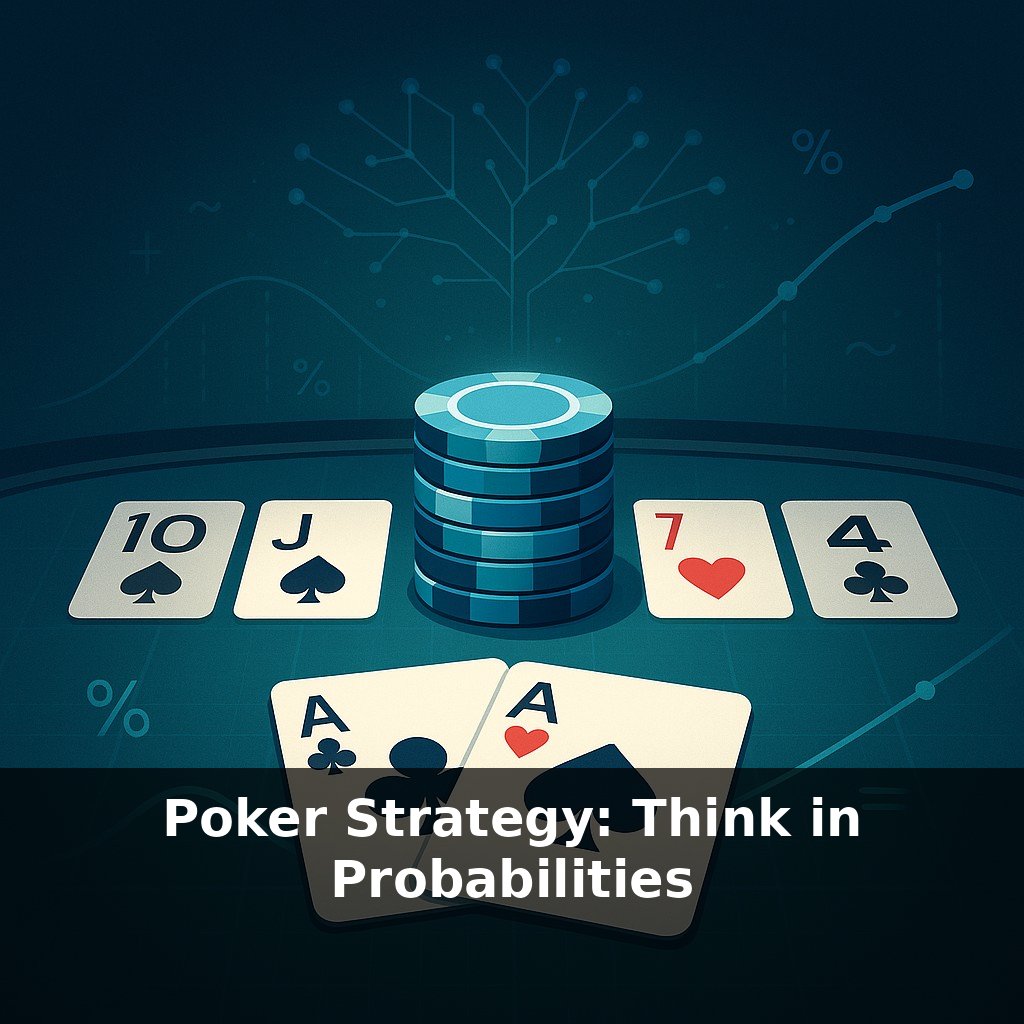
You’re more likely to be dealt pocket Aces than to play a full session without making a mathematically bad call. A late‑night hand, a tempting draw, a pot that’s just a little too big… and, without noticing, you’ve stepped away from math and back into wishful thinking.
At some point, every serious player discovers an uncomfortable truth: most “tough decisions” at the table are actually simple arithmetic hiding behind noise and adrenaline. The cards feel unpredictable, but under the hood the game is rigidly structured: 1,326 starting hand combinations, millions of possible five‑card outcomes, and a fixed, knowable number of cards that can save you—or sink you—on every street. Once you start seeing hands as combinations instead of dramas, patterns emerge. That “gut feeling” you used to trust becomes just another data point, not the boss. The real power comes from quietly counting your outs, weighing pot odds against the price of a call, and asking one relentless question: “If I made this decision a thousand times, would I want this exact spot to repeat?”
So where does that leave you in an actual hand, with the clock ticking and chips in the middle? This is where probability stops being a concept and becomes a habit. Now you’re layering details: how ranges collide on different board textures, how multiway pots shrink the value of “pretty” hands, how stack sizes quietly rewrite the script of what’s profitable. The math isn’t just about raw percentages; it’s about context—position, tendencies, pressure. Your goal isn’t to memorize charts, but to wire your brain to ask, under fire: “What does the math say here, for *this* configuration?”
Most players stop the math right after they count outs. That’s like a painter sketching the outline, then never touching color, light, or shadow. The outline matters, but the picture isn’t finished until you layer in *how* those outs interact with the pot, the stacks, and the people.
Start with pot odds, but don’t stop at “call or fold.” Turn it into: “If I hit, how much more can I realistically win?” That’s implied odds. A bare flush draw in a tiny pot with tight opponents has worse real value than the same draw in a bloated pot against someone who can’t fold top pair. The raw percentage hasn’t changed; the *payoff* has.
Then flip it: when do you *want* someone to chase? If the pot is $100, you bet $50, and their draw hits 20% of the time, their break-even call is $25. By betting $50, you’re offering a bad price. If they call anyway, your EV climbs—even when the river punishes you. This is where the “poker is all luck” myth dies: your profit comes from how consistently others misprice their decisions.
Ranges sharpen this further. You’re never up against “a hand”; you’re up against a *set* of hands that make sense given pre-flop action, position, and board. Two players can face the same board and have totally different EV decisions because their ranges collide with that texture in different ways. A dry ace-high board might blast the pre-flop raiser’s range while whiffing the caller’s; a low, connected board can invert that advantage.
Now add stack depth. With shallow stacks, hands that make strong but non-nut holdings (top pair, strong kicker) go up in value; there’s less room for implied disasters. Deep stacks, though, reward hands that can make disguised monsters and punish “good but second-best” holdings. The same top pair that’s a comfortable stack-off at 40 big blinds becomes a potential landmine at 200.
Modern solvers don’t “feel” any of this; they just grind through these layers: pot odds, implied odds, range interaction, stack leverage. You don’t need solver precision at the table, but you *do* want their habit: every decision framed as, “Across all the branches from here, is this action printing or burning?”
A four-way pot on a wet board is where this really shows up. You hold middle set on T♣8♣5♦, stacks are 150bb deep, and action goes bet–call–call in front of you. Old you just sees “strong hand, big pot.” New you starts cataloging branches: which overcards are bad; how many turn cards complete straights; how many club runouts kill your action even when you’re still ahead. You’re not just ahead *now*—you’re asking, “On how many future runouts do I stay ahead *and* keep getting paid?”
Think of it like a track race where some lanes secretly get longer on the final lap: in multiway, certain turns (cards, not streets) silently stretch the distance you have to run to win the pot. That’s why flatting to “keep the pot manageable” with a vulnerable value hand can be worse than shoving and forcing shorter branches—fewer players, fewer ugly rivers, fewer scenarios where your equity is capped and theirs is perfectly realized.
Your challenge this week: in every big pot you play, freeze the action at the turn and *verbally list* three good and three bad river cards *for your exact hand*. Then force yourself to choose a line—bet small, bet big, check—that *changes* how many of those rivers you’re willing to see. Don’t worry about perfect accuracy; focus on deliberately shaping the future tree instead of drifting into it.
Solvers hint at where this is heading: poker as a live laboratory for decision science. As tools spread, edge shifts from knowing formulas to *applying* them under pressure—like a musician who can improvise on top of the same notes everyone else has. Regulators may lean on AI to spot collusion patterns too subtle for humans. Away from the tables, the same tree-thinking that guides a turn shove can steer negotiations, policy design, even how we route autonomous vehicles through uncertain traffic.
When you treat each hand as a small research project instead of a drama, your win rate becomes less streaky and more like a steadily rising line on a graph. The next step is curiosity: review tricky spots, plug them into a solver or equity tool, and compare its lines to yours. Over time, you’re not just “playing better”—you’re quietly redesigning how you think.
Before next week, ask yourself: 1) “Looking at the ‘expected value’ of my daily habits, which 1–2 activities clearly have positive long‑term payoff (like studying the odds before placing a bet), and where am I still ‘calling’ on negative‑EV behaviors out of emotion or habit?” 2) “If I treated my calendar like a poker bankroll, what specific ‘high‑probability’ actions (deep work blocks, skill practice, key relationships) would I double down on this week, and which low‑probability ‘long shots’ (busywork, doom‑scrolling, unplanned meetings) would I immediately fold?” 3) “In the past seven days, when did I let short‑term variance (a bad outcome from a good decision, or a lucky win from a bad decision) push me off a solid strategy, and how will I track decisions vs. outcomes this week so I stick to the math rather than the mood?”