“Projects rarely die from bad code or weak ideas. They die because the wrong person says no at the last minute.”
You’re in a meeting, slides polished, deadline close. One quiet executive frowns—and months of work stall.
Who was that person, and why weren’t they on your radar?
That moment when a quiet stakeholder stops your project? It usually isn’t bad luck—it’s bad mapping.
In Episode 1, we focused on clarifying the “why” and “what” of your project. Now we shift to a more political question: **whose world are you changing, and who can quietly change yours back?**
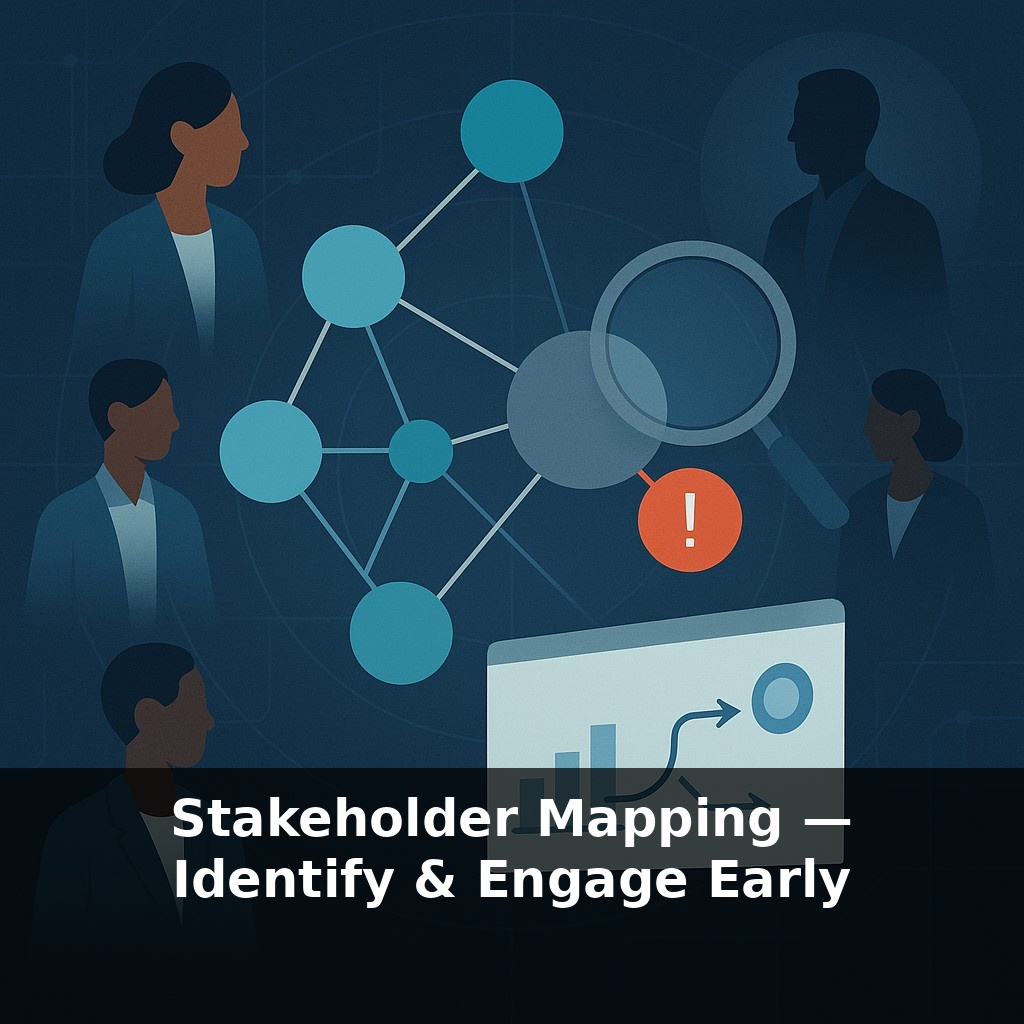
Stakeholder mapping is how you stop guessing. Instead of a vague list of “people to keep in the loop,” you build a clear view of who has **influence** over your project, who has **interest** in it, and how each group should be engaged.
Using tools like the Influence–Interest Grid, you move from treating everyone the same to designing different conversations for different players—supporters, skeptics, sponsors, blockers.
This is where projects start to gain real momentum—or quietly accumulate friction you won’t see until it’s expensive.
Some stakeholders shout; others whisper through back channels. Both can reshape your timeline, budget, or scope without ever touching your Gantt chart. That’s why a stakeholder map isn’t just a static diagram—it’s more like a live weather radar for your project’s political climate. You start noticing where storms are forming, where conditions are calm, and where a sudden gust could blow your plans off course.
As your project evolves, new “fronts” appear: reorganisations, new hires, shifting priorities. The map must flex with these changes—or you’ll be flying blind just when you need visibility most.
Start with a simple question: **whose opinion could actually change what you build next week?** Not in theory, but in the next sprint, the next steering meeting, the next procurement decision. That’s the level of concreteness your stakeholder map needs if you want it to guide action instead of decorating a slide.
A practical approach is to work **from decisions backward**, not from an abstract org chart. List the 5–10 big decisions ahead: approving funding, signing off designs, agreeing on rollout timing, changing scope, accepting delivery. For each decision, ask: *who can say yes, who can say no, and who can make that “no” stick?* These names often differ from the formal RACI.
Next, widen the lens beyond hierarchy. Look for three categories that are often missed:
- **Hidden influencers** – the senior engineer everyone trusts, the assistant who controls diary access, the union rep, the internal lawyer who always “has concerns.” - **Impact magnets** – groups whose daily work will change the most: call-centre staff, store managers, field technicians, customer success. - **External shapers** – regulators, auditors, key customers, vocal partners, or communities who can escalate issues into headlines or board-level panic.
Now, instead of asking “how do I keep them informed?”, ask “**what do they worry about losing or hope to gain?**” A product owner might care about speed and learning; finance about predictability; operations about stability and workload; legal about precedent and liability. Their **motivation** tells you whether to lead with prototypes, business cases, pilots, or guarantees.
Engagement then becomes **designed**, not improvised. High‑influence supporters might need early previews and room to co-create. High‑influence skeptics might need structured experiments with clear exit ramps. High‑interest but low‑influence users might need forums to surface edge cases before they become late-stage defects.
Treat this as iterative. At each phase boundary, deliberately scan for **new entrants**: a new sponsor, a merged department, a changed vendor, a fresh regulator guideline. Add them, re‑plot them, and adjust how you spend your time and political capital.
A hospital upgrading its patient records system once treated “doctors” as a single stakeholder group. On paper, they all looked similar. In reality, emergency physicians cared about speed under pressure, surgeons worried about operating theatre scheduling, and GPs focused on continuity across years. Mapping them only by seniority or department missed these fault lines—issues surfaced late, under stress, when changing course was painful and political.
In your own projects, go beyond job titles and departments. Look for **micro‑communities**: the early‑morning shift, the franchise owners in rural areas, the senior salespeople who still prefer spreadsheets. Ask: who swaps tips in private Slack channels, or vents in side chats after town halls? Those informal clusters often move faster than any formal governance group.
Think of yourself as a curator planning an exhibition: you don’t just invite “the public.” You anticipate critics, regular members, first‑time visitors, sponsors—each needs a different doorway in, or they’ll all walk past the same artwork and see a different problem.
As AI tools scan email tone, meeting transcripts, and public feeds, they’ll flag subtle shifts—fatigue in a sponsor’s language, a regulator’s new concern, or a customer segment going quiet. Treat these as weather reports, not verdicts: prompts to ask better questions, not shortcuts to judgment. The real advantage won’t be having the earliest warning, but responding with curiosity and small, reversible moves before tensions harden into formal opposition.
Treat your map like a living sketch, not a finished painting. As priorities shift, redraft it: move names, add arrows, note tensions and alliances. Look for patterns the way a meteorologist studies cloud shapes—where pressure is building, where there’s unexpected calm. Over time, you’re not just tracking reactions; you’re learning how your system really behaves.
Start with this tiny habit: When you open your laptop in the morning, add just ONE name to a “Stakeholders – Week of [date]” list in your notes app and type three words about what they care about (e.g., “VP Sales – quota, speed, renewals”). Then, before your first meeting starts, star ONE of those people as “high influence” and jot a single question you could ask them this week (like “What would make this a win for your team?”). Do this every workday, and by the end of the week you’ll have a living, focused stakeholder map you can actually use.