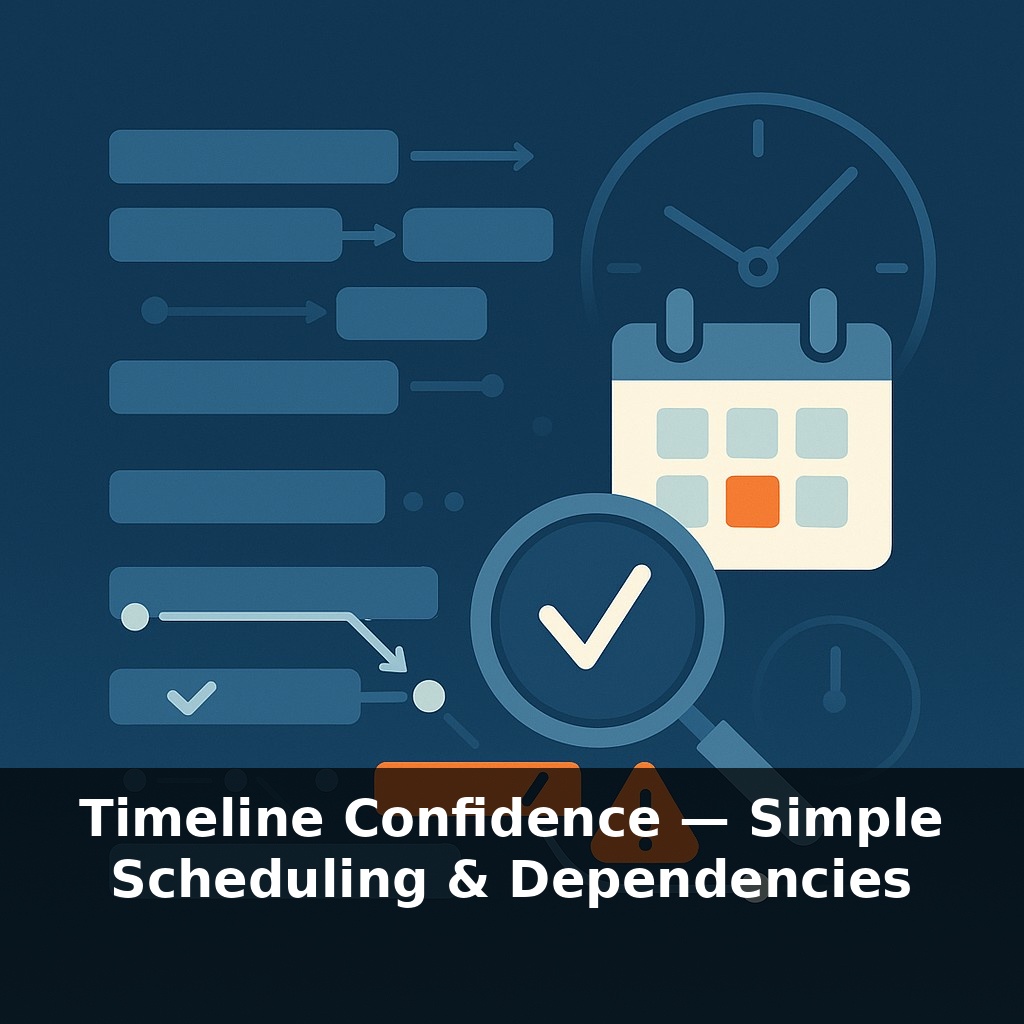
About two out of three projects miss their promised finish date, yet most teams still build timelines on gut feel. You’re in a status meeting, everyone nods at the calendar on the slide… and deep down, nobody believes it. Why do obviously shaky schedules survive unchallenged?
Only 31% of projects land on time, on budget, with the promised features. Yet most plans are still built from a mix of optimism, politics, and half-remembered past projects. In earlier episodes, we mapped stakeholders, clarified success, and broke work into concrete tasks. Now the question is: in what order does all that work actually happen, and how long will it really take?
This is where many teams quietly bluff. People give single dates instead of ranges. Dependencies are “assumed” instead of drawn. Buffers are hidden or, worse, silently deleted in the name of efficiency. The result is a plan that looks clean but behaves like wet paint: you touch one task, and everything smears.
In this episode, we’ll treat time as a single line and your tasks as movable units on it, so you can see which pieces truly drive your finish date—and where you actually have room to breathe.
Now that the big picture is on the table, we can zoom into the details that quietly decide whether your plan holds or unravels. Most teams stop at listing tasks and dates; they rarely question the *shape* of those tasks. Are they chunky “we’ll do the integration” blobs, or small enough that you can see where risk actually lives? Are estimates a single, fragile number, or a range that reflects real uncertainty?
Think of this step less like drawing a Gantt chart and more like tuning an instrument: tighten one string too much and something else goes out of tune. Our goal is a schedule that can flex without snapping.
Here’s how to move from “nice-looking plan” to “defensible timeline” without turning into a scheduling fanatic.
Start with the smallest useful unit of work. Take one deliverable from your breakdown and ask, “What are the concrete steps that move this from ‘not started’ to ‘done’?” Write those steps in verbs: “draft”, “review”, “revise”, “deploy”. If a step hides different skills, tools, or owners, split it. You’re hunting for tasks that are small enough to estimate in days, not weeks, but big enough that you’re not micromanaging hours.
Next, expose the real sequence. For each task, answer two questions: 1) What must finish *before* this can start? 2) What can run *in parallel* without stepping on toes?
Draw this, even if crudely. Boxes and arrows on a whiteboard beat a pretty but untested Gantt chart. When in doubt, ask the people who’ll actually do the work: “Could you start this if that slipped by three days?” Their hesitation is a clue that you’ve just discovered a dependency no one wrote down.
Once you can see the web, trace the longest chain from “kickoff” to “done”. That’s your actual constraint: the path where any delay moves your end-date. Many teams are surprised to find it doesn’t pass through the most expensive task, but through a modest activity with lots of predecessors and no slack.
Now layer in uncertainty. Instead of one number, get three for each task: optimistic, most likely, pessimistic. You don’t need fancy tools: a simple range forces people to say, “If everything goes right, five days; if it’s ugly, ten.” Tasks with huge spreads are where risk lives.
With ranges in place, decide where to place explicit buffers. Put them *on the path*, not scattered randomly. A visible buffer in front of a milestone is honest protection; hidden padding in every estimate makes trade‑offs impossible. Studies using Monte‑Carlo methods show that modelling these ranges can narrow your confidence window meaningfully; even without software, just knowing which dates are fragile changes how you manage.
Your schedule becomes less a promise and more a living model: tweak a single task, and you immediately see which follow‑ons wobble and which are safe to ignore.
When teams actually map this “string of work”, strange things surface. A marketing lead suddenly realises content can move ahead while legal reviews a separate piece. An engineering manager spots that two teams both booked the same testing environment, turning a quiet resource conflict into a visible fork in the road. These aren’t abstract issues; they’re concrete chances to shorten the path or reduce risk.
Think of how doctors sequence treatment: they don’t just list procedures, they decide what must happen before surgery, what can happen during recovery, and what only makes sense after test results. The power isn’t in the list, it’s in the order and spacing.
You can do the same by asking, for each step: “If this slipped a week, who else would feel it?” That question alone often reveals approval bottlenecks, vendor lead‑times, or quiet single‑points‑of‑failure—like the one database expert everyone secretly depends on. Once visible, you can design around them: stagger work, add backups, or renegotiate scope before the crunch actually hits.
Only about a third of projects land on time, on budget, and with the promised features. As AI tools mature, your “timeline string” becomes less static chart and more weather forecast: constantly updated as new data rolls in. Instead of guessing at buffers, you’ll test different routes through the work like flight paths around a storm. Leaders who treat schedules as living models—not one‑off commitments—will adapt faster, spot safer shortcuts, and justify dates with real evidence.
When you treat your plan like a draft, not a decree, you gain options instead of excuses. Patterns in slippages start to look like fingerprints: recurring wait times, habitual over‑committers, approval queues that move like rush‑hour traffic. Those clues aren’t just blame targets—they’re redesign opportunities for the *system* that keeps creating the same delays.
Try this experiment: Pick one real project on your plate this week (like “launching the new sales page”) and turn it into a dependency chain by listing each concrete step in the exact order it truly has to happen (e.g., draft copy → get feedback from Sam → finalize design → hand off to dev → QA → publish). Now open your calendar and assign each step a specific time block based on how long you realistically think it will take, then add one “dependency buffer” block after any step that relies on another person. As you go through the week, don’t change the original plan—instead, track where reality diverges (tasks taking longer, people being late, approvals slipping) and note exactly which dependency caused the delay. At the end of the week, adjust your default estimates and buffer sizes based on what actually happened, then rerun the same experiment on a new project with your updated numbers.