About half of projects still launch without a clear, written charter—despite evidence they’re far more likely to succeed with one. The result? Teams start running before anyone agrees where the finish line is, then act surprised when they cross in the wrong place.
Executives scan, they don’t study: at ~300 words per minute, they’ll give your proposal maybe two minutes of real attention. That’s why sprawling 20-page initiation decks quietly kill momentum—leaders can’t quickly see the essentials, so decisions stall. A sharp, one-page plan flips that dynamic. It compresses your core decisions into 400–600 words: who owns what, the key dates that matter, and the constraints you can’t break. Basecamp reports its one-page pitch cut approval cycles from weeks to just 48 hours; PMI data shows projects with an approved charter are 2.5× more likely to succeed. Yet many teams still bury these decisions across slides, emails, and chats. In this episode, you’ll learn how to build a single-page charter that leaders actually read, teams actually use, and you can update in minutes—not hours—when priorities inevitably shift.
Most teams either overbuild early documents or skip them entirely. One group I worked with had a 34-slide “initiation” deck; another ran a US$600k rollout from a single email thread. Both burned time on rework because nobody could see the same picture. The sweet spot is a one-page view that’s structured, not simplistic. That means naming trade-offs explicitly—scope vs. timeline vs. budget—in plain language. If your launch date moves, everyone should instantly see what shifts: features, cost, or quality. That clarity is the real reason a tight charter pays off in delivery.
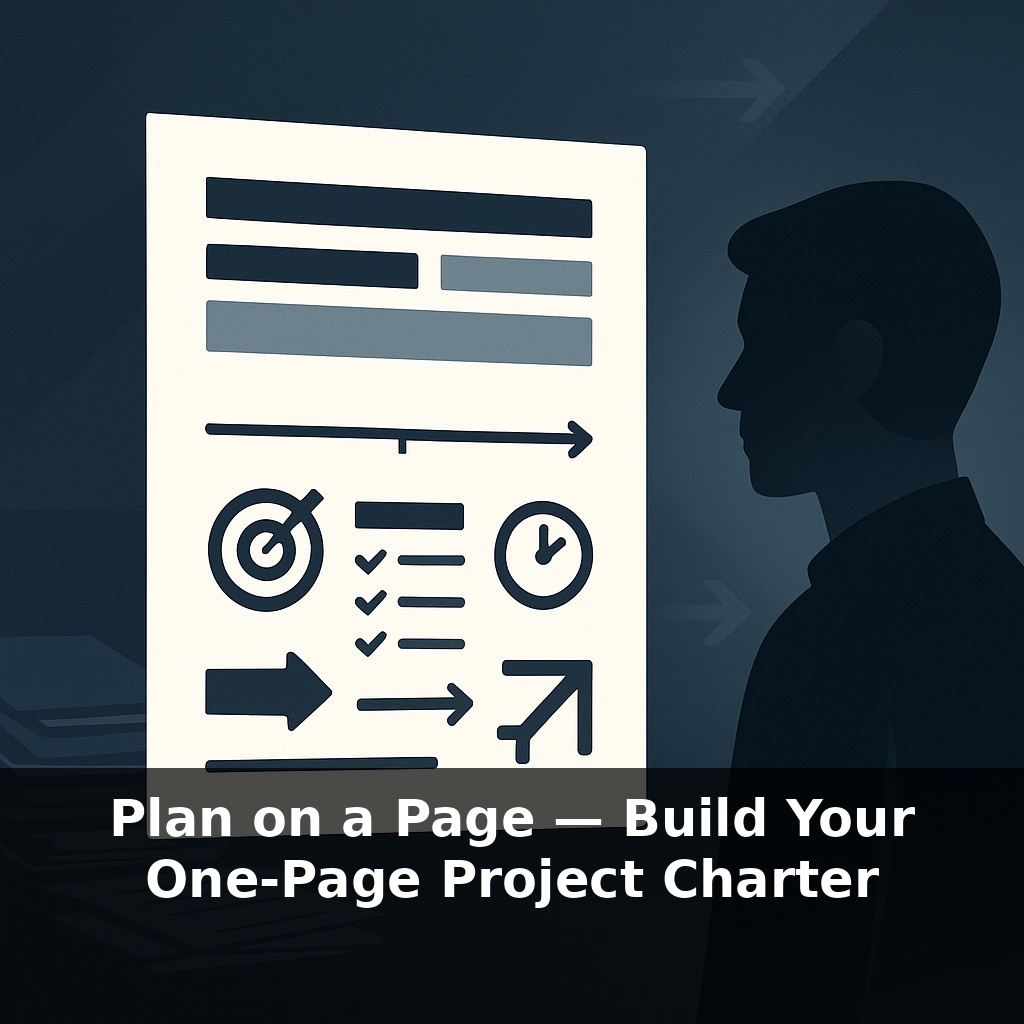
Start your one-page charter by forcing ruthless focus on five blocks: Purpose, Outcomes, Scope, Constraints, and Roles. Think of these as the minimum structural steel of your project—everything else is optional décor.
1) Purpose (1–2 sentences, ~30–50 words) Answer: “Why now, for whom?” Include a trigger (regulation change, churn spike, sales target). Example: “Reduce customer onboarding time by 40% before Q4 peak to prevent losing an estimated 300 high‑value accounts annually.”
2) Outcomes (3–5 bullets, each with a number) Outcomes are not activities. Tie them to metrics, time, or money. Example bullets: - Cut average onboarding from 10 to 6 days by 30 Nov 2026 - Lift NPS for ‘new customers’ from 32 to 45 by Q1 2027 - Avoid projected US$1.2M annual revenue leakage from early churn
If an outcome lacks a number, it’s still a wish.
3) Scope (In / Out table, max 5–7 rows) In-scope = what you will definitely deliver. Out-of-scope = what you explicitly won’t. Use short, testable phrases: - IN: New digital forms for SMB segment only - OUT: Enterprise onboarding redesign, CRM replacement, pricing changes
Scope rows become your main defence when requests creep in during execution.
4) Constraints & Assumptions (4–8 bullets) Separate what’s fixed from what you’re guessing: Constraints: - Budget capped at US$450k including vendors - Must ship minimum viable version before 15 Nov sales event Assumptions: - Legal review turnaround ≤ 5 business days - Existing SSO platform can handle 30% more load
Each assumption is a future risk candidate (link back to your risk radar work).
5) Roles & Governance (simple grid) Name 3–8 people, not departments. Columns: Role, Name, Decision Rights. Example: - Sponsor – VP Sales – approves scope changes > 10% impact - PM – You – owns plan, RAID log, weekly status - Tech Lead – owns solution design, technical estimates
On a separate line, define your decision forum in one sentence: “Biweekly, 30‑minute steering huddle: sponsor + PM + leads; decisions logged same day.”
Finally, cap the page with a single line for “Go / No-Go Signature & Date.” That one line quietly turns a neat summary into an authorising document that unlocks funding, people, and priority.
Spotify’s internal “squad” projects often start with a lean, written brief that fits on a single screen. One growth squad lead shared that moving from loosely defined launch emails to a 500‑word, structured starter doc cut their “are we actually doing this?” back‑and‑forth from ~15 Slack messages per person to 3–4, saving several hours per week during ramp‑up.
Try this structure in action. Suppose you’re leading a 3‑month, US$120k pilot to test a new self‑service support portal in one region. Your Outcomes might be: - Deflect 15% of tier‑1 tickets by week 10 - Hold CSAT ≥ 4.3/5 for assisted channels - Prove ≤ 6‑month payback on full rollout
Your Scope could explicitly include “English‑only knowledge base, top 25 issues” and exclude “phone system replacement, AI chatbots.”
Your challenge this week: take one active or upcoming project, and draft a one‑page charter limited to 550 words. Then, time how long it takes 3 different stakeholders to skim it and explain the outcomes and scope back to you in their own words. Adjust until all three give the same answer in under 3 minutes.
As AI tools draft charters from transcripts, your real edge will be refinement, not typing. Treat each draft as a hypothesis: tighten metrics, strip vague phrases, and cap at 600 words. In regulated work, expect auditors to sample 10–20 charters per year; sloppy wording will surface. For complex, cross‑domain projects, insist on one shared page before deeper docs—if 5 teams can’t agree on 500 words, they’ll definitely conflict over 50 pages later.
As you refine your page, stress‑test it with “failure previews”: write three ways the project could still waste US$50k–US$100k even with this charter. Maybe benefits are overstated, handoffs unclear, or timelines politically driven. Update names, dates, and numbers until those failure paths feel implausible, not probable.
Try this experiment: Pick one active project and force yourself to build its entire one-page charter in 25 minutes, using just these headings: Problem, Desired Outcome (with 1–2 measurable success metrics), Scope (in/out), Stakeholders, Constraints, and First 3 Milestones. Set a timer, ban yourself from opening old docs or slides, and fill it in from memory and instinct only. When the timer ends, send the one-pager to your core stakeholders and ask them two questions: “What did I miss?” and “What would you change?” Then compare their feedback to your original assumptions and note at least one way the project direction or scope needs to shift based on what you learned.