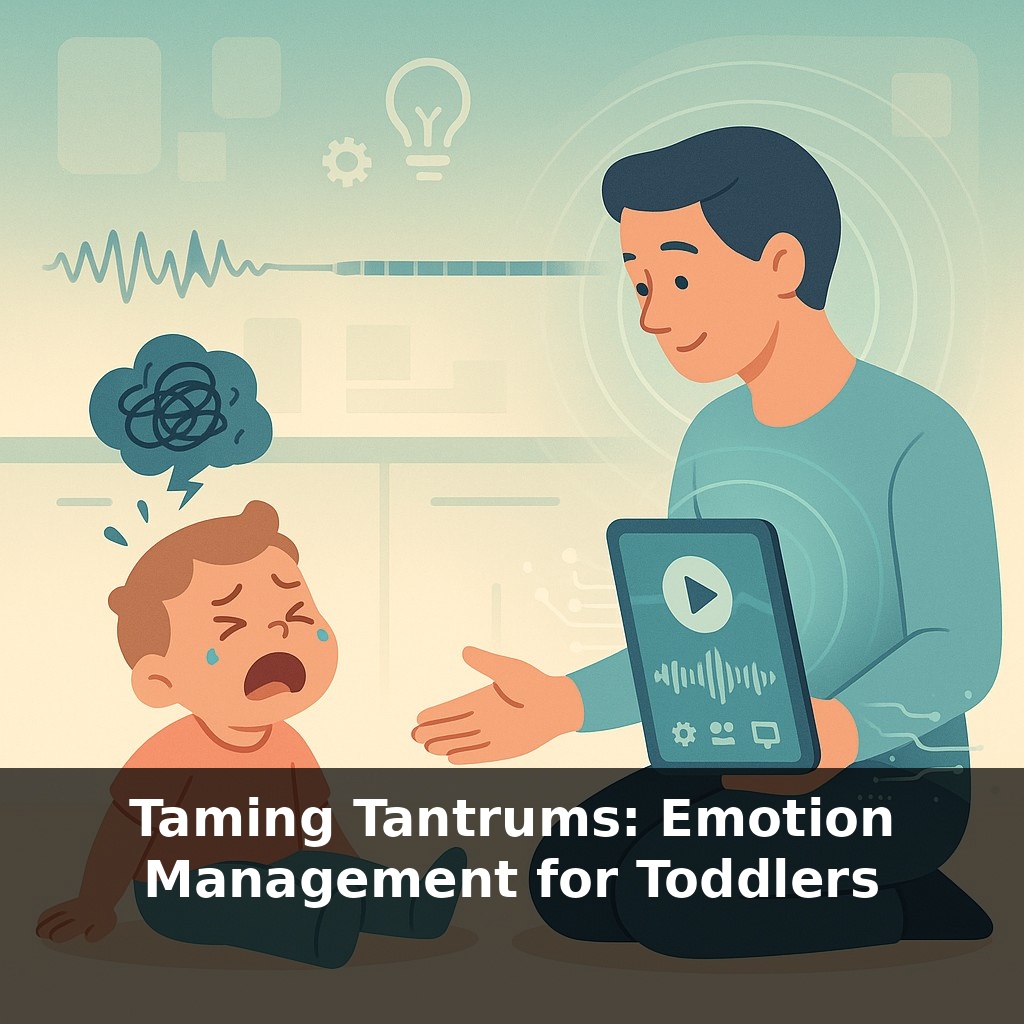
A toddler’s tantrum usually lasts just a few minutes—yet it can hijack an entire evening. Your child is screaming on the kitchen floor, you’re torn between snapping or giving in, and the tablet is right there. In this episode, we’ll turn that chaos into a plan you can actually use.
By age two, most toddlers have tantrums—but only about 8 out of 100 melt down every single day. That difference isn’t luck; it’s mostly about how adults respond in the hard moments. Studies following hundreds of families show that when parents use calm, structured responses, severe tantrums drop by roughly a third in just a couple of months. That’s the kind of change you can feel in your home routine: fewer 7 p.m. battles, faster recovery after “no,” less walking on eggshells around small frustrations. In this episode, we’ll move past just “getting through” the storm. You’ll learn how to spot early warning signs in under 10 seconds, what to say in 1–2 short sentences that actually helps, and how to practice simple, 3-step calming tools when your child is not triggered—so they’re ready when the next big feeling hits.
Many parents reach for quick fixes—distraction with a show, giving in “just this once,” or threatening punishments—to stop the yelling. Those tricks can work in the moment, but across 30 or 40 outbursts a month, they quietly teach your toddler which buttons to push. Studies of programs like Triple P show that when families consistently use predictable steps instead, intense behaviors improve within 6–8 weeks. That’s our focus now: shrinking the number of blowups and boosting your child’s recovery skills, using responses you can actually remember at 6 p.m. in the hallway or grocery aisle.
Step one is knowing when you’re dealing with a *typical* explosion versus something that needs extra help. Researchers find that most toddlers have between 1 and 7 outbursts a week. If you’re seeing more than 5 per day, episodes lasting over 15 minutes, or any self-harm (head-banging, biting themselves hard, hitting until bruised), that’s your cue to talk with your pediatrician or a child psychologist—don’t wait to “see if they grow out of it.”
Inside the normal range, your leverage point is *how* you respond in the first 60 seconds. Studies of parent–child interactions show that when adults go straight to scolding or debating, the outburst often spikes and lasts longer. When adults do three things—get low, say less, and name the feeling—kids de-escalate faster.
You can think in terms of a simple script you repeat the same way, every time:
1. **Position:** Move to your child’s level. If you’re more than 2 meters away, close the gap unless it’s unsafe. 2. **Words:** Use one feeling word and one reason: “You’re mad because I turned off the show.” Keep it under 10 words. 3. **Boundary:** Add a short limit: “It’s OK to be mad. Not OK to hit.”
That’s usually enough talking for the early storm. Many parents accidentally deliver 100+ words in 30 seconds—lectures the toddler’s brain can’t use. Aim for 1–2 sentences, then silence. Count 20 slow seconds in your head before you add anything else.
Next, offer a *tiny* choice to give back a sense of control without changing the limit. Research on compliance shows that two options work better than open-ended questions:
- “Do you want to stomp on the pillow or squeeze your bear?” - “Drink water or take a snack break first?”
Keep choices concrete and immediate; avoid anything more than 5 minutes in the future.
Later, when everyone’s calm (ideally within 30–90 minutes), do a 2-minute “replay”:
- Label the feeling once. - State the limit once. - Practice one alternative: “Next time you’re that mad, we can stomp 10 times together.” Then actually stomp 10 times.
Repeated across 20–30 outbursts over a month, this short replay is what wires the new habit. It’s not about perfection; if you hit even 60–70% consistency, the data from programs like Triple P suggest you’ll still see a clear drop in severe episodes.
On Monday, your toddler screams because you poured the wrong color cup. Instead of fixing it, you say one feeling word, one reason, one limit, then stop. By Friday, the trigger is a broken cracker; you follow the same 3-step script, then add a tiny choice: “Jump on the spot or squeeze my hands?” After about 10–15 consistent uses, many parents notice intensity dropping from a “10” to a “7”—still loud, but shorter and less wild.
Think of it like adjusting a recipe: change one thing, then repeat. You wouldn’t swap 5 ingredients at once and hope for the best; you’d tweak the salt, taste, and keep what works. Do the same here:
- Choose 1 trigger (transitions, sharing, or “no”). - Use the same 3-step script for that *one* trigger for 7 days. - Track start and end times on your phone; aim for a 1–2 minute reduction over 2 weeks.
Your “win” isn’t zero outbursts; it’s a clearer pattern and a child who comes back to calm faster.
As tech catches up, expect home support to look very different. In the next 5–10 years, you may tap an app, type “screaming over blue cup,” and get a 3-line, research-based script in under 3 seconds. Some pilots already pair this with 24/7 coach access. Add wearables tracking heart-rate changes of 10–15% to flag rising stress before eruptions. At scale, if just 20% of families use such tools, schools could see thousands fewer behavior referrals per district each year.
Your challenge this week: pick one daily flashpoint—bedtime, getting in the car, or putting away toys. For 7 days, change just *one* thing: your first 10 words. Prepare a single sentence (“You’re upset; it’s time for ___, I’ll help”) and use it every time. Note how many minutes it takes to settle. If it drops by even 2 minutes by day 7, you’re reshaping your child’s stress wiring.