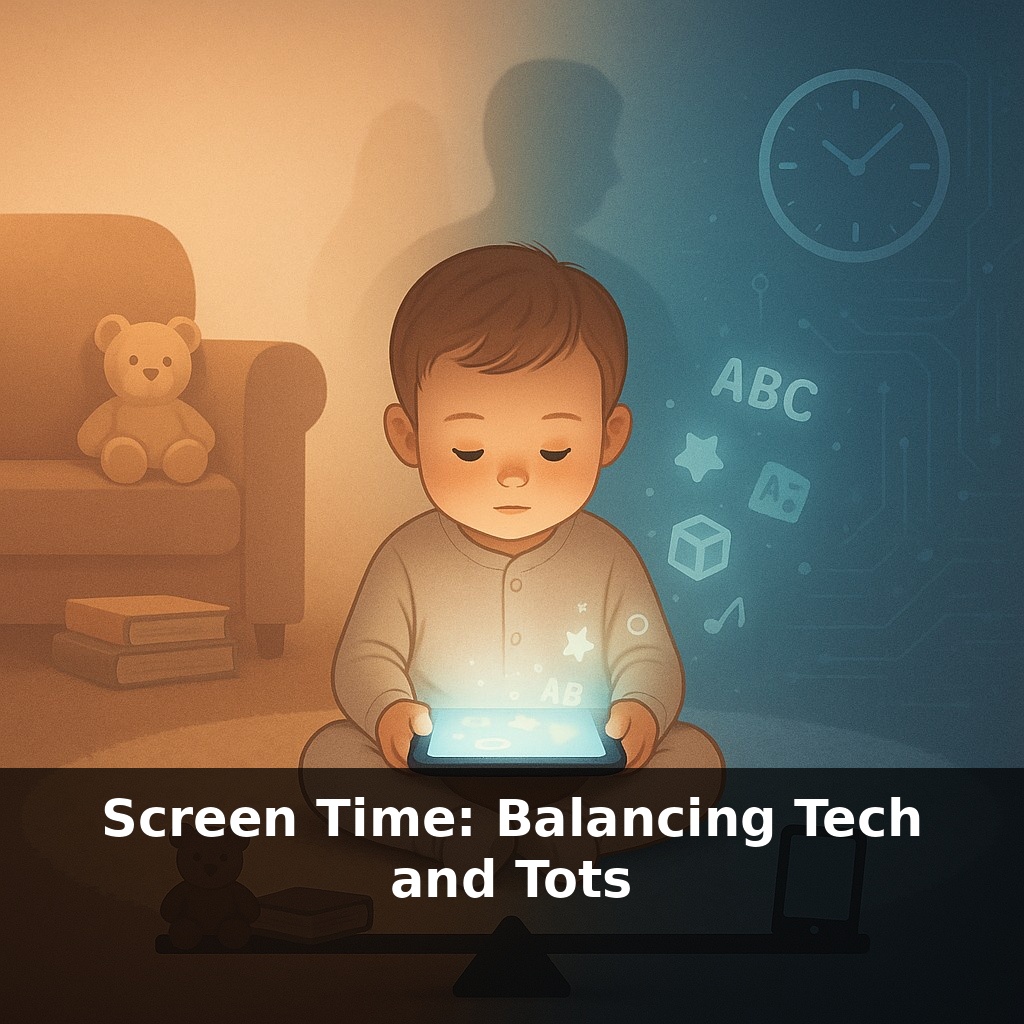
One major health organization says babies should have no screen time at all—yet many toddlers now spend more hours on devices than in their parents’ arms. A sleepy child, a glowing tablet, a quiet house: is this peaceful progress, or a trade we don’t fully understand yet?
“Sesame Street” once boosted preschoolers’ literacy scores by more than five percentile points—through a TV show. Yet the same type of glowing screen, left to autoplay cartoons all afternoon, is tied to language delays and restless sleep. How can the same device act like a helpful tutor at 9 a.m. and an over-tiredness trap by 9 p.m.?
In most homes, the tablet or TV isn’t a villain or a hero; it’s more like a very powerful spice in the family recipe. A pinch, added thoughtfully, can bring out new flavors in your toddler’s curiosity. A heavy shake, at the wrong time, can overpower everything else on the plate—play, conversation, cuddles, even sleep.
So in this episode, instead of asking “screens: yes or no?” we’ll ask sharper questions: When? What? With whom? And what might they be quietly replacing in your child’s day?
Some parents hear “no screens under two” and feel instant guilt; others shrug and pass the tablet back anyway because laundry, emails, and siblings still exist. Real life isn’t a lab, and most families live somewhere between “always on” and “tech-free.” What research actually shows is less about being perfect and more about patterns: when screens sneak into meals, push bedtime later, or replace chats in the stroller. The goal isn’t a rigid rule, but a clearer map: where do screens fit smoothly into *your* routine, and where are they quietly crowding out the moments your toddler’s brain needs most?
Researchers keep circling back to two things that shape outcomes far more than the device itself: **content quality** and **human connection.** Not whether a toddler saw a screen today, but *what* they saw and *who* they were with when they saw it.
On quality, think less about the label “educational” and more about how the program behaves. High-quality content moves slowly enough for a young brain to follow, uses clear language, repeats key ideas, and shows faces and emotions your child can actually copy. Characters pause to ask questions and then wait, giving space for your toddler to answer out loud. Many apps and videos marketed as “brain boosting” skip these basics; they flash, bounce, and reward tapping, but teach very little that transfers off-screen.
Then there’s **context.** When a parent sits nearby, names what’s happening, and links it to real life (“That’s a triangle, like your block”), the screen becomes a springboard to conversation. Studies suggest that this kind of co-viewing can soften a large chunk of the attention and behavior issues tied to heavy device use. Without that back-and-forth, toddlers often slip into passive watching—quiet in the moment, but missing the serve-and-return interactions their brains expect.
Timing also matters. Not all hours of the day are equal. Screens packed into transition moments—waking up, meals, just before sleep—tend to echo into the rest of the day: harder bedtimes, more protest when devices turn off, fewer chances for boredom to blossom into pretend play. Mid-morning or early afternoon, after movement and snacks, is usually a better fit than right before naps or nighttime.
And finally, watch what screens **replace.** A 20‑minute show while you cook might be a survival tool. Three hours that crowd out playground time, messy art, or chatting in the bath start to tip the balance. Like a family budget, you’re not just counting total minutes—you’re deciding which “expenses” are worth it, and which quietly drain resources you’d rather spend on play, sleep, and conversation.
A toddler staring at a cartoon alone may look calm, but peek closer at *how* they’re using it. Are they silently soaking in fast, chaotic scenes, or pausing to answer a character’s question while you echo their words? One child taps mindlessly through videos; another re-enacts a scene later with stuffed animals, inventing dialogue. Same device, very different brain workout.
Think of your options like designing a small learning “portfolio.” You might “invest” ten minutes in a slow, story-driven show, five in a video call with Grandma counting toy cars together, and skip the flashy app that winds your child up. A rainy afternoon could mean recording your toddler “hosting” their own cooking show with toy food, then watching it back and naming their actions. Even background choices matter: a music playlist with simple lyrics can invite dancing and singing, while constant chatter from a TV in the next room pulls attention away from block towers and picture books without anyone pressing play.
Soon, “no screens” may be impossible, even in toddlerhood. Nursery toys will respond to your child’s voice, walls might project AR story worlds, and AI assistants could join pretend play like an extra sibling. The real frontier becomes *how visible* these systems are. Will parents see clear “nutrition labels” for digital play, or hidden algorithms nudging attention like quiet puppeteers? Your future role may be less gatekeeper, more coach—helping your child learn *why* and *when* to tap, not just *what* to tap on.
So rather than chasing a perfect number of minutes, you’re really curating *moments*: a silly dance-along while pasta boils, a short video call to show Grandpa a block tower, then plenty of unplugged mud pies and blanket forts. Over time, your child learns not just to consume media, but to choose it—like reaching for water after cake, because it simply feels better.
Before next week, ask yourself: Which specific screen moments with my child this week felt genuinely positive (like laughing together at a favorite show or exploring an educational app) and what made them feel different from the “zombie scroll” times? When I need to rely on screens—for cooking, work calls, or a meltdown reset—what clear boundary could I test (for example, choosing one 20-minute show instead of background TV all evening)? Looking at our day tomorrow, where could I swap just one default screen moment (like cartoons during breakfast or in the car) for a simple connection ritual instead—maybe a 5-minute story, a song, or a quick game of “I spy”?