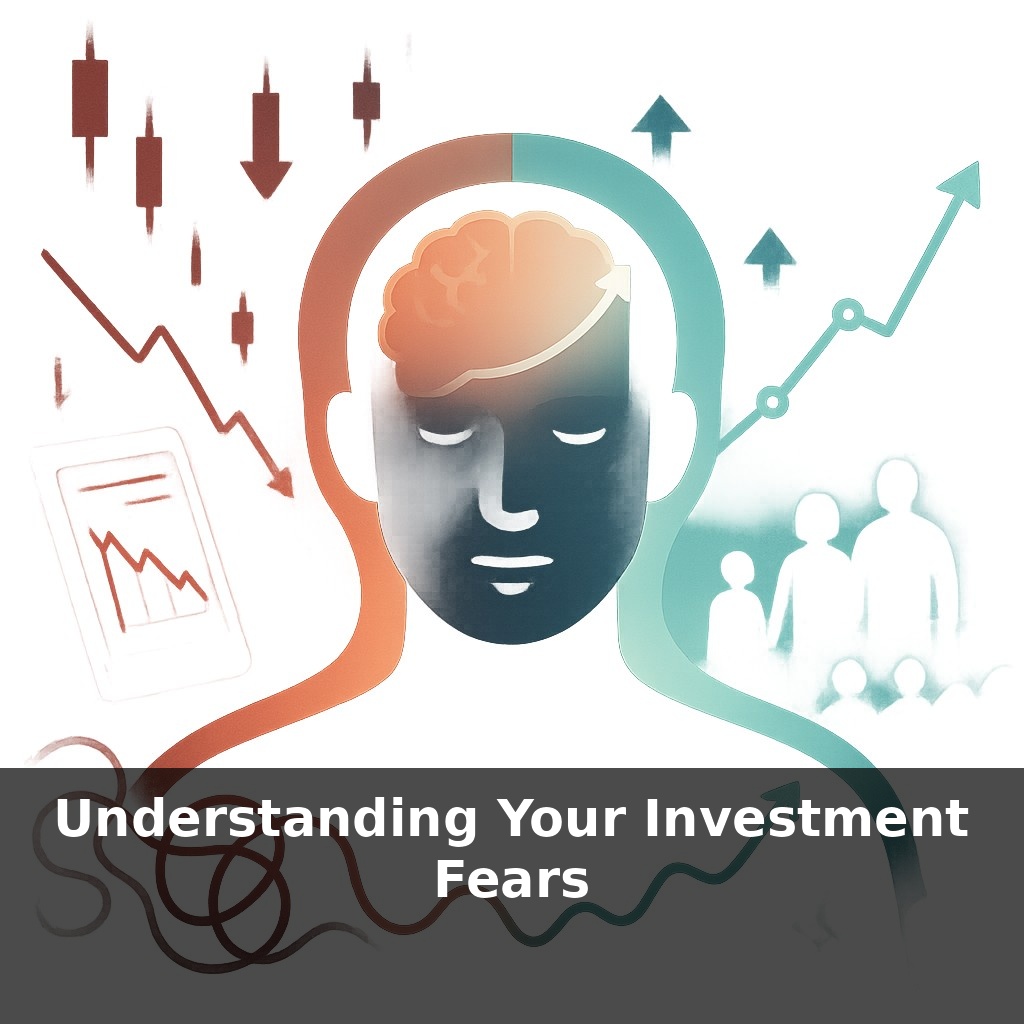
Understanding Your Investment Fears
📝 Transcript
Most people lose more money from fear than from bad investments. A trader freezes as prices flash red. A parent postpones starting a simple index fund yet again. Here’s the twist: their brains are doing exactly what they were built to do—just in the wrong century.
So if your brain is doing what it was built to do, why does investing still *feel* so wrong, so often? Part of the answer is that money isn’t just numbers on a screen; it’s tangled up with identity, security, and even family history. A market dip can stir memories of a parent’s job loss or a business that failed, turning a routine fluctuation into a personal alarm bell. Social media amplifies this: a few scary headlines, a viral chart, and suddenly it feels like “everyone” is bracing for disaster. The result is a constant background noise of urgency—act now, move to cash, do *something*. In this series, we’ll zoom in on those moments when your stomach tightens and your cursor hovers over the “sell” button, and we’ll translate that discomfort into specific signals you can understand, anticipate, and eventually use to your advantage.
Think of this as learning a new language: at first, every headline sounds urgent, every chart looks like a warning. What we’re really decoding is how evolution, stories, and noise collide whenever you move money. Your brain stores past shocks—news crashes, layoffs you watched, warnings from people you trusted—and quietly uses them as a “danger dictionary” for every new market move. On top of that, social circles act like group chats that never mute, constantly forwarding worst-case scenarios. Before we can change your choices, we need to map this whole environment with a colder, clearer lens.
Here’s the uncomfortable part most people never get told: your *fears* about investing are often more detailed and vivid than your *knowledge* about investing itself. That imbalance quietly puts fear in charge.
When you think about “losing money,” your mind usually jumps to one of three mental movies:
- the sudden crash (everything falls fast) - the slow bleed (it never seems to recover) - the missed chance (you waited, then it ran without you)
Each of these is powered by a different bias.
With loss aversion, your mind zooms in on pain. A 20% drop in your account doesn’t just feel like a number; it feels like a verdict: “You were wrong.” Your brain magnifies that possibility so much that a very normal outcome—temporary declines—starts to look like catastrophe. That’s one reason the average investor trailed the market by several percentage points for decades: the “get me out” impulse kept winning.
Availability bias works differently. It doesn’t care how *likely* something is; it cares how *memorable* it is. You remember the friend who “got wiped out” in 2008, the headline about someone delaying retirement, the tweet storm predicting doom. Quiet recoveries and boring, compounding returns leave almost no emotional trace, so they don’t show up in your mental risk calculations.
Then there’s social proof. If enough people around you act scared, it starts to feel rational to be scared—even if nothing in your personal plan actually changed. Selling after a drop can feel less like a mistake and more like “being responsible” when everyone else is doing it too.
Your goal isn’t to silence these reactions; that’s not realistic. Your goal is to *tag* them correctly. “This spike of anxiety is my brain’s loss aversion talking,” is very different from, “This spike of anxiety means the market is about to collapse.”
One way to think about it: your emotions are like the notification system on your phone—loud, sometimes useful, often badly configured. The work ahead is not to turn the phone off, but to choose which alerts deserve your immediate attention and which can be safely swiped away.
A useful next step is to notice *where* fear sneaks into your actual decisions. For some people, it shows up as endlessly “researching” but never funding the account. For others, it’s checking prices 12 times a day and tweaking tiny things that don’t move the needle. Think of a home cook who keeps opening the oven every two minutes to “make sure” the cake isn’t burning; the constant peeking makes the outcome worse, not better.
Concrete example: one investor sets up automatic monthly contributions and only reviews their plan quarterly. Another reacts to every sharp headline by logging in and second‑guessing. Over ten years, the first person may barely recall specific swings; the second can recount every scare in detail—but often with less progress to show for it.
Notice too how context changes your reactions. A drop in a small “experiment” account feels intriguing; the same percentage move in a retirement account feels intolerable. That gap is a clue about which stories you’ve attached to each dollar.
As tools evolve, you may soon see apps that flag “emotional hot zones” the way maps show traffic—highlighting moments you’re most prone to overreact. Some platforms already hint at this by nudging long‑term views instead of flashing intraday moves. Over time, you’ll be able to customize your “emotional settings,” like muting certain alerts, so your future self interacts with money more like a calm editor than a frantic first‑draft writer.
As you notice these reactions, you’re quietly drafting a user manual for your future self. You’re learning which headlines jolt you, which balances calm you, which stories tighten your chest. That awareness is like debugging code: every bug you find now reduces the odds you’ll crash the system later—right when staying online matters most.
Try this experiment: Pick one stock or fund you already own that makes you anxious when it moves and set a “worry threshold” (for example, a 5% drop in a day). For the next two weeks, any time it crosses that threshold, don’t touch it—instead, log exactly what you feared would happen (“It’s going to keep crashing,” “I’ll miss my chance to get out”) and what actually happened 24 hours later and 7 days later. At the end of the two weeks, look back over your notes and compare your fear predictions with the real outcomes to see how often your worst-case scenarios came true versus how often the market or your investment stabilized.
From this course
Rebuilding Your Investment Confidence
5 episodesUnlock all episodes
Full access to 5 episodes and everything on OwlUp.
Subscribe — $1.99/monthLess than a coffee ☕ · Cancel anytime