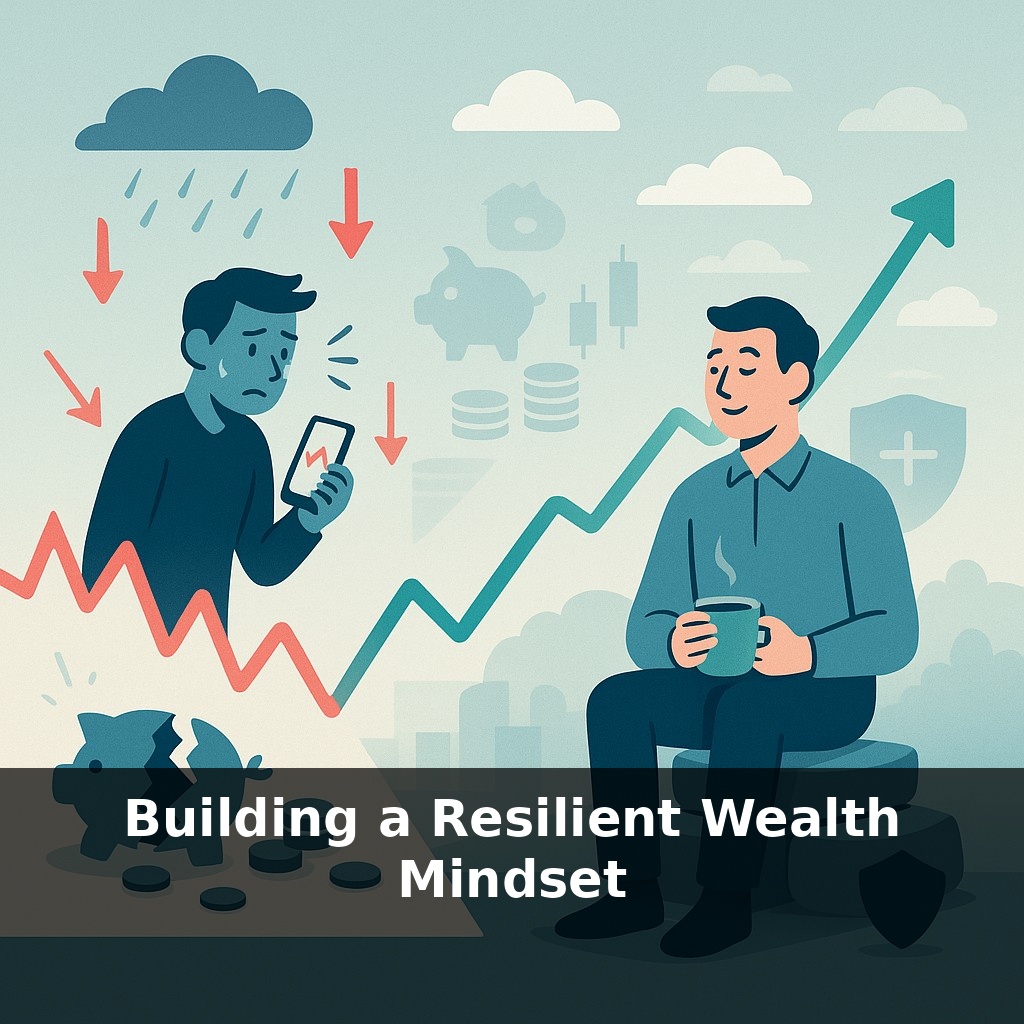
About a third of adults in the U.S. can’t handle a few hundred dollars of surprise expense in cash. Now, picture two friends: one checks their investments daily and panics with every dip; the other barely looks. Strangely, it’s usually the calm one who ends up wealthier.
Here’s the twist most people miss: resilience with money isn’t built during calm markets—it’s built in advance, so you don’t fall apart when things get rough. The data is brutal: from 1926 to 2022, U.S. stocks delivered about 10% a year before inflation, yet many real investors earned far less, not because markets failed, but because they bailed out at the wrong time and never fully got back in. Miss just a handful of the strongest rebound days each decade and you lose roughly half your potential return. In this episode, we’ll shift your focus from trying to outsmart the market to upgrading the only system you truly control: your own decision-making. You’ll learn how long-term thinking, planned risk, and emotional rules can keep you participating when it matters most—and how to start wiring those habits into your daily financial life.
So where does a resilient wealth mindset actually start? Not with charts or forecasts, but with buffers and systems. A 2022 Fed survey showed 32% of adults couldn’t cover a $400 emergency in cash—that’s the kind of fragility that forces people to sell investments at the worst possible time. Contrast that with an automatic transfer of even $50 a week: in one year, that’s $2,600 of shock absorber you don’t have to think about. Layer on low-cost index funds with expense ratios under 0.10%, and you’re quietly keeping thousands more over decades—without needing to predict a single headline.
Resilience at the portfolio level starts with one idea: expect specific bad things to happen, and pre-design how you’ll respond. Not “if markets fall someday,” but “when my stocks drop 30%, here is exactly what I do.”
Step one is defining your risk capacity with numbers, not vibes. Two questions:
1. Time: “When is the earliest year I might need this money?” 2. Tolerance: “What drawdown, in dollars, would make me lose sleep?”
Suppose you’re investing $1,000 a month, aiming for 20+ years. At a 7% real return, that’s roughly $520,000 in today’s dollars. A 30% drop then is about $156,000 on paper. Many people say “I’m aggressive” until they imagine that number disappearing from a statement. If the idea of a $50,000 drop already feels unbearable, your equity share is probably too high.
Now translate that into allocation. A simple example:
- 60% global stocks - 30% high-quality bonds - 10% cash-like or short-term bonds
From 2000–2022, U.S. stocks alone saw drawdowns over –50% twice. A 60/40 mix historically cut that about in half. If a $100,000 all-stock account might fall to $50,000 in a severe crash, a 60/40 version might fall closer to $70,000–$75,000. Still painful, but far less likely to trigger panic.
Diversification isn’t about owning more line items; it’s about owning things that behave differently. For instance:
- In 2008, long-term U.S. Treasuries gained over 20% while the S&P 500 lost 37%. - In March 2020, some bond funds held steady or even rose while stocks plunged over 30% in weeks.
A practical rule: for every $10,000 you invest, decide in advance what maximum temporary loss you’ll accept—say $2,500. Then back into a mix that historically stayed within that band most of the time. You won’t be perfect, but you’ll be intentional.
Finally, pair the mix with behavior rules triggered by numbers, not news. For example:
- “If stocks fall 20% from their peak, I increase my monthly contribution by 10%.” - “If my bond share drifts 5 percentage points from target, I rebalance once that month, and only then.”
These pre-commitments turn volatility into cues for action instead of reasons to freeze. Over years, that’s what lets you keep collecting the returns others talk themselves out of.
Consider two investors, both earning $80,000 a year and investing $1,000 a month.
Investor A builds a simple policy: “30% of my contributions go to bonds until I’ve saved six months of expenses; then I move new contributions to stocks.” With $3,000 monthly expenses, that’s an $18,000 target. At $300 a month into bonds, they hit it in about 5 years, ending with roughly $20,000–$21,000 there (assuming modest growth) plus about $36,000 in stocks.
Investor B “plays it by ear,” putting the full $1,000 into stocks unless markets feel scary. In strong years, they chase hot funds; in scary years, they stop contributions entirely. After the same 5 years, they might still have around $50,000–$55,000 total—but with no clear safety pool and no rules for what happens next.
The gap isn’t the return; it’s the structure. Precise percentages and dollar targets give Investor A a script when conditions change, instead of improvising under stress.
As AI tools mature, expect “autopilots” for money decisions that adapt faster than human willpower. A system could detect you doomscrolling during a –15% drop and suggest: “Pause. If you sell now, you lock in a $12,000 loss that historically recovered in 3–7 years.” Schools and employers may soon bundle these tools: for example, defaulting new workers to a 15% savings rate, auto-escalating 1% yearly, and nudging them only when behavior drifts from their own rules.
Start small and specific. Pick one account—say a brokerage with $12,000—and write a 3-line policy: target mix (e.g., 70% stock/30% bond), max loss you’ll tolerate this year (e.g., $2,400), and one action if it’s hit (pause changes for 7 days). Systems like this, repeated across 3–4 accounts, quietly upgrade how your entire net worth behaves.
Here’s your challenge this week: Block 30 minutes today to run a “stress test” on your money by listing your *actual* recurring expenses and then cutting one subscription or downgradeable service that you could live without for three months. Next, set up an automatic transfer—no matter how small—into a separate “Resilience Fund” account that you commit not to touch for 90 days. Finally, choose one fear-based money thought that comes up most often (like “I’ll never catch up” or “I’m bad with money”) and, every time it appears this week, replace it out loud with a specific, empowering version (for example, “I’m learning to build a buffer and I just funded my resilience account today”).