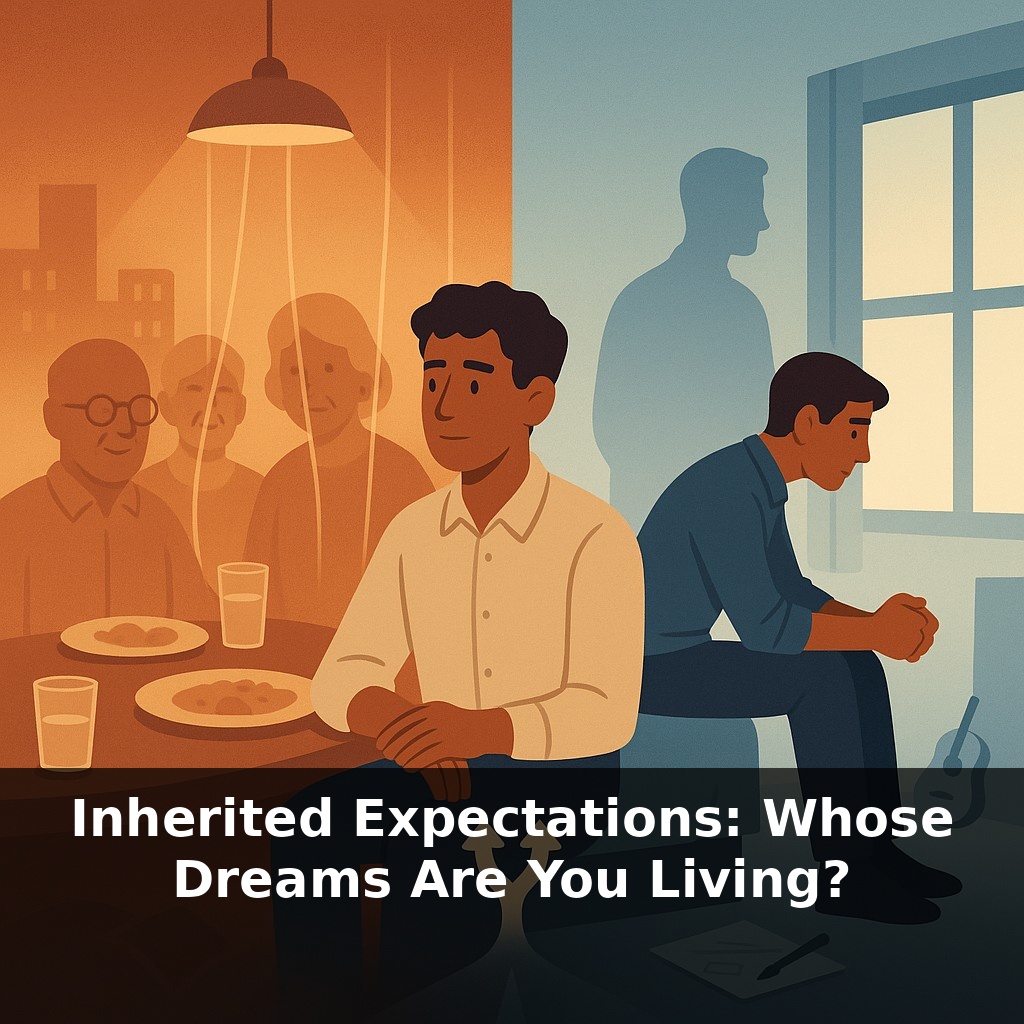
About half of workers say they “fell into” their career. Now, pause on that. In one scene, you’re at a family dinner, nodding as relatives praise your “stable path.” In another, you’re alone, wondering: if no one had an opinion about my job, would I still choose this life?
Maybe your story didn’t “just happen”—maybe it was drafted for you. Research shows that what we choose to study and where we work often echo the unspoken rules of our upbringing: “real jobs look like this,” “success sounds like that.” These messages aren’t always barked as orders; they seep in through praise, raised eyebrows, and the quiet comparison to cousins who are “doing so well.”
At school, friends and trends add new layers: certain majors become shorthand for status, creativity, or security. By the time you sign your first contract, it can feel less like a decision and more like following a well-worn path.
In this episode, we’ll explore a simple but unsettling question: when you strip away family, peers, and culture, how much of your professional life is actually yours—and how much is inherited script?
Some clues are loud: “In this family, we…” followed by a clear directive. Others are barely audible—who gets celebrated at holidays, whose news gets glossed over, which careers earn a long silence and a quick subject change. Over time, these signals stack up like little post-it notes on your choices: “Smart,” “risky,” “selfish,” “impressive.”
Add in peer reactions—who gets admired for their internship, who’s pitied for “wasting their potential”—and it’s easy to mistake external ratings for internal truth about what you’re “meant” to do.
Think of your work story as having three authors: you, your family, and the crowd around you. The tricky part is that only one of them signs their name.
Developmental research shows that by your mid-teens, you’re already carrying a mental shortlist of “acceptable futures” built from years of comments, examples, and reactions. That shortlist can feel like free choice, but it’s often pre-filtered: you don’t even consider paths that would trigger conflict, worry, or disappointment in the people who matter most.
Intergenerational patterns are one layer. If most people in your family do similar work, there’s usually an explicit message (“this is a good, solid path”) and an invisible one (“straying too far might mean you don’t belong here”). Even when nobody says anything directly, noticing who gets respect, financial help, or quiet disapproval teaches you where the invisible fences are.
Peers add a second layer, especially in late adolescence when your brain literally lights up more for their approval. At 15, a friend’s impressed “That’s so prestigious” or skeptical “Why would you do that?” can weigh more in your nervous system than your own curiosity. Later, workplace peers play a similar role: whole teams can drift toward burnout because “everyone” stays late, chases promotion, or job-hops for status.
Then there’s culture: stories in media about what a “successful life” looks like, which jobs are framed as noble, glamorous, or a fallback. These narratives don’t usually shout “Do this.” They just make some options feel normal and others feel like social risk.
None of this means you’re a puppet. It does mean your “gut feeling” about what’s right can be shaped by years of subtle conditioning. This is where autonomy comes in. Studies on autonomy-supportive environments show that when people feel they can question, modify, or even reject inherited plans without losing love or belonging, they later report more satisfaction and less regret—even when they choose conventional paths.
The goal isn’t to burn down everything you’ve inherited. It’s to sort it. Some passed-down dreams genuinely fit your interests and strengths. Others you might keep but tailor. And some, once examined, turn out to be more about someone else’s unresolved hopes than your own direction.
A useful test is to notice where your storyline feels strangely “predictable.” For instance, maybe you always assumed you’d “eventually move into management,” even though the days you feel most alive are when you’re solving technical problems alone. Or you catch yourself saying, “People like us don’t do X,” and can’t quite name who decided that.
Consider three quick lenses: First, look for family phrases that show up in your own thinking: “a proper job,” “wasting your talents,” “nice hobby, but…”. Second, scan your choices for moments you overruled excitement in favour of appearing responsible, impressive, or sensible to others. Third, notice where guilt appears: “If I left this path, I’d be letting them down.”
Inherited expectations are like a hand-me-down coat that’s already been broken in along certain seams: check where it pulls tight (strain), hangs loose (disengagement), or feels oddly heavy (obligation). Those pressure points often reveal whose dreams you’re actually carrying.
Some inherited expectations will soon be easier to spot. Subtle patterns in your choices, language and online behaviour can be analysed by AI tools that flag when you’re echoing family scripts more than personal motives. You might see prompts like: “You light up describing mentoring, yet you avoid roles without clear prestige.” Treat these tools less like oracles and more like mirrors that reveal blind spots, so you can choose which expectations to keep, adapt, or quietly retire.
Now the question shifts from “Whose script am I following?” to “What do I want to add, rewrite, or cut?” You don’t need a dramatic plot twist; small edits count. Testing one new task, one new conversation, or one new boundary can reveal fresh lines for your story—lines that sound less like an echo, and more like your own voice.
To go deeper, here are 3 next steps: (1) Read chapter 1–3 of *The Defining Decade* by Meg Jay with this lens: highlight every goal that sounds like something your parents, culture, or community would applaud, then underline what actually sparks curiosity or relief in you. (2) Print or download the free “Life Values Inventory” (lifevaluesinventory.org) and complete it start-to-finish, then circle the 5 values that most *conflict* with how your family measures success—those are your starting points for redefining whose dreams you’re living. (3) Watch Alain de Botton’s TED talk “A Kinder, Gentler Philosophy of Success” and, as you listen, pause twice to jot down one career/relationship choice you’d make differently if no one ever judged you; bring those two examples into your next therapy session, coaching call, or a trusted-friend conversation to reality-check what living your own script could look like this year.