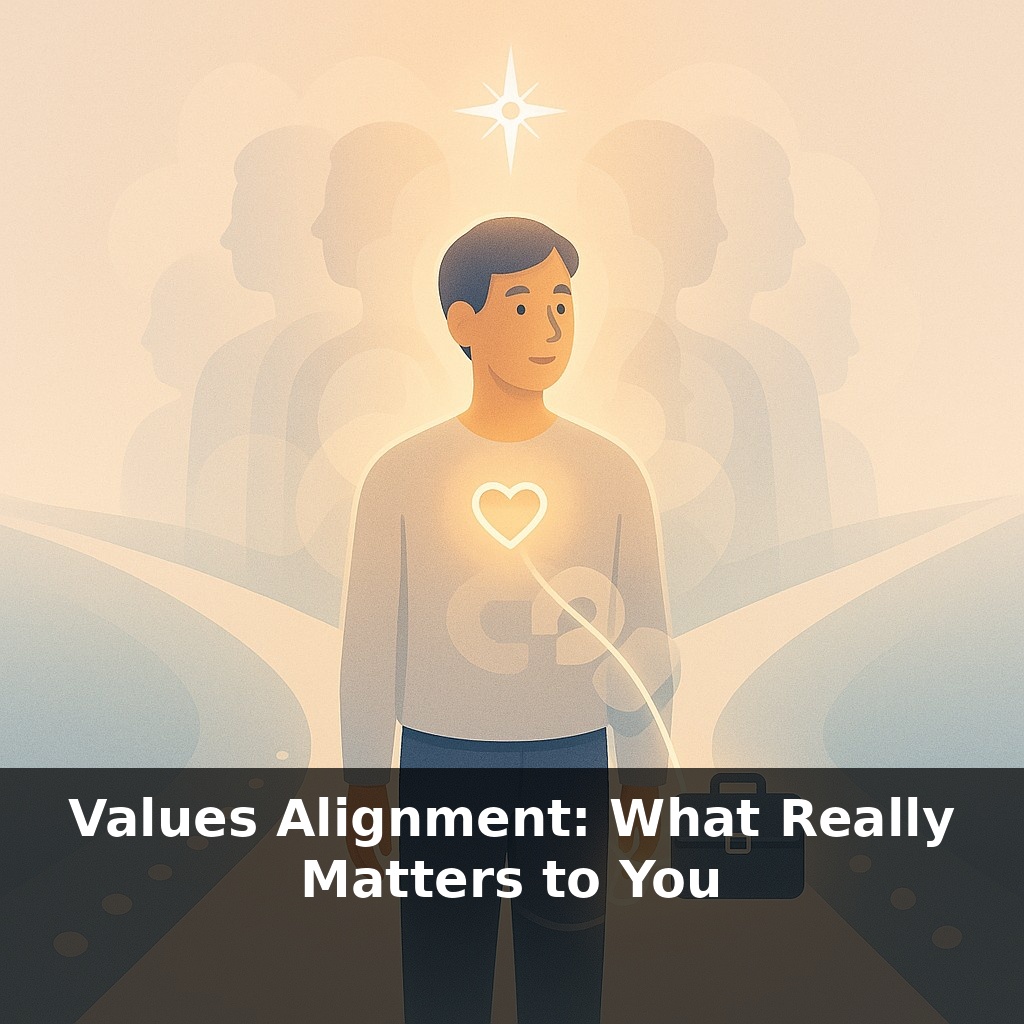
About half of working adults can’t name their top values on the spot—yet those who feel their company’s purpose truly matters are several times more engaged. In this episode, we’ll step into that gap and explore what changes when your work finally lines up with what you care about most.
Values don’t just sit in a journal or on a poster—they quietly steer thousands of micro‑choices you make every week: what you say yes to, what drains you, what you procrastinate, and where you feel oddly alive even on a long day. The tricky part is that most of this happens just below conscious awareness, so it can feel like “random” motivation spikes and energy crashes. In reality, your nervous system is constantly scanning: *Does this matter to me or not?* When the answer is yes, your focus tightens; when it’s no, you feel that subtle disengagement or even resentment. Over time, those tiny nudges shape your career far more than any five‑year plan. In this episode, we’ll surface that hidden pattern, so you can see the through‑line in your best days at work—and start using it on purpose, instead of by accident.
Most people don’t discover what really matters by filling out a worksheet; they notice it in the oddest places. The project you volunteered for even though your calendar was full. The late‑night rant to a friend about “how things *should* be done.” The task you’ll protect from meetings, notifications, and interruptions. These are clues, not quirks. Research shows that when these clues line up with your role, stress hormones drop and performance rises—not because you “tried harder,” but because your brain stops wasting energy pretending to care. Our goal now is to trace those clues backward until your priorities become unmistakable.
If you strip away job titles, salaries, and LinkedIn headlines, most people are driven by a surprisingly small set of priorities: things like growth, stability, fairness, creativity, contribution, autonomy, belonging, or impact. These aren’t slogans; they’re the criteria your brain uses to label an experience as “worth it” or “why bother.”
One way to see them is to follow the trail of **strong reactions**—where you felt unusually lit up or unreasonably annoyed.
Think about three kinds of moments:
1. **Peak days.** Times you finished work and thought, “I could do more of this.” Not just because something went well, but because it *felt* right. Maybe you spent hours mentoring a junior colleague and lost track of time. That points to values like growth or service. Maybe you simplified a messy process and felt oddly proud. That hints at order, efficiency, or craftsmanship.
2. **Non‑negotiable lines.** Situations where you felt, “I can’t do it that way,” even if everyone else seemed fine. Declining to smooth over a misleading sales pitch may signal integrity or honesty. Refusing to email all weekend might reveal a value around health or family, not just “laziness” or poor time management.
3. **Jealous admiration.** People whose careers you envy—but for *specific* reasons. One person might admire a friend who works remotely from anywhere (autonomy), while another fixates on someone embedded in a tight‑knit team (belonging). The envy is information, not a flaw.
Here’s where many people get stuck: they confuse **goals** (get promoted, earn X, lead a team) with **reasons** (have more influence, feel secure, create things that last). Goals can be met and replaced; reasons tend to persist. When you name the reasons, you get far more flexibility in how to satisfy them. Leading a team, for example, is just one way to express a value of developing others; teaching, coaching, or designing training could work too.
It’s also easy to treat your current role as the only canvas. But alignment can come from **how** you work, not just **what** you do. A data analyst who values creativity might redesign dashboards or storytelling methods. A nurse who values learning may take on student supervision or quality‑improvement projects. Same job title, very different alignment.
And remember: mismatches don’t always mean you chose “wrong.” Sometimes they’re an early‑warning system that you’re ready for a different way of contributing—not a different you.
Think about your calendar as a bank statement—every “yes” is a withdrawal from what you say matters. If you claim you value creativity but your week is packed with status meetings and zero build time, that discrepancy is worth studying. One client in finance realized his best days weren’t on big deal closings, but during quiet hours modeling scenarios nobody asked for; the real draw was intellectual play, not prestige. Another, a product manager, noticed she lit up only when interviewing users. She didn’t need a new industry; she needed more time in discovery and less in slide‑making.
You can also listen for values in the stories you replay. Which memories do you bring up unprompted in interviews or with friends? The time you fixed a broken handoff between teams might point to a pull toward collaboration or systems. The moment you challenged a leader in a meeting—despite the risk—can reveal that protecting fairness or truth beats staying comfortable for you. Those stories are like highlighters on your internal rulebook.
As AI quietly takes over more routine tasks, what you choose to care about stops being “soft” and starts being strategic. Roles will split: some people will babysit systems; others will be trusted to decide *why* something matters. Think of it like weather fronts shifting—those who can read where their own pressure systems are moving will pick projects, teams, and industries that feel like a steady climate instead of living in a constant personal storm watch.
Treat this week like a test kitchen: tweak one small ingredient in how you work—a type of task, a boundary, a conversation—and notice which “recipes” feel more satisfying. You’re not locking in a life plan; you’re running experiments. Each honest reaction is data, slowly revealing the conditions under which you don’t just function, you actually thrive.
Try this experiment: For the next 24 hours, whenever you face a decision (what to eat, how to respond to an email, whether to scroll your phone, etc.), pause for 10 seconds and silently ask, “Which choice fits better with my top values: growth, connection, or integrity?” Then deliberately pick the option that best matches one of those three, even if it’s slightly more uncomfortable or inconvenient. At the end of the day, score each decision from 1–5 on how aligned it felt in hindsight, and notice where choosing values over autopilot changed your mood, energy, or sense of pride in yourself.