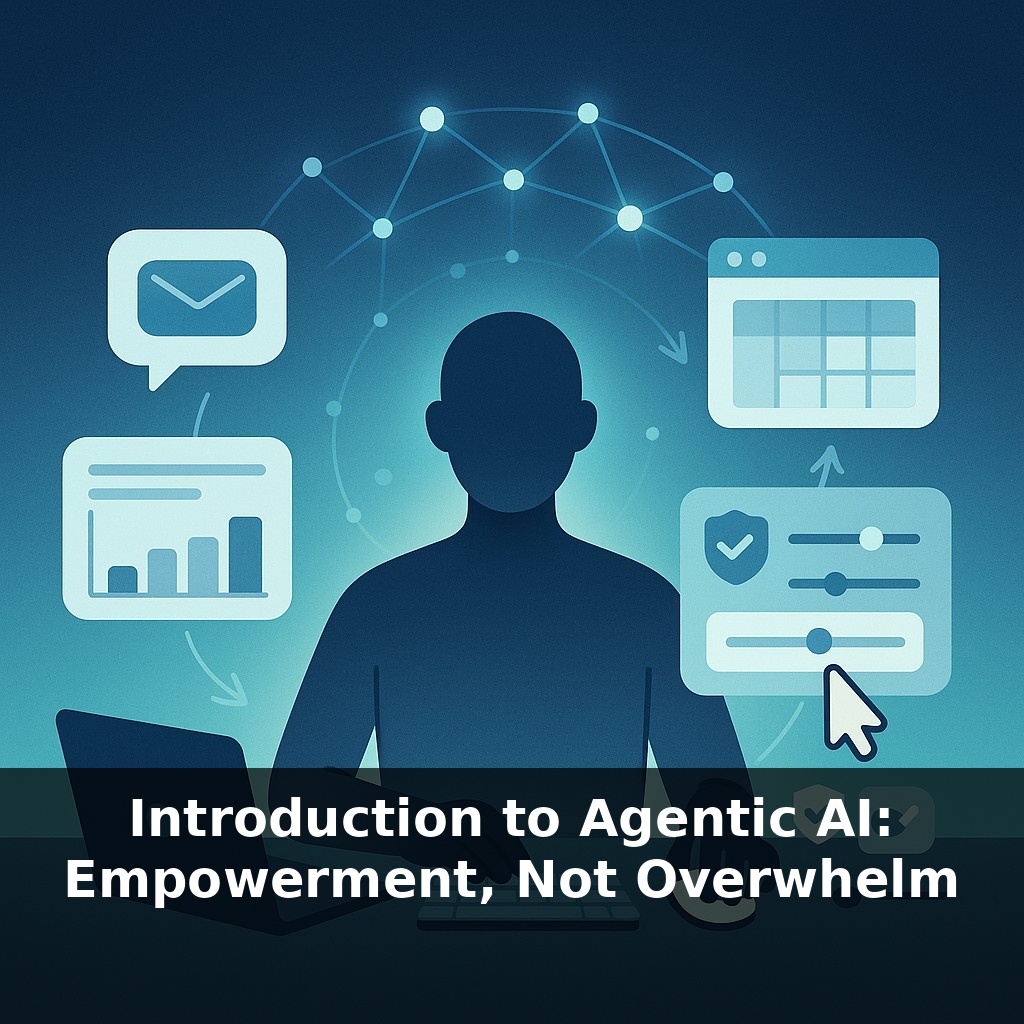
Introduction to Agentic AI: Empowerment, Not Overwhelm
📝 Transcript
Your inbox writes back, your calendar rearranges itself, and a report you didn’t start quietly finishes in the background. Helpful—or a little terrifying? In this episode, we’ll explore why AI that “acts for you” doesn’t have to mean giving up control.
That subtle tension you feel—between “this could save me hours” and “am I still the one in charge?”—is exactly where agentic AI becomes interesting. The real shift isn’t that software is suddenly more powerful; it’s that your role in the system is changing. Instead of being the person who clicks every button, you’re increasingly the person who decides which buttons matter.
We’re moving from “Do this for me” to “Work with me on this, here are the edges you can’t cross.” That means you’ll need new skills: setting sharp goals, defining boundaries, and reading AI feedback as carefully as you scan a contract. The overwhelm comes when everything feels automatic and opaque; the empowerment comes when you can see, pause, and redirect the flow of decisions before they harden into outcomes.
You’re already seeing hints of this shift in everyday tools: email that drafts itself, note apps that surface action items, meeting tools that promise to “handle the follow-up.” What’s really changing isn’t just convenience—it’s the kind of work you’re now free to notice. Patterns in your week, tensions on your team, blind spots in your plans suddenly have more room to come into focus. Think of this episode as a map for that extra mental space: how to use it, what to guard, and how to keep your judgment at the center as software grows more proactive around you.
Look beneath the surface of “AI that helps” and you’ll notice something subtle: the most powerful systems aren’t just answering questions, they’re quietly managing *process*. They can turn a fuzzy end goal—“prepare for this client meeting,” “launch this internal project,” “update my financial plan”—into a sequence of concrete steps, call the right tools along the way, then bring you in for the decisions that actually matter.
That’s the core of agentic AI: not a brain in a box, but a coordinator that can organize work across documents, apps, and workflows. Instead of you juggling tabs and copy‑pasting between systems, the agent can search, summarize, draft, and route information, then surface the key forks in the road: “Option A is faster, Option B is safer—what do you prefer?”
You’re already seeing early hints of this in the stats. Internal studies from tools like Microsoft Copilot show big time savings in “glue work” such as composing email. Firms like Morgan Stanley are using GPT‑4 to slice through giant research libraries in seconds. Early open-source agents like AutoGPT exploded in popularity, not because they were perfect, but because they revealed what happens when software can *chain* actions without you manually steering every click.
The promise isn’t magic; it’s leverage. Most knowledge work is a mix of: - High-value judgment (what should we do?) - Mid-level coordination (who needs to know, in what format?) - Low-level execution (formatting, searching, filing, scheduling)
Today’s agentic systems are best at that last layer and are getting better at the middle one. They’re still brittle when you push them into open‑ended strategy or unfamiliar domains—which is why keeping you in the loop isn’t just “safer,” it’s necessary for quality.
A useful way to think about this shift is like planning a long train journey through multiple countries: you choose the destinations and budget; an intelligent planner can handle timetables, connections, and seat reservations. You don’t hand over your passport; you hand over the logistics.
The practical question becomes: where in your work are the “train schedules” hiding—complex, rule-based, repetitive—and where are the “destination choices” that only you can make? Agentic AI is most empowering when you draw that line explicitly, then let the system operate confidently on its side of it.
Think about the moments in your week when your brain feels stretched thin, not because the work is deep, but because you’re tracking too many moving parts. That’s often where an agent can quietly shine. For instance, a product lead might point an AI agent at a messy backlog, a pile of customer interviews, and a roadmap doc—not to “decide the strategy,” but to propose three coherent release plans with risks and trade‑offs spelled out. The human still chooses, but no one had to manually sift through forty tickets to get there.
Or consider personal finance: instead of nudging you with generic tips, an agent connected to your actual accounts could simulate different savings and spending patterns, then sit in the background updating scenarios as your life shifts. You’re not outsourcing responsibility; you’re getting a living dashboard of consequences.
The pattern is the same in creative work. A writer can ask an agent to mine past drafts, comments, and outlines, then suggest structures that honor their voice. The agent holds the threads; the author pulls the ones that matter.
That same “quiet coordinator” power scales beyond work. Agentic layers around your life could replay your week like a highlight reel: where energy spiked, where you stalled, which people or projects kept showing up. Over time, the question shifts from “what can this tool do?” to “what do I actually want more of?” Your metrics might move from inbox zero to “hours spent learning,” “deep-focus mornings,” or “stress-free evenings”—a personal scoreboard for agency.
Used well, these systems don’t just save time; they can surface patterns you’d never notice in the daily rush—like which projects quietly energize you, or which meetings always leave you drained. Over time, that’s less about productivity and more about shaping a life that fits you, not your calendar. Your tools expand, but so can your sense of choice.
Here’s your challenge this week: Pick one repetitive task you do at least 3 times a week (like inbox triage, meeting prep, or summarizing docs) and turn it into an “agent brief” for an AI assistant—spell out the exact inputs it gets, the decisions it should make, and the format of the output. Then, run that same task through the AI every day for 5 days, tweaking your brief after each run to make the agent more autonomous (less back-and-forth, clearer rules). By the end of the week, compare how long the task takes you manually vs. your tuned agent, and decide whether to “promote” this agent into your regular workflow.
Unlock all episodes
Full access to 5 episodes and everything on OwlUp.
Subscribe — $1.99/monthLess than a coffee ☕ · Cancel anytime

