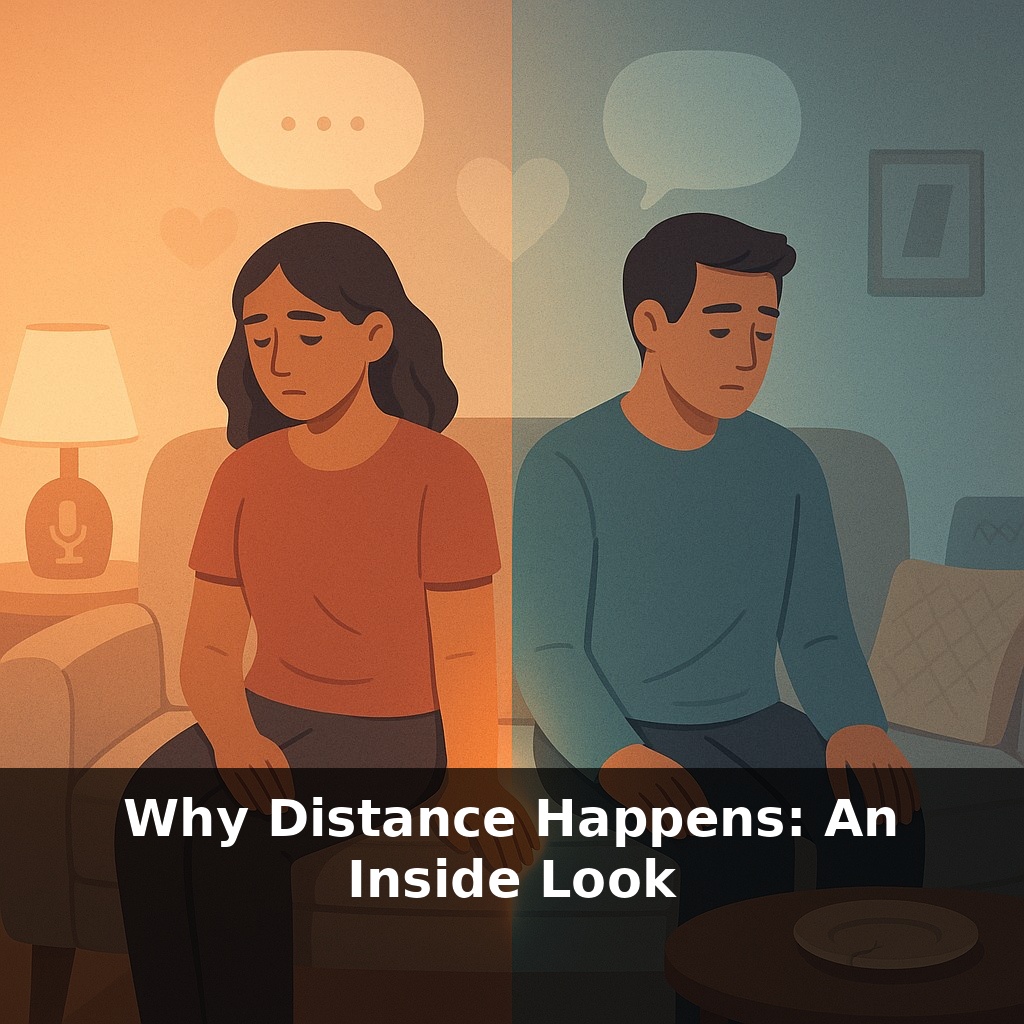
Why Distance Happens: An Inside Look
📝 Transcript
A typical couple waits years after the first “something feels off” moment before doing anything. In one home, that moment is a quiet dinner where no one speaks. In another, it’s a hug that feels a bit hollow. The mystery is: how does warmth fade so slowly we barely notice?
Sometimes the real story of “distance” starts long before silence at dinner or a hollow hug. It begins in much smaller moments: the stressed “I’m fine” that isn’t, the joke that lands wrong and never gets clarified, the tiny sting when your bid for attention gets ignored because your partner is glued to their phone. Each one seems too minor to mention, so you don’t. They don’t either.
Underneath, your nervous systems are quietly keeping score: “Do you come closer when I’m overwhelmed—or step back?” Over years, changing careers, kids, losses, and shifting identities mean your needs keep evolving while your routines stay the same.
This series will zoom in on those barely-noticed turning points—how biology, unspoken stories, and mismatched expectations slowly nudge two people onto parallel tracks, even while they still share the same bed.
Over time, two quiet forces tend to take over: habit and assumption. You start predicting each other instead of actually checking in. “She always needs space when she’s upset.” “He doesn’t care about this stuff.” Sometimes you’re right—but often you’re recycling old data about a person who’s still changing. Add stress hormones, less sleep, and more responsibilities, and responsiveness becomes something you outsource to autopilot. The risk isn’t one big betrayal; it’s a slow drift where both people feel less seen, even while they’re technically doing all the “right” relationship things.
Think of emotional distance as less about “falling out of love” and more about three silent systems running in the background that no one taught you to monitor.
First, there’s your attachment style—the default template your brain uses for closeness and safety. One partner might seek contact when uneasy, another might shut down to stay in control. Neither is wrong, but when those templates collide, everyday moments get misread. A simple “I need a minute” can register as rejection for one person and basic survival for the other. Over months and years, both start bracing for impact instead of turning toward each other.
Second, there’s the way conversations subtly train you what is and isn’t welcome. If you regularly get interrupted, minimized, teased when you risk honesty, or met with advice when you wanted comfort, your system quietly updates: “Better to keep this to myself.” You’re not deciding to withdraw; you’re adapting. Eventually, the topics that once brought you close—fears, dreams, half-formed thoughts—get replaced by logistics and headlines. The relationship looks functional from the outside, but the private channel between you gets thinner.
Third, there’s the issue of needs that shift across your life span while the “rules” of the relationship stay frozen in an earlier chapter. What felt caring in your twenties—constant texts, sharing everything—might feel suffocating when you’re juggling kids or an intense career. Or the opposite: someone who once prized independence now deeply craves reassurance after a loss or health scare. If you keep performing an old version of love for a partner who has subtly changed, both of you can end up feeling unappreciated and oddly lonely together.
That’s where shared meaning comes in. Couples who stay connected treat the relationship like an ongoing, living conversation: What are we building now? What does support look like this season? They renegotiate rituals, roles, even inside jokes, instead of assuming last decade’s answers still fit. Without that conscious recalibration, tiny disappointments stack up. Not dramatic betrayals, just hundreds of moments where neither of you quite feels met—and those are what gradually widen the gap.
Think about the last time you reached for your phone to share something with your partner, then thought, “Eh, they’ll be busy,” and didn’t. Or the moment you noticed they seemed off, considered asking, but went with, “They’ll tell me if it’s important.” Those micro‑choices are like tiny edits to the “us” story you’re writing together—each one a quiet vote for a little less overlap between your worlds.
For some couples, this shows up as parallel evenings: one person scrolling on the couch, the other doing chores, both assuming the other doesn’t really want company. For others, it’s jokes that cover over tender spots because vulnerability feels riskier than banter.
Neglecting a relationship is like forgetting to water a houseplant: missing a day rarely shows, but repeated neglect leads to wilting that’s hard to reverse. The good news is that these patterns are built from small moments—which means they can be rebuilt, on purpose, from small moments too.
If tech and culture keep evolving, couples may get “early warning lights” long before things feel dire: a wearable nudging you when your body shows you’re checked out around your partner, or a VR‑based check‑in that feels more like co‑op play than therapy. Workplaces might treat your relationship health like they treat ergonomics now—part of sustainable performance. The real shift? Seeing long‑term intimacy less as a static promise and more as a creative project you keep revising together.
So this first episode isn’t about blame; it’s about learning to notice the early tremors instead of waiting for the earthquake. Emotional space isn’t always a sign you chose the wrong person—it can be a signal that the old map of “us” needs updating. Like hikers who pause to recheck the trail, couples can course‑correct long before they’re truly lost.
Start with this tiny habit: When you notice yourself pulling out your phone instead of engaging with your partner, pause and silently name one feeling you’re actually having (for example, “I’m overwhelmed,” “I feel rejected,” or “I’m tired”). Then add just one simple sentence in your head that you wish you could say out loud, like “I miss you” or “I need a minute, but I still care.” If they’re nearby, make brief eye contact—just two seconds—before going back to what you were doing. This tiny pause starts rewiring that automatic distancing into a moment of honest connection.
Unlock all episodes
Full access to 6 episodes and everything on OwlUp.
Subscribe — $1.99/monthLess than a coffee ☕ · Cancel anytime