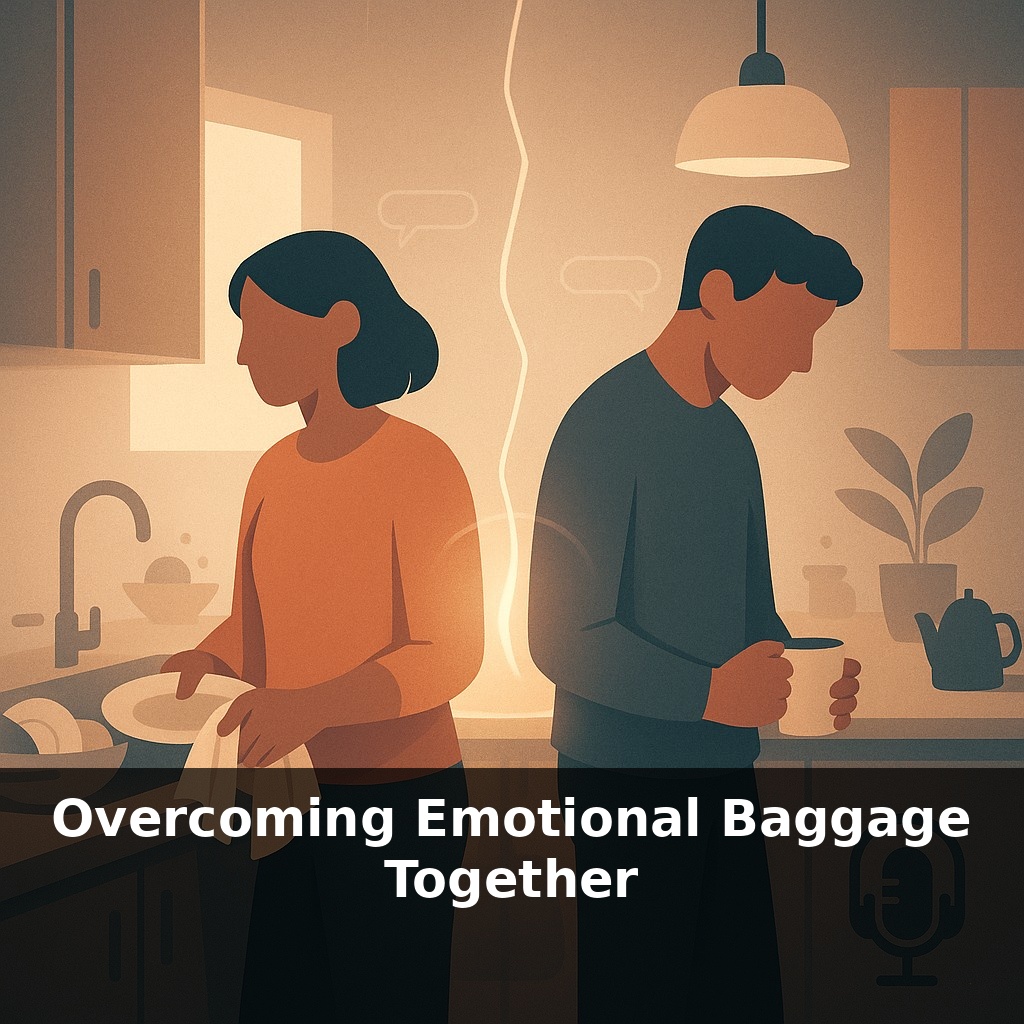
“Most couples don’t break up because of one big betrayal… they drift apart under the weight of tiny, unspoken hurts.” You’re in the kitchen, arguing about dishes, but your chest is tight for a different reason entirely—and your partner has no idea what just got triggered.
“Couples who practice repair attempts within five minutes of conflict have an 83% lower breakup rate.” That number isn’t just about better arguments—it’s about what’s *under* the argument. Research shows that old wounds quietly train your nervous system to brace, attack, or shut down before you even know what you’re feeling. So the fight about the tone of a text reply might actually be your body remembering a parent who went silent for days, or a past partner who cheated when they got “busy.”
Here’s the tricky part: your partner is having their own invisible history flare up at the same time. Two nervous systems, both on high alert, trying to solve a present-day problem while running yesterday’s software. In this episode, we’ll explore how to spot when the past is driving the moment—and how to gently bring those older stories into the light *together*, without turning therapy into a blame session.
So where do you go from “We keep reacting” to “We can actually handle this together”? Research on couples therapy and neuroscience points to something hopeful: you don’t need to erase the past; you need new ways to *hold* it as a team. EFT, CBCT, mindfulness, and narrative work all share a core move—helping partners name patterns without making either person the villain. Think less “cross-examination” and more “joint investigation,” like you’re slowly turning up the lights in a shared studio, noticing which colors keep bleeding into the canvas whenever you try to paint something new.
“Unresolved childhood adversity predicts a 2.7× higher likelihood of intimate-relationship conflict.” That doesn’t mean you’re doomed; it means there’s *data* for why some arguments feel wildly disproportionate—and a roadmap for changing them.
One powerful shift is moving from “What’s wrong with you?” to “What happened to you—and what happens *in* you when we get close or fight?” EFT calls this tracking the “cycle”: not who started it, but the predictable loop you both get pulled into. Instead of debating the content (“You never text back”), you get curious about the pattern (“When you don’t reply, I tense and assume I don’t matter; then I get sharp, and you shut down.”)
Here’s where the science of memory helps. Those spikes of panic, anger, or numbness are often old learning firing up: your body predicting danger based on earlier relationships. Memory reconsolidation research suggests that when an old memory is reactivated *and* paired with a new, safer experience, it can literally be updated. That’s why talking about the past isn’t enough; you’re trying to create different endings to familiar emotional stories, in real time, with each other.
CBCT leans on this by having couples notice and test the thoughts that rush in during a fight: “You’re late” quietly turns into “I’m not important.” Instead of assuming those thoughts are accurate, you treat them as hypotheses and check them *with* your partner: “When you’re late, the story I tell myself is that I’m last on your list. Is that actually what’s happening?” Now you’re collaborating on reality-testing rather than battling over who’s “too sensitive.”
Mindfulness adds a pause button. You practice catching the first bodily signals—jaw clenching, stomach dropping—and naming them out loud at low intensity: “I’m starting to feel that old ‘I’m about to be abandoned’ feeling.” This isn’t drama; it’s early warning so you can co-regulate before you’re both flooded.
Narrative techniques then help you zoom out. Together, you trace how certain themes—being ignored, criticized, controlled—show up across time. The goal isn’t to assign fault, but to move from “This is just how I am” to “This is a story I learned. Do we still want to live by it, or write a different one?”
Think of a moment when a small comment lands way too hard. You snap, then later say, “I know it was minor, but something in me just freaked out.” That “something” often shows up most clearly in repeat scenes. For one couple, it was running late. For another, it was one partner glancing at their phone mid-conversation. The topics differed, but the deeper themes—“I don’t matter,” “I’m about to be rejected,” “I’m failing again”—were strangely similar each time.
Instead of hunting for a single “root cause,” you can treat these scenes like chapters in a series you’re co-writing. Ask: When does this theme show up? How do we each behave in that chapter? What role do I usually play—pursuer, fixer, ghost, judge? You may realize you’re both reciting lines learned years ago.
Your challenge this week: Pick *one* recurring scene and gently map it together. No fixing, just noticing the script you fall into and what each of you is secretly hoping for in that moment.
Future implications stretch far beyond two people in a room talking. As tools improve, partners may eventually get real‑time cues—like subtle haptic nudges—whenever shared stress spikes, turning tense evenings into chances to practice new responses on the spot. On a cultural level, community‑based programs could help families rework patterns together, the way neighborhoods sometimes repaint old murals: not erasing the past, but layering new colors, meanings, and scenes over what came before.
So the work isn’t about “fixing” each other; it’s more like tending a shared garden. You notice which moments scorch the soil, which small gestures act like rain, and which old roots keep resurfacing. Over time, patterns shift: conflicts become trail markers instead of dead ends, and both of you get better at choosing curiosity over automatic defense.
Try this experiment: Tonight, ask your partner to set a 15-minute “baggage swap” timer where you each share *one* recurring trigger (like feeling abandoned when texts go unanswered or shutting down during conflict) and then each guess what childhood story might be underneath it—without defending or explaining. When the timer ends, switch roles and have the *listener* summarize what they heard in two sentences beginning with “When X happens, you feel Y because Z from your past shows up.” Before bed, each of you rate from 1–10 how emotionally “lighter” or more understood you feel, and compare notes in the morning about what surprised you most.