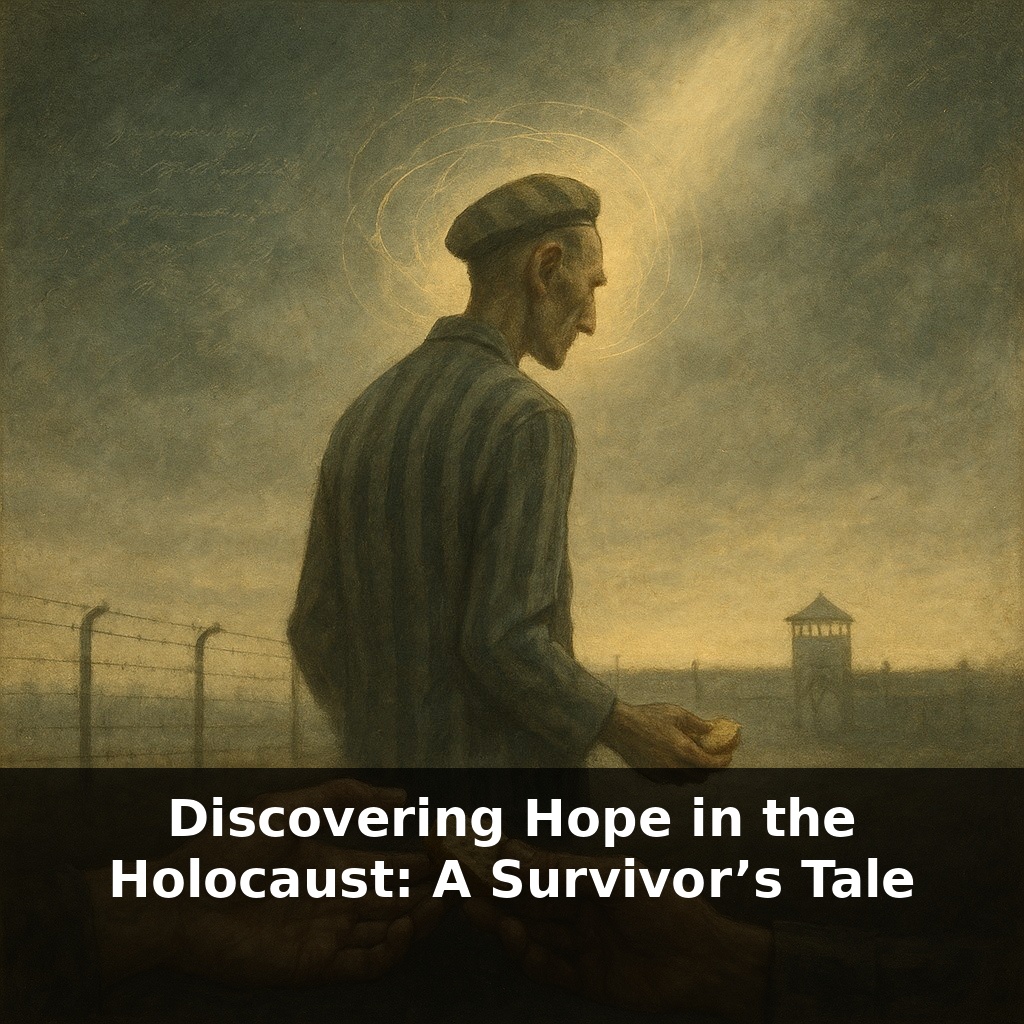
Discovering Hope in the Holocaust: A Survivor’s Tale
📝 Transcript
In a world built to erase hope, one prisoner in Auschwitz used his mind as his last free territory. While others clung to bread, he clung to meaning. Here’s the paradox: surrounded by death, Viktor Frankl discovered a way of thinking that still saves lives today.
Frankl was not alone. Across camps and ghettos, survivors found fragile ways to keep going: sharing a crust of bread, whispering a joke in the dark, reciting poetry from memory like a secret password to a life before barbed wire. These moments didn’t change the brutality around them, but they changed something inside. Modern trauma research now has a name for this: micro-acts that protect the mind when the body is trapped. Survivors like Gerda Weissmann Klein spoke of braiding each other’s hair as if they still had a future; Primo Levi recalled teaching chemistry in his head as though a classroom might return. These were not grand gestures of heroism, but tiny stitches holding together a torn sense of self. In the worst conditions recorded in modern history, people quietly practiced skills of hope that anyone, in any century, can learn.
In the camps, hope was not a feeling that arrived on its own; it was something people pieced together under conditions designed to strip them of identity. Frankl later described watching men straighten their uniforms before roll call as carefully as if preparing for work back home. That small ritual said, “I am still someone.” Modern trauma psychology notes that such patterns of thought and behavior can be trained much like a muscle. Survivors did this without textbooks or therapists, improvising mental routines the way a musician finds a melody on a broken instrument, turning whatever remained into a lifeline.
In Auschwitz, survival calculations were brutally concrete: about 1,300 calories a day for work that could burn twice that. Under such math, the body was destined to fail. Yet some prisoners behaved as if another equation also mattered: not just “Can my body last?” but “Can anything of me remain human while it lasts?”
Frankl watched this second equation play out in choices that, from the outside, looked irrational. A man gave away part of his bread so a weaker prisoner could stand through roll call. Another risked a beating to adjust an elderly man’s shoes before a march. Gerda Weissmann Klein later described deliberately planning conversations about dresses and dances she might one day attend, even as she trudged through snow on a death march. Statistically, none of this altered the odds of a bullet or typhus. But it changed the texture of the time they had left and, sometimes, who they were able to become afterward.
Modern research on extreme imprisonment finds similar patterns: prisoners who hold onto a sense of “why I must endure” and “who needs me if I make it out” tend to show lower rates of complete psychological collapse. Historian Doris Bergen notes that camp survival wasn’t pure lottery; variables like trade skills, language ability, and physical health mattered. Yet alongside those external factors, survivors repeatedly highlight inner commitments: “I have to live to tell,” “I must see my sister again,” “I want to finish the work I began.” These were not guarantees; they were anchors.
Primo Levi illustrates this in a moment from Buna-Monowitz: he and a fellow prisoner recite Dante from memory while hauling a soup cauldron. Around them, mud, dogs, guards. Within them, suddenly, a tercet about human dignity. The guards don’t care. The rations don’t change. But Levi later wrote that, for a few minutes, he felt “almost a man again.”
Viewed from our present, where most threats are not SS guards but layoffs, diagnoses, or failures, these stories pose a quiet question: if such commitments could be forged under barbed wire, what might be possible in a life with far more room to move?
Some survivors later described a quiet practice: scanning each day for one thing that wasn’t entirely swallowed by the camp. For one woman, it was a sliver of sky above the fence at dawn; for another, the exact way her friend pronounced a joke from home. These details did nothing to reduce hunger or cold, yet they acted as tiny proof that the world still contained more than brutality.
Frankl spoke of composing lectures in his head as if his future students were already seated before him. Others, like Gerda Weissmann Klein, mentally “collected” moments—a guard looking briefly away, a song hummed under breath—and stored them as if they were valuables hidden under floorboards.
In less extreme lives, people reporting strong resilience often describe similar habits: a nurse in an underfunded hospital keeping a notebook of “small wins” from each shift; a widower tracking brief moments of relief after loss. These are not grand transformations. They are precise acts of noticing that keep experience from collapsing into a single color.
As testimony becomes digital, the question quietly shifts from “What happened?” to “What will we do with what we know?” Therapists now adapt survivor-informed practices for refugees, ICU patients, and communities after climate disasters, treating human connection almost like emergency infrastructure. Schools and workplaces, too, can train people to pass along steadiness in crises the way musicians pass a theme through an orchestra—subtle, but changing how the whole piece is heard.
The next step is uncomfortably simple: treat these testimonies less like distant history and more like a manual passed down. Researchers now study survivor interviews the way botanists study seeds—tracking which habits still sprout strength in new crises. As you face your own lesser storms, their experiments in staying human are now quietly, persistently available to you.
To go deeper, here are 3 next steps:
1) Watch the full testimony of a survivor like Elie Wiesel or Gerda Weissmann Klein through the USC Shoah Foundation’s Visual History Archive Online, and jot down one specific moment of courage you want to remember this week. 2) Read Viktor Frankl’s *Man’s Search for Meaning* alongside the podcast, and after each section on the camp experience, pause to compare his insights on purpose with the survivor’s story you just heard. 3) Visit Yad Vashem’s online exhibitions (yadvashem.org) and choose one “Righteous Among the Nations” story; then share that specific story—and why it moved you—with a friend, family member, or in a social post today to actively pass on their legacy of hope.
From this course
Resilience and Hope: Lessons from WWII Survivors
5 episodesUnlock all episodes
Full access to 5 episodes and everything on OwlUp.
Subscribe — $1.99/monthLess than a coffee ☕ · Cancel anytime