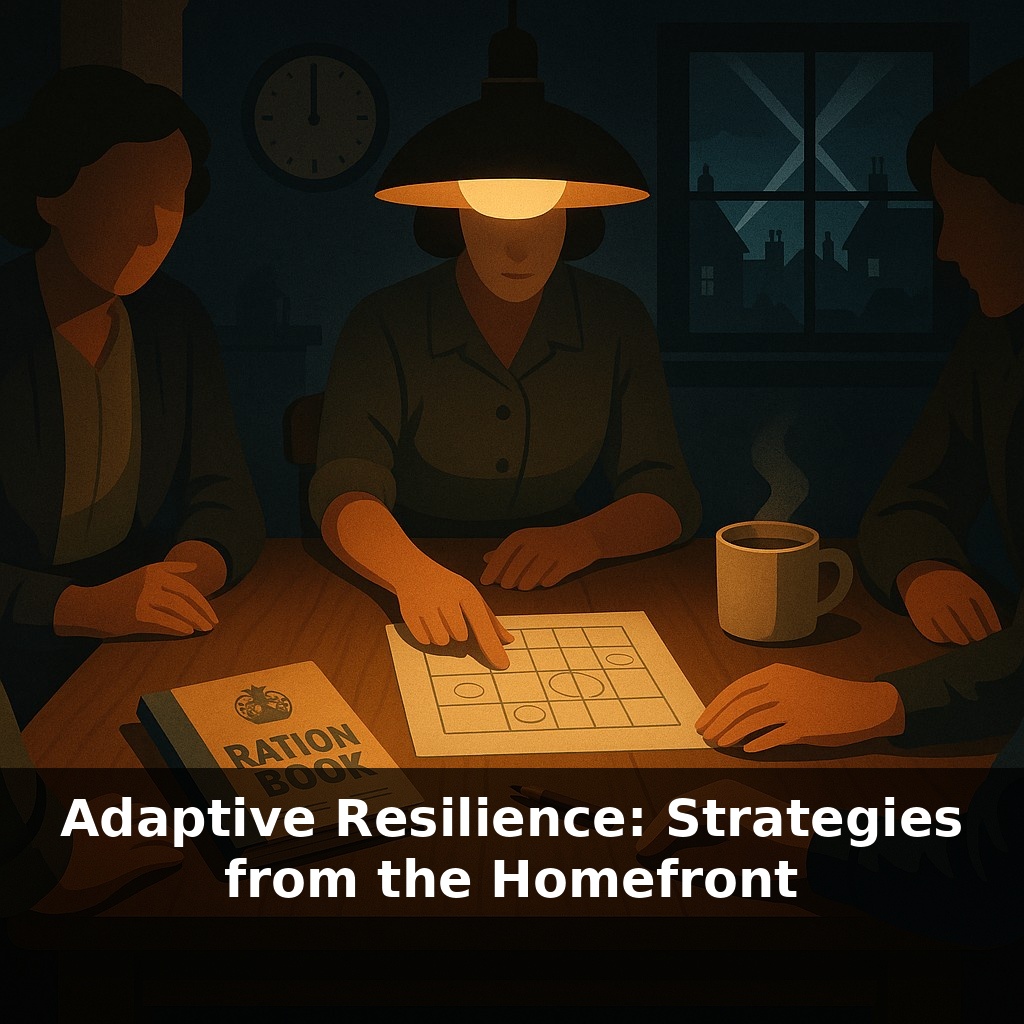
Sirens wail overhead, lights are blacked out, and yet a neighbourhood meeting is calmly planning next week’s childcare rota. Here’s the paradox: some of the most innovative problem‑solving in World War Two didn’t happen in war rooms, but around kitchen tables.
By daylight, those same kitchen tables became planning hubs for stretching rations, swapping skills, and quietly rewriting social rules. On the WWII homefront, women weren’t just “coping” with disruption; they were re‑designing daily life at high speed. Scarcity turned into a kind of unwelcome coach, forcing experiments with new recipes, repair tricks and neighbourhood systems that had never existed before. A torn coat meant a lesson in tailoring. An empty shelf meant a shared recipe that used entirely different ingredients. As old routines collapsed, informal networks thickened: someone knew how to sew, someone had a spare plot of land, someone else had contacts at the factory. Out of this web grew a form of adaptive resilience—flexible, practical, and built from ordinary people learning, improvising and coordinating under pressure.
Instead of waiting for instructions from above, home‑front women built resilience from the ground up. They took on new roles at record speed: millions entered factories and shipyards; others joined land armies, civil‑defence teams or massive volunteer groups like the WVS. Streets organised salvage drives the way schools run fundraisers, turning old pans, bones and paper into metal, glue and packing. Back gardens and borrowed plots became small, stubborn food systems. These weren’t random efforts; they functioned like overlapping safety nets, so if one knot slipped—bomb damage, lost income, failed harvest—another could catch the fall.
At first glance, the numbers just look impressive: millions more women at work, shipyards smashing production records, allotments carpeting spare land. Look closer, and you see a process: people repeatedly absorbing shocks, adjusting, and then operating at a new level.
One layer was speed of role‑switching. A clerk could be in overalls within weeks, learning to rivet at Kaiser Shipyards or manage complex machinery in a munitions plant. Training centres ran day and night; women taught other women, passing on tricks that never appeared in official manuals. In Britain’s Women’s Land Army, urban recruits went from office desks to hedgerows and lambing sheds, picking up tasks that had taken farm kids years to master. The pace was brutal, but it proved that “I can’t do that” often meant “I haven’t been asked yet.”
Another layer was redesigning the household itself. Kitchens became mini‑laboratories. Ration books forced calculations about calories, fuel and time. New recipes, pressure‑cooker methods, batch baking and shared meals weren’t just about saving food; they redistributed labour. Neighbours traded specialties—one good at sewing, another at canning, another at childcare—so that no one person carried the whole load. This redistribution quietly challenged old assumptions about who did what at home.
Then there was civic muscle. Groups like the Women’s Voluntary Services ran canteens, rest centres and clothing depots with logistical discipline any company would envy. They coordinated transport, supplies and volunteers across bomb‑damaged cities, updating plans after each raid. These systems were rarely tidy, but they were responsive: if a rest centre flooded, tea and blankets appeared somewhere else the same evening.
The most durable shift came from expectation. Once women had run workshops, farms, air‑raid posts and council committees, many did not simply revert to pre‑war limits. The war didn’t create equality, but it cracked open the idea that competence belonged to one gender or one class. You can see echoes today whenever communities self‑organise around floods, pandemics or blackouts: the tools differ, but the pattern—rapid learning, shared responsibility, and quietly altered norms—looks strikingly familiar.
Think of three distinct “home‑front modes” that still show up today. First, the rapid upskilling mode: the woman who’d never touched a lathe has a modern echo in nurses cross‑training during COVID surges or teachers mastering remote platforms in a weekend. Second, the neighbourhood infrastructure mode: WVS canteens have cousins in pop‑up WhatsApp groups arranging school‑run rotations, flood‑relief cooking, or checking in on elderly neighbours during heatwaves. Third, the micro‑logistics mode: those who once mapped tea, blankets and bunk space now appear in community organisers who track spare bedrooms for refugees, share real‑time data on medicine availability, or coordinate laptops for kids without internet.
You can also hear a musical parallel: like a jazz ensemble, each player picks up a new line when another drops out, keeping the tune going, slightly altered, but recognisable—and often richer than before.
Future implications
Today’s disruptions are less like a single air raid and more like a rolling storm front—automation, climate shocks, care crises arriving in waves. The WWII home‑front hints that the most robust plans won’t live only in command centres but in kitchens, group chats and union halls. Expect “civilian readiness” to look more like neighbourhood mesh‑networks and local repair hubs than sirens and stockpiles, with caregiving capacity tracked as carefully as fuel or data. Your challenge this week: map three nearby skills you’d lean on if the grid went down—then tell those people.
So the question becomes less “Will things go back to normal?” and more “What small experiment could we run next?” Like tuning a radio during a storm, you twist the dial—try a new skill share, a backup childcare swap, a shared tool shed—listening for the moments when the static clears and a more livable future comes through.
Try this experiment: For the next seven days, pick one recurring homefront stress point (like the chaotic 5–7pm window, homework time, or morning rush) and treat it like a mini “deployment drill.” Before it starts, huddle your household for 3 minutes: name the mission (“Operation Calm Dinner Hour”), assign simple roles (who’s on “logistics” like setting the table, who’s on “communications” like checking in with each person, who’s on “recovery” like starting wind-down music after), and set one clear success metric (e.g., “no yelling” or “everyone seated by 6:15”). After each drill, quickly rate it together from 1–5 on calmness and connection, and tweak *one* element for the next day (swap roles, change the timing, or add/remove a step). By the end of the week, compare Day 1 vs. Day 7 and notice what specific adjustments made your homefront feel more resilient under the same pressure.