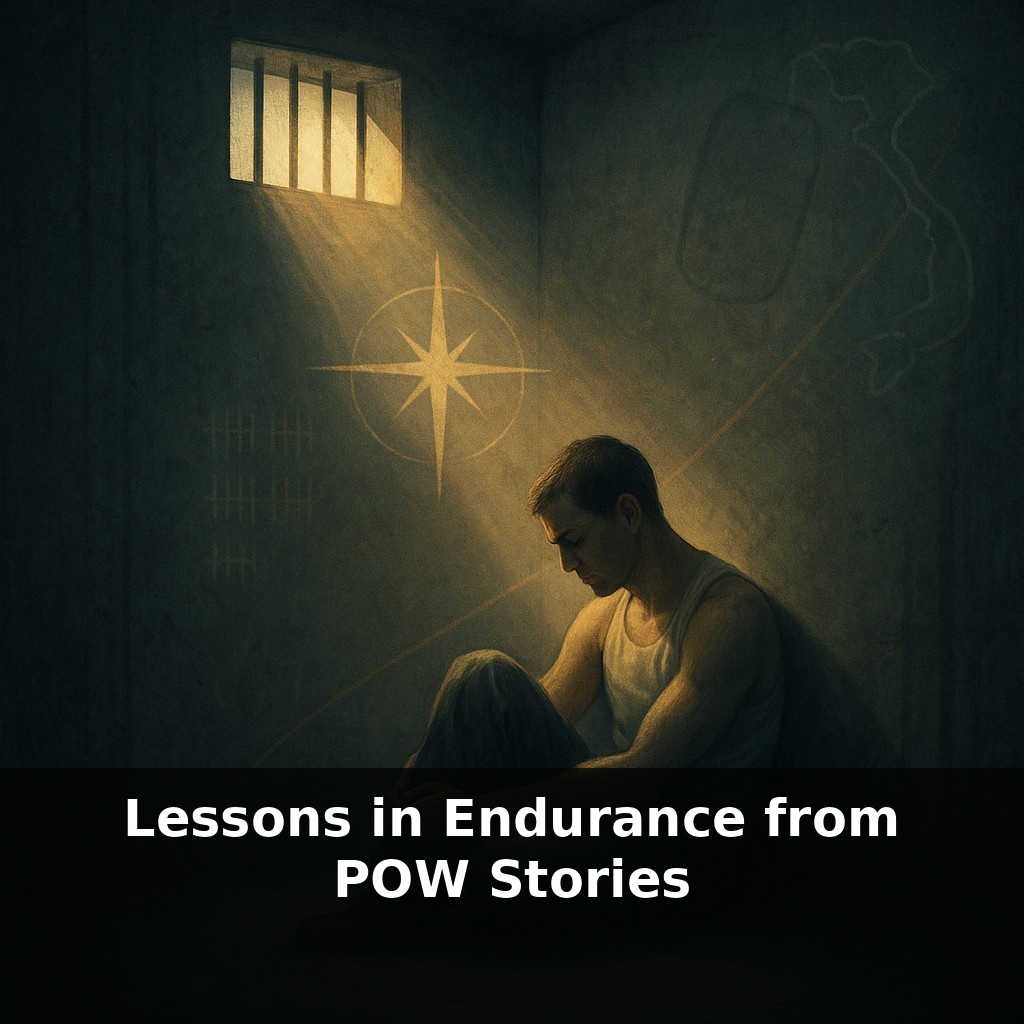
A man survives nearly six years in a cell the size of a bathroom—not because his body is stronger, but because his *story* about the suffering keeps changing. In this episode, we’ll walk straight into that cell and ask: what did he know about endurance that we usually miss?
“Survival in a POW camp has surprisingly little to do with who’s strongest,” one Vietnam veteran reflected, “and almost everything to do with who can stay *oriented* inside the chaos.”
Under starvation, sleep deprivation, and random punishment, the usual anchors—time, routine, freedom of choice—are stripped away. What separates those who slowly disintegrate from those who hang on is not a single heroic trait, but a *small ecosystem* of habits, beliefs, and relationships that quietly keep the mind from coming apart.
Across conflicts—from European stalags to the Hanoi Hilton—survivors describe three pillars: a stubborn sense of purpose (“someone needs me to get out”), a way to feel even a sliver of control (“I still choose *this*”), and a thread of connection to others. These aren’t abstractions; they show up in tiny, almost invisible behaviors that, repeated daily, become a lifeline.
Across wars, the details of captivity vary—jungle cages in Vietnam, frozen barracks in Europe, tropical disease in the Pacific—but the psychological patterns echo each other with eerie consistency. What modern researchers now call “resilience factors” showed up long before the term existed: POWs instinctively built tiny routines, shared crude jokes, or risked beatings just to tap a few letters through a wall. These weren’t signs of denial; they were deliberate bets that the mind could outlast the body. Neuroscience now suggests those bets change brain chemistry in ways that subtly tilt the odds toward survival and—even later—growth.
In Vietnam, some POWs secretly ranked themselves as “captain of Tuesday” or “chief of laundry,” even when there was no laundry and no Tuesday—because any role, however absurd, pulled them out of the identity of “victim” and into “person who still has a job to do.” That tiny shift turns out to be deeply biological.
Under extreme confinement, the body enters a kind of emergency budget mode: metabolism slows, hormones like cortisol and adrenaline spike, muscle is quietly cannibalized for fuel. Left unchecked, that state erodes memory, sleep, and hope. But how the brain *interprets* what’s happening can partially redirect that chemistry. Psychologists call this “cognitive appraisal”: the difference between “this is meaningless torment” and “this is brutal training for the life I’ll live later.”
Across POW testimonies, three practical patterns keep showing up:
First, **time-framing**. Survivors rarely tried to endure “years”; they targeted the next inspection, the next tap message, the next chance to smuggle food. Breaking vast suffering into near-term checkpoints gave the nervous system something it can actually process. One ex-prisoner said he survived by deciding he only had to make it until sundown—every single day for more than five years.
Second, **mental work**. With no books or paper, POWs built elaborate inner projects: reconstructing entire novels from memory, designing dream houses room by room, rehearsing conversations with children they hadn’t met yet. Far from escapism, this sharpened attention, preserved a sense of competence, and signaled to the brain, “We are still building something.”
Third, **micro-rituals of defiance**. A smuggled prayer, a forbidden song hummed under breath, a deliberate choice to straighten one’s posture on the way to interrogation—these small acts reasserted agency. They didn’t change the guards; they changed the prisoner’s chemistry, nudging the stress response from utter helplessness toward “hard challenge.”
Think of it like a storm at sea: POWs couldn’t calm the waves, but they could keep adjusting the rudder by a few degrees, hour after hour. Those degrees—how they framed time, where they aimed their attention, when they chose symbolic resistance—often made the difference between minds that fractured and minds that bent, then slowly re-formed.
A Vietnam POW once spent months “teaching” an imaginary university course in his head—syllabus, lectures, even fake student questions. Another man in a Japanese camp quietly counted fence posts every morning, checking for changes. To outsiders, both look pointless; inside, they functioned like tuning an instrument before a performance, keeping the mind aligned enough to respond instead of just endure.
Modern therapists borrow similar moves for long hospital stays or burnout. One clinician asks patients to design a “micro-mission” for each day—something so small it almost feels silly, like memorizing five foreign words or noticing three new sounds on the commute. The content doesn’t matter; the act of choosing and completing does.
In harsh Arctic expeditions, teams now train with “mental drills” inspired by POW stories: five-minute check-ins where each person names one thing they still *can* influence in the next hour. It’s a rehearsal of agency, like musicians practicing scales so that, when the real concert of crisis begins, the fingers already know where to go.
A striking implication: lessons from POW camps are quietly shaping plans for places most of us will never see—lunar bases, deep-space voyages, undersea labs. Engineers now pair oxygen and food models with “psychological life-support,” asking: how do we preserve dignity when freedom shrinks to a metal hull? Emergency teams test drills that treat trapped civilians less as “victims to extract” and more as partners, like adding a second conductor to keep an orchestra steady through a power outage.
Your challenge this week: borrow one POW tactic and stress‑test it in ordinary life. Pick a daily situation that wears you down—long commute, tense meeting, rehab, night feedings. Then add a tiny “anchor”: a fixed song, a brief mental drill, or a set micro-ritual. Notice which one holds you steady, the way a lighthouse keeps its beam in rough weather.