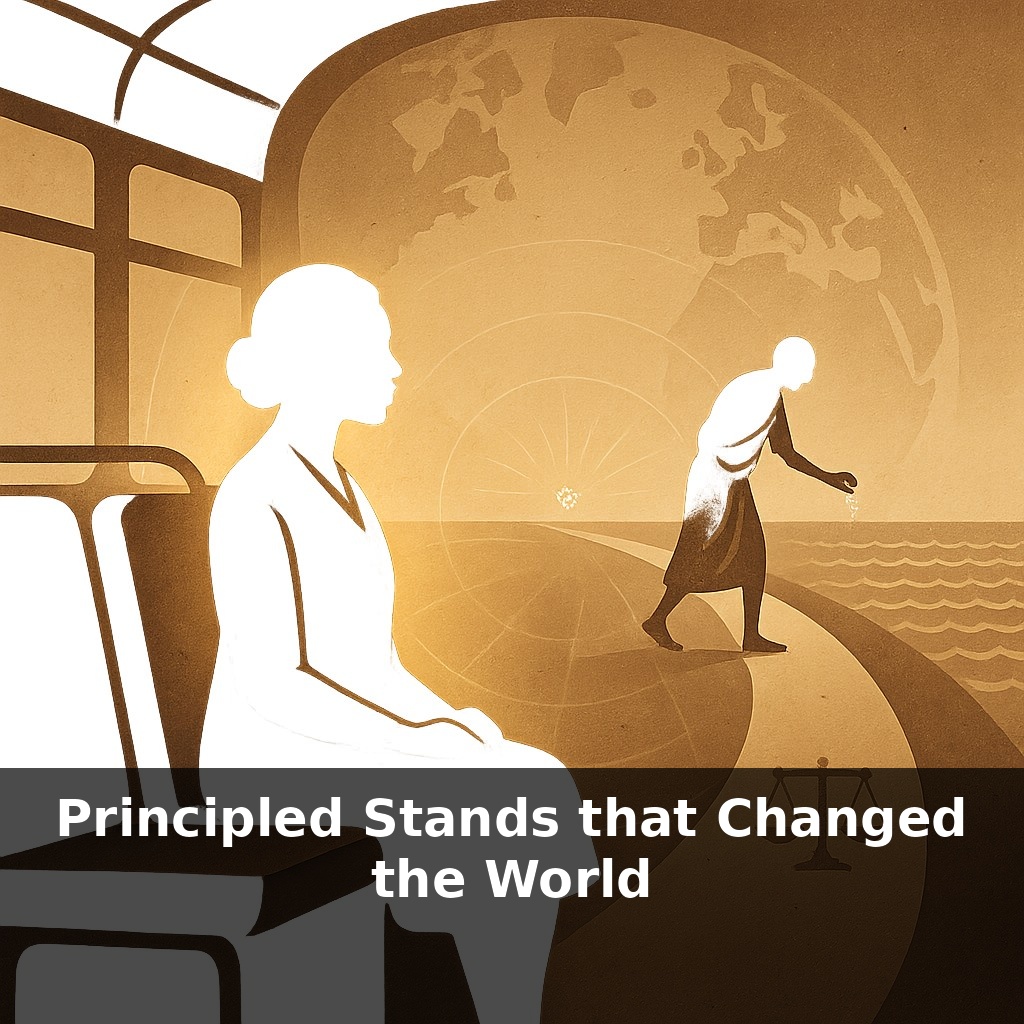
A woman refuses to stand up on a bus. A thin lawyer walks toward the sea to collect a handful of salt. On paper, these are tiny acts, almost trivial. Yet history pivots on them. How does one ordinary “no” bend the arc of entire nations? That’s what we’re exploring today.
Those world‑shaping refusals didn’t work because history “got lucky” or because their protagonists were superhuman. They worked because they hit a very specific nerve in their societies: a felt sense that “this crosses a line,” combined with the shock of watching someone pay a visible price rather than step back. Social psychologists call this principled defiance: when people see someone accept real consequences for a moral boundary, they’re far more likely to update their own standards and join in. It’s less like a private opinion and more like pulling a fire alarm in a crowded building—suddenly everyone has to decide whether to keep pretending nothing’s wrong. In the episodes ahead, we’ll dig into how context, cost, and clarity of principle turn a lonely stand into a tipping point, and how that pattern shows up far beyond famous protest movements.
Today we’ll zoom in on a less glamorous detail: timing and visibility. The same act can fizzle or explode depending on when and where it happens, and who’s watching. Rosa Parks wasn’t the first to resist bus segregation; her stand landed when local organizers, churches, and lawyers were poised to move. Gandhi’s salt law protest mattered because salt touched every kitchen table in India. Think of these stands less as isolated events and more as carefully placed fault‑line tests, poking at cracks already running through a society’s routines, stories, and institutions.
Consider three less‑mythologized ingredients that quietly determine whether principled stands spread: moral contrast, narrative fit, and “joinability.”
First, moral contrast. Stands that catch fire don’t just say “no”; they stage a side‑by‑side comparison that’s hard to unsee. Charter 77 in Czechoslovakia didn’t unveil new atrocities; it simply held the communist regime’s own human‑rights signatures against its daily behavior. That gap was the spotlight. Similarly, when protesters accept arrest while acting calmly and transparently, they sharpen the contrast between their conduct and the system’s response. Psychologically, that contrast makes fence‑sitters reassess who is actually behaving “normally.”
Second, narrative fit. A stand resonates when people can plug it into stories they already use to make sense of right and wrong. Gandhi’s salt protest fused easily with Indian ideas about self‑rule and everyday dignity. Rosa Parks’s case connected to Black church narratives of Exodus and deliverance. By contrast, some technically brave acts disappear because they don’t map onto any shared storyline; onlookers struggle to explain them to themselves, let alone to others. Movements that win often spend as much energy crafting simple, repeatable explanations—phrases, songs, rituals—as they do planning actions.
Third, “joinability.” An isolated act becomes a movement only if people can see a clear on‑ramp. The Montgomery Bus Boycott offered a concrete script: don’t ride the buses; use carpools; support the legal case. The Salt March evolved into nationwide salt‑making and tax refusal. Each created low‑risk follow‑up behaviors that echoed the original principle. Without these, observers may admire courage yet stay spectators. Research on collective action shows that when people can identify even a small, specific next step that aligns with the initial stand, their likelihood of participating jumps sharply.
Put together, these elements turn defiance into a kind of open‑source blueprint: the initial actor draws the line, but everyone else can see where to trace their own version, at their own scale and risk level, without asking permission.
In practice, these ingredients show up far beyond headline protests. Think about a junior engineer who refuses to ship a feature that quietly harvests extra user data. Their private objection, buried in an email thread, probably dies there. But if they escalate in a public sprint review, calmly stating, “This breaks our own privacy policy,” they create a visible clash between stated values and actual behavior. Colleagues can now decide: stay silent, or echo that line. Narrative fit comes from tying the objection to stories the team already respects—“we built our reputation on trust.” Joinability appears when others see concrete follow‑ups: logging data only with consent, adding a veto step in code review, or supporting an internal guideline. In sports terms, it’s like a captain insisting the team won’t fake injuries to win; that stance only spreads when it’s aired in the locker room, linked to the club’s identity, and teammates get simple ways to act on it in the next game.
Livestreamed whistleblowing, viral threads, even a lone worker posting “I won’t do this” in a company Slack can now travel farther than many street protests once did. Yet reach without depth is brittle. The next frontier is designing systems—schools, platforms, workplaces—where people can safely rehearse dissent in small stakes, like a scrimmage before a championship, so that when real pressure comes, moral courage feels practiced rather than improvised.
So the live question is less “would you die on this hill?” and more “which small hills are worth marking now?” Your challenge this week: spot one moment—a meeting, message, or policy—where a quiet compromise bothers you. Don’t fix everything. Just name the line, out loud, once. Think of it less as a grand stand and more as placing the first brick of a new path.