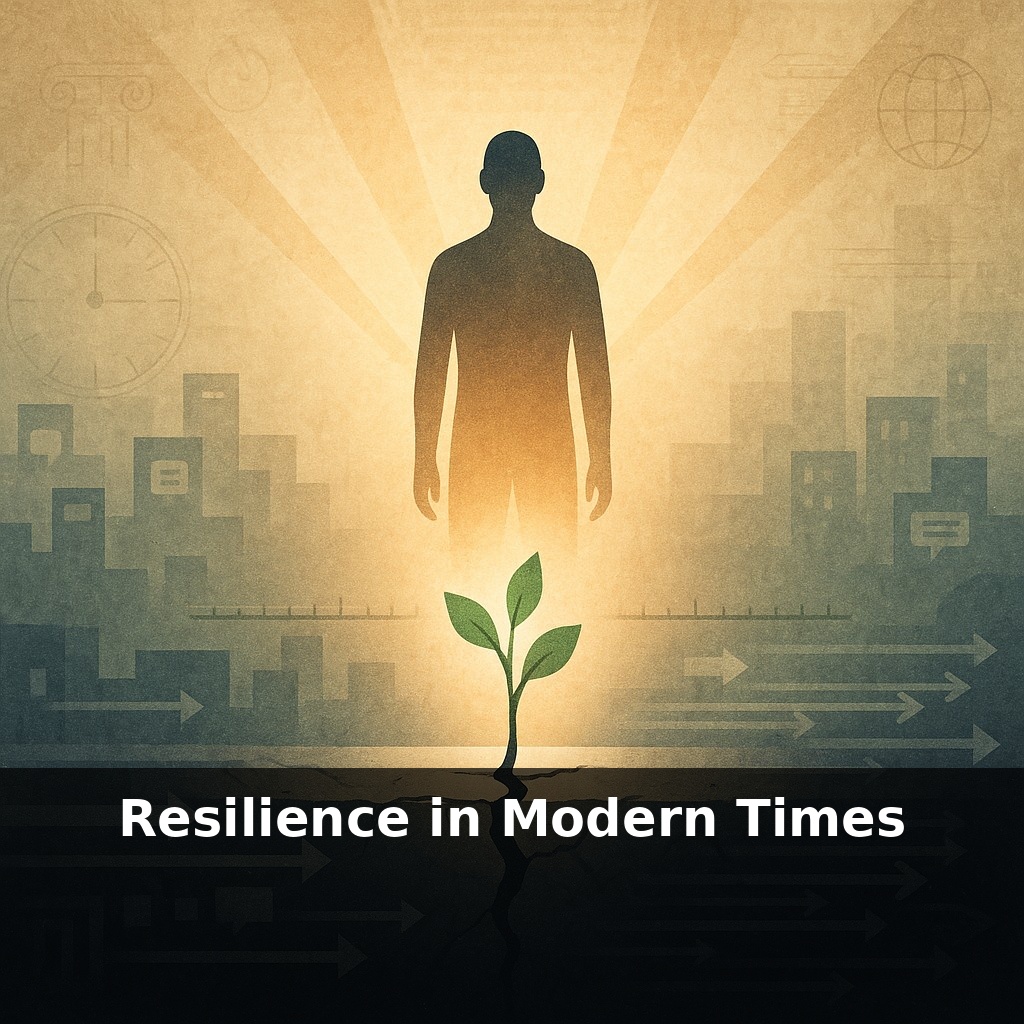
About half of what we call “resilience” isn’t hardwired at birth—it’s learned. A teen survives an assassination attempt and becomes a global voice. A tiny startup weathers a financial crash and reshapes travel. So the real question is: what, exactly, are they practicing that we’re not?
Modern life quietly trains us in the opposite direction of what helps us bounce back. Infinite scroll rewards outrage, not recovery. Work culture glorifies “always on,” then acts surprised when people snap. Even our language betrays us: we talk about “breaking” under pressure far more than “bending” and re-forming afterward.
Yet beneath that noise, three powerful forces are working in our favor: a plastic brain that keeps rewiring long after childhood, social networks that can spread coping skills as quickly as memes, and institutions slowly waking up to the cost of neglecting mental health. Neuroscience labs, HR departments, and community organizers are all—often unknowingly—running parallel experiments on how humans adapt now.
In this episode, we’ll trace those experiments: how individuals, teams, and whole systems are quietly redesigning the way we deal with shocks.
We’re also discovering that modern resilience is less about lone heroes and more about the systems wrapped around them. Neuroscientists track how repeated practices carve sturdier “paths” in the brain, while sociologists map how one calm, skilled person can steady a whole family or team. In workplaces, resilience programs quietly influence who burns out and who stays creative under pressure. In neighborhoods, one well-run community center can function like a power grid, keeping lights on for dozens of lives when everything else flickers.
A 2014 meta-analysis found that just eight weeks of mindfulness training can cut cortisol—the body’s stress hormone—by about 15%. That’s not a personality makeover. That’s physiology shifting in response to practice. Add to that: around half of the differences in how resilient people are trace back to learned behaviors rather than genetics. The old story—“some people are just built tougher”—starts to look less like wisdom and more like an excuse to avoid doing the work.
Across very different fields, similar patterns keep appearing. At the individual level, cognitive habits like re-framing setbacks, naming emotions precisely, and deliberately seeking perspective are turning out to be trainable skills with measurable effects on mood, health, and even immune function. Malala Yousafzai’s journey after being shot isn’t just inspiring—it mirrors what clinicians see in thousands of quieter cases: people using meaning-making, activism, or creative work to turn chaos into coherence.
Zoom out to groups, and a similar logic holds. Teams that practice “psychological safety” rituals—short debriefs after failures, leaders admitting their own mistakes, peers checking in on workload—recover faster from shocks and innovate more under pressure. During the pandemic, organizations that had already built such norms often didn’t need flashy wellness campaigns; their existing culture acted as shock absorbers. (The exact “60% lower burnout” figure often quoted still needs stronger data behind it, but the directional trend is hard to ignore.)
Then there’s the social scaffolding around children. Longitudinal studies show that one consistent, supportive adult can multiply a child’s odds of high resilience after trauma by roughly four. Not a perfect home, not a flawless school—one adult who shows up, listens, and doesn’t vanish when things get messy.
At the largest scale, cities and companies are quietly testing resilience as a design principle: diversifying supply chains, cross-training staff, building redundancies into digital systems. Think of it like software engineering for human systems: you assume crashes will happen, so you architect for graceful recovery rather than pretending failure is avoidable.
A pro athlete rehabbing after a torn ligament isn’t just “toughing it out”—they follow a progression: micro-movements, then resistance, then full scrimmage. Modern resilience training borrows this logic. Therapists use “stress inoculation,” exposing people to small, controlled challenges—like practicing a hard conversation in session—so real conflict doesn’t hit as hard.
On a neighborhood level, some cities now run “preparedness block parties” where residents meet, map shared resources, and rehearse what to do in outages or heat waves. The point isn’t stockpiling canned food; it’s building familiarity so people coordinate faster when systems fail.
In tech companies, incident-response runbooks quietly serve a similar role. Teams simulate outages, rotate who leads the drill, and debrief afterward. It’s not just about keeping servers online. Those reps build a shared memory: we’ve been under pressure together before, and we know how to move.
By 2035, “resilience literacy” may sit beside reading and coding in schools, with kids practicing micro-failures the way they now run fire drills. Hiring managers could scan “adaptation portfolios” showing how candidates learned from past disruptions, not just what they accomplished. Cities might rate transit lines, hospitals, even data centers on recovery time after failure, the way we rate fuel efficiency. The risk: a new inequality, where only the well-resourced can afford elite resilience training.
Resilience in the next decade may look less like a heroic trait and more like shared infrastructure: break rooms designed for decompression, calendars with recovery blocks baked in, leaders trained to de-escalate like skilled referees. Your own experiments—tiny boundary shifts, new check-in rituals—quietly feed this larger redesign in how we face disruption.
Here’s your challenge this week: Every day for the next 7 days, deliberately put yourself into one small “controlled discomfort” zone that mirrors what the episode called “micro-adversity” — for example, take a cold 30-second shower finish, have a hard conversation you’ve been avoiding, or spend 15 minutes working on a task you usually procrastinate on without checking your phone. After each micro-adversity, say out loud one thing you learned about how you react under stress, mirroring the episode’s idea of “naming your stress pattern.” By the end of the week, choose one of those situations and intentionally repeat it once more, this time applying a specific resilience tactic from the episode (like box breathing, reframing the story you’re telling yourself, or breaking the task into tiny reps) to feel the difference in real time.