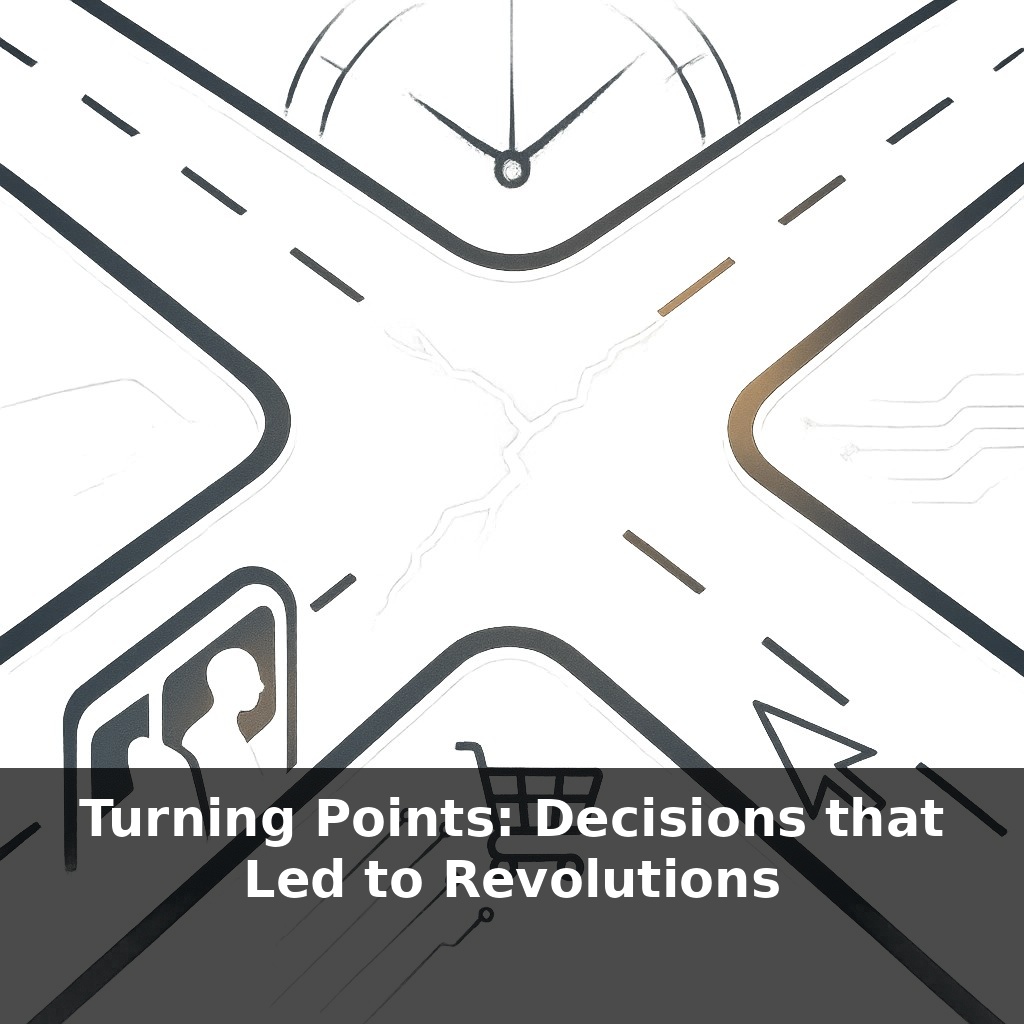
A single choice once drove about a third of Amazon’s sales. Another, from a tired seamstress on a bus, shook U.S. law. In this episode, we step into those crossroads—moments when one decision doesn’t just react to history, it quietly rewires what happens next.
Revolutions, it turns out, are less like sudden explosions and more like fault lines giving way after years of quiet pressure. The ground has been shifting—through technology, inequality, cultural change—long before anything seems to “happen.” Then someone makes a specific, time-bound choice that turns background tension into visible upheaval. That’s the pattern we’ll track in this series: not vague “turning points,” but concrete trigger decisions made under uncertainty, constraint, and risk.
Think of a startup founder choosing to open-source a core tool, or a manager deciding to share internal metrics with the whole team. On paper, they’re just policy changes. In practice, they can reset incentives, trust, and behavior at scale—often faster than anyone expects, and sometimes past the point of reversal.
Some of history’s most disruptive choices looked small in the moment: a software tweak buried in Amazon’s code, a single bus ride in Montgomery, a policy memo in Moscow authorizing more open speech. What unites them is timing. These decisions landed when systems were already strained by technology, inequality, or cultural shifts. In this series, we’ll track how leaders sensed that hidden pressure, judged when “later” had quietly turned into “now,” and accepted that action might unleash outcomes they could influence—but never fully control.
Rosa Parks didn’t start by planning a 381-day boycott. Amazon’s engineers didn’t begin with a prediction that one feature would drive 35% of sales. Gorbachev didn’t sign Glasnost expecting the country he led to dissolve. In each case, the visible outcome dwarfed the original intent. The pattern isn’t heroic foresight; it’s something subtler: a decision that happens to intersect with a system already near its critical threshold.
To see how that works, look at what surrounded those choices, not just the choices themselves. In Montgomery, there were trained organizers, legal strategies, and Black economic networks ready to coordinate. In Seattle, there was a rapidly digitizing marketplace, cheap computing power, and an internet user base big enough for data patterns to matter. In the USSR, there were exhausted citizens, stagnant growth, and nationalist movements waiting for any legal opening. The “moment” was less a spark than a doorway into structures that had quietly become unstable.
This is the first important lesson: the same decision has wildly different effects depending on when and where it lands. A company-wide transparency move in a small, aligned startup might deepen trust; the same move in a scandal-ridden giant could expose rot and trigger a purge. The decision is identical on paper; the surrounding conditions are not.
A second lesson is that influence often flows through design rather than declarations. Amazon’s recommendation engine didn’t argue with customers; it altered what they saw on the page, gently reshaping attention and habit at scale. Policy shifts like Glasnost didn’t persuade every citizen; they changed what could legally be published, debated, and organized—rewriting the practical rules of public life.
In your own context, “design” might mean how you structure meetings, who has access to which dashboards, or which metrics appear in weekly reports. A small tweak to those defaults can function less like a speech and more like new architecture: once it’s in place, people begin to move differently without being told every step.
A practical way to see this is to zoom into smaller arenas. Consider a product team that quietly flips a switch from “ship when ready” to “ship every Friday, no exceptions.” On paper, it’s just a calendar rule. In practice, bugs get surfaced faster, experiments get leaner, and people start planning in tighter loops. Over a quarter or two, the organization’s tolerance for long, vague projects erodes without anyone issuing a manifesto.
Or look at a leader who decides that every major proposal must include a one-page “kill strategy”: clear conditions under which the team will shut the project down. That single requirement can lower sunk-cost bias, make risk discussable, and normalize strategic retreat.
In sports terms, it’s like a coach moving one player from defense to midfield; the formation looks almost the same, but passing lanes, responsibilities, and scoring chances all subtly reconfigure around that shift. Your smallest visible change can function like that positional move.
Those moments don’t just reshape systems; they reshape how future moves are made. Once one bold shift succeeds, others start testing edges faster, like developers pushing smaller, more frequent updates after a smooth release. Your challenge this week: spot one small structural tweak you could make—changing a default, a recurring agenda item, or an approval path—and map how it might quietly redirect behavior over the next three months.
You won’t always know which move becomes your “Rosa Parks moment” or your Glasnost. What you can do is design for it: choose levers that, once pulled, keep working without constant willpower, like a well-placed valve in a plumbing system. Over time, these quiet re-routings of flow can turn private intent into shared, durable momentum.
Before next week, ask yourself: 1) “Where in my life am I currently at a ‘pre-revolution’ moment—like the Boston merchants before the tea protests—quietly tolerating something I know is unjust or unsustainable, and what concrete line in the sand would I actually refuse to cross?” 2) “If I had to choose one ‘Pamphlet Moment’ this week—like Paine publishing *Common Sense*—what bold opinion or idea would I share publicly (with a friend, online, or at work) even if it risks discomfort?” 3) “Looking at the French Revolution’s cascading alliances, who are the two or three people I’d need to talk with or bring together this week if I truly wanted to change this situation, and what’s the specific conversation I’m willing to start with them?”