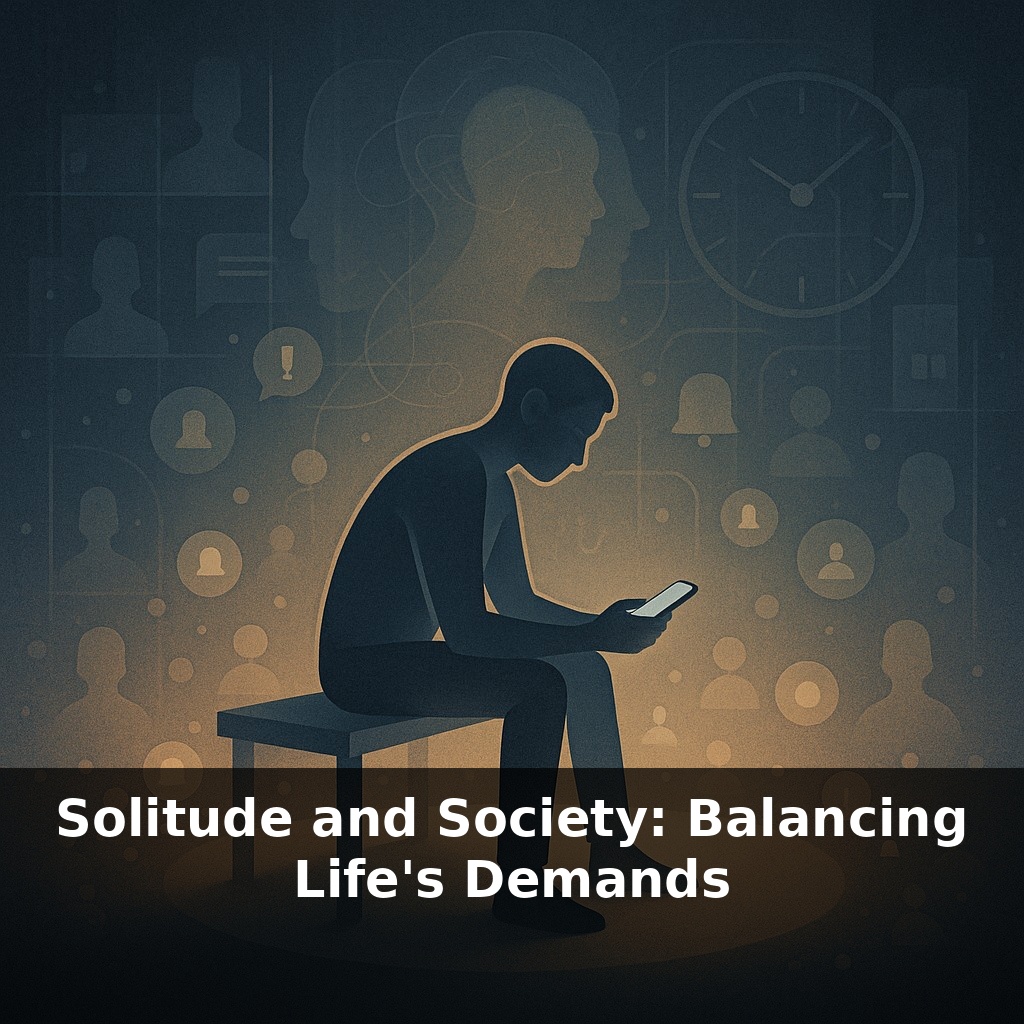
Right now, about half your waking thoughts are drifting somewhere else—away from what you’re doing, and away from what you really care about. Yet your calendar suggests you’re “busy” every minute. How can a life be packed and still feel mysteriously unfinished?
Seneca warned Lucilius that a life constantly “in public” slowly forgets who is living it. Our problem is sharper: we carry the crowd in our pocket. Messages, meetings, and metrics press in until even our private thoughts sound like notifications. We confuse being reachable with being available, being scheduled with being intentional.
Modern research backs Seneca’s worry. Brief, voluntary solitude doesn’t make us antisocial; it quietly resets the system that our social life depends on. Step away for even 20 focused minutes and stress chemistry, attention, and self-understanding begin to tilt in your favor. You return less like a drained battery and more like an updated operating system.
This series of reflections will use Seneca’s letters as a guide, not to romanticize retreat, but to design a livable rhythm: time with others that has depth, and time alone that has direction.
Seneca’s word for fruitful aloneness, *otium*, wasn’t a spa day; it was a workshop. He urged Lucilius to “withdraw into yourself, as often as you can,” not to escape life, but to audit it. In that workshop, you lay your week out on the bench like tools after a long project: which conversations sharpened you, which obligations dulled you, which ambitions are just shiny clutter. Today, “withdrawing” might mean closing the laptop, putting the phone in another room, and letting the noise settle long enough to notice what actually deserves a place in your limited hours.
Seneca thought most people made the wrong comparison. They weighed time alone against time with others, as if one had to win. The real contest, he says, is between *used* time and *surrendered* time. You can lose yourself in a crowd, but you can also lose yourself in your own house, scrolling, replying, reacting. The question isn’t “Am I around people?” but “Who is steering while I am?”
Modern studies add a concrete twist: what you *do* with short stretches alone changes what you can do with everyone else. It’s not enough to shut the door; you have to give your mind a job better than refreshing the latest feed.
Seneca offers three “jobs” for solitude that translate surprisingly well.
First, review. Not obsessive replay, but a brisk daily debrief. He describes questioning his own day before sleep: Where did I act from principle? Where did I drift? Today that might look like ten quiet minutes noting one decision you’re proud of and one you’d like to handle differently next time. This shifts your private time from vague rumination to targeted learning.
Second, rehearse. Seneca mentally walked through upcoming difficulties: difficult conversations, temptations to overwork or overindulge, moments where he knew his temper or fear might flare. Athletes now use almost the same technique—pre-visualizing a race or play. A few minutes alone in the morning, running through the key “pressure points” of your day, can preload better responses so you’re not improvising under fire.
Third, re-anchor. Seneca kept a short set of core convictions ready to hand, lines he could return to when pulled by public opinion or flattery or panic. In your terms: a handful of written sentences about what actually matters to you this quarter—not for life, just for the next season. Solitude is when you look at your calendar, your to-do list, and those sentences at the same time, and ask: does any of this match?
Notice what this makes *otium* and *negotium* look like. Time alone becomes the place you set your internal compass; time with others becomes the field where you test and refine it. Solitude that never feeds back into action curdles into fantasy. Activity never checked against reflection hardens into automatic habit.
The balance isn’t found once. It’s tuned like an instrument: a little flat after heavy social demand, a little sharp after prolonged withdrawal, always needing small corrections—not a grand life overhaul, but a series of quiet, deliberate adjustments.
Consider two people leaving the same intense meeting. One walks straight into the next call, inbox open, chat pings live. By evening, their reactions from that first meeting have hardened into quiet resentment and vague anxiety, but they’re not sure why. The second blocks 15 minutes, closes the door, and does a quick three-part pass: What actually happened (review)? What similar moment is coming tomorrow (rehearse)? What matters more than “looking good” in those moments (re-anchor)? They emerge carrying a decision instead of a mood.
A manager at a design firm tried this between project handoffs: a short walk, no phone, just jotting three bullet points—one lesson, one risk to watch, one value to protect. Within a month, feedback from her team shifted: less “scattered,” more “clear, even under pressure.”
Your version might be a commute done without podcasts, or sitting in a café *without* opening the laptop, letting the sediment of the day settle just enough to see what’s actually at the bottom.
If more people practiced this kind of deliberate alternation, cities and schedules might start to look different. Homes could include small “thinking corners” as routinely as desks. Teams might treat quiet time like athletes treat recovery days—non‑negotiable, performance‑critical. Laws that once focused only on wages and hours may slowly expand toward protecting cognitive space. Over time, a culture that respects retreat may argue less about “work–life balance” and more about “clarity–connection balance.”
Treat this as ongoing fieldwork in your own life. Adjust how much quiet you get the way a runner tweaks training: log what happens when you add even one more “empty” block to your week. Notice which relationships feel easier, which choices come faster, which habits loosen their grip when you’ve had time to think before you join the crowd.
Start with this tiny habit: When you close your laptop at the end of the workday, pause for 30 seconds and take one slow breath while asking yourself, “Do I need solitude or connection right now?” If the answer is solitude, spend just 2 minutes in a quiet spot (even the bathroom), with your phone on airplane mode, doing nothing but noticing sounds and your breathing. If the answer is connection, send one sincere, specific message to a friend (e.g., “That article you shared about burnout really stuck with me today”). This tiny check-in builds the muscle of choosing between being alone and being with others on purpose, instead of getting pulled by habit or guilt.