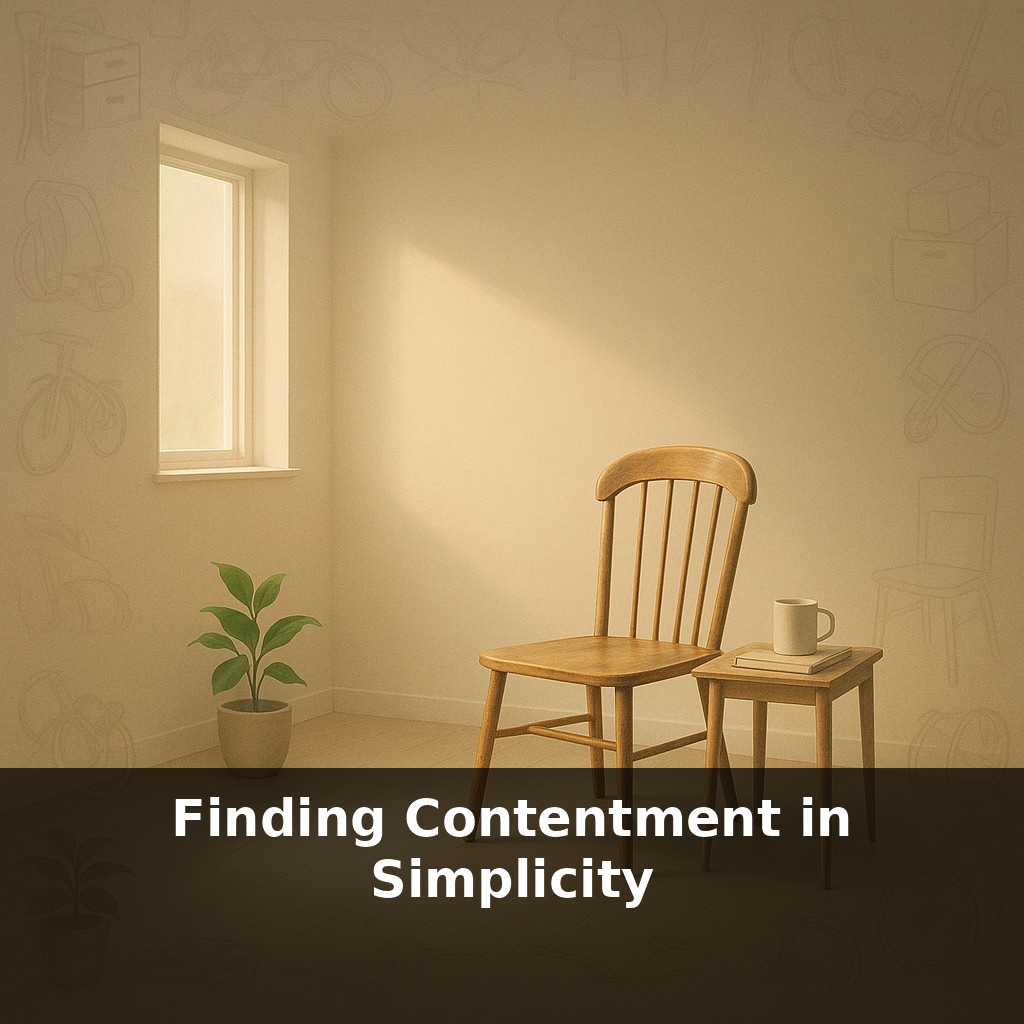
Most families regularly use only about a fifth of their homes. The rest? Boxes, “just in case” gadgets, forgotten hobbies. Now here’s the twist: even as our spaces grow, reported contentment often shrinks. So why does adding more to life so often leave us feeling like we have less?
Seneca thought the real luxury in life wasn’t owning more, but needing less. Modern research quietly backs him up: people who care less about “getting ahead” in visible ways often score higher on measures of peace, autonomy, and self-respect. Not because they’re saints, but because their lives demand fewer trade-offs they secretly resent.
Think about your calendar, browser tabs, notifications, half-finished projects. Most of us now carry a portable crowd in our pockets: opinions, comparisons, offers, updates. Each one is tiny, but together they nudge us toward a life organised around reaction rather than intention.
Here’s the shift this series is aiming at: instead of asking, “How can I fit more in?” we’ll ask, “What earns a place in my limited time, energy, and attention?” Contentment in simplicity often begins there—not with a smaller life, but with a sharper one.
Seneca warned that “the man who is everywhere is nowhere.” Today that “everywhere” is less about travel and more about mental tabs left open. Research on decision fatigue shows that every extra choice—outfits, apps, subscriptions, social plans—quietly taxes our mood and self-control. The result isn’t dramatic burnout, but a low-level erosion of clarity. We say yes because it’s easier than pruning. We scroll because it’s easier than choosing a focus. In this episode, we’ll treat your life like a limited interface: fewer buttons, clearer signals, more deliberate use of the functions that truly matter.
“Materialism is linked to lower well-being with an average correlation of about –0.30.” In research terms, that’s not a tiny blip—it’s a consistent, medium-strength nudge in the same direction across hundreds of studies: as our attachment to possessions rises, our overall life satisfaction tends to fall.
Seneca would say this isn’t a moral punishment; it’s a design flaw in the strategy. When externals become the main source of comfort or identity, you’re forced into a permanent maintenance job: earning, upgrading, defending, comparing. The more parts your life’s “machine” has, the more ways it can break.
Notice something about the lives you quietly envy—not the loud, performative ones, but the people who seem grounded. Often, their days are structured around a few stable anchors: a craft, a small circle of relationships, a rhythm of work and rest. Their peace isn’t in dramatic retreats to cabins; it’s in not needing constant novelty to feel okay.
Modern data supports this shift from “more stuff” to “more aligned use of self.” Intrinsic goals—learning, close connection, contribution—are less dependent on perfect conditions. You can pursue them in a studio apartment or a large house, with old furniture or designer pieces. That flexibility makes them robust sources of meaning.
Stoic practice adds another layer: training attention to rest more on what can’t be taken away—your choices, character, and response. Exercises like negative visualisation don’t just reduce anxiety; they recalibrate what counts as “enough.” When you spend a few minutes genuinely contemplating life with less health, fewer comforts, or lost status, your current baseline stops looking like a deprivation.
This isn’t about ascetic heroics. It’s about margin. Excess commitments shrink the gap between your capacity and your load, so minor problems feel like crises. When you deliberately limit inputs—possessions, projects, even social streams—you’re reclaiming slack: time you don’t have to justify, attention you don’t have to defend.
From there, “living according to nature” becomes less abstract. It might look like aligning your day with your real energy curve instead of your inbox, or choosing hobbies that restore you rather than advertise you. The outer simplification is just scaffolding; the real construction project is an inner life that can stay steady, even when circumstances don’t.
A practical way to see this is in a workday. Two colleagues both log eight hours. One keeps adding “just one more” tool—three chat apps, overlapping side gigs, constant status checks. The other quietly prunes: one main communication channel, a short list of priorities, a fixed shutdown time. Same job title, different architectures. A month later, their stress levels and sense of agency have drifted far apart. The second hasn’t escaped pressure; they’ve reduced friction.
You can see the same pattern in how people use technology. One person lets every app default to “on,” so their phone behaves like an open-plan office with no doors. Another treats settings as boundaries: batches notifications, removes non-essential apps from the home screen, unsubscribes aggressively. Both own the same device; only one treats it as a tool rather than a corridor others can enter at will.
Like refactoring a bloated codebase, they delete redundant functions, simplify what remains, and suddenly everything runs faster on the same hardware.
A quieter life doesn’t mean a smaller life; it often means a sharper one. As AI, automation, and endless feeds expand what you *could* do, choosing what you won’t do becomes a core skill. Treat constraints like the rules of a good game: they don’t limit play, they create it. You might notice that when your schedule, home, and screen are less crowded, bolder moves feel safer—starting a project, ending a stale role, saying “no” without a speech. Space outside quietly invites more honesty inside.
Let your days be more like well-edited playlists than endless autoplay: fewer tracks, chosen on purpose, with quiet between them. As you strip away what’s merely “fine,” you create room for what feels alive—curiosity, craft, real rest. Your challenge this week: remove one recurring obligation, app, or purchase you don’t truly miss, and notice what quietly grows in its place.