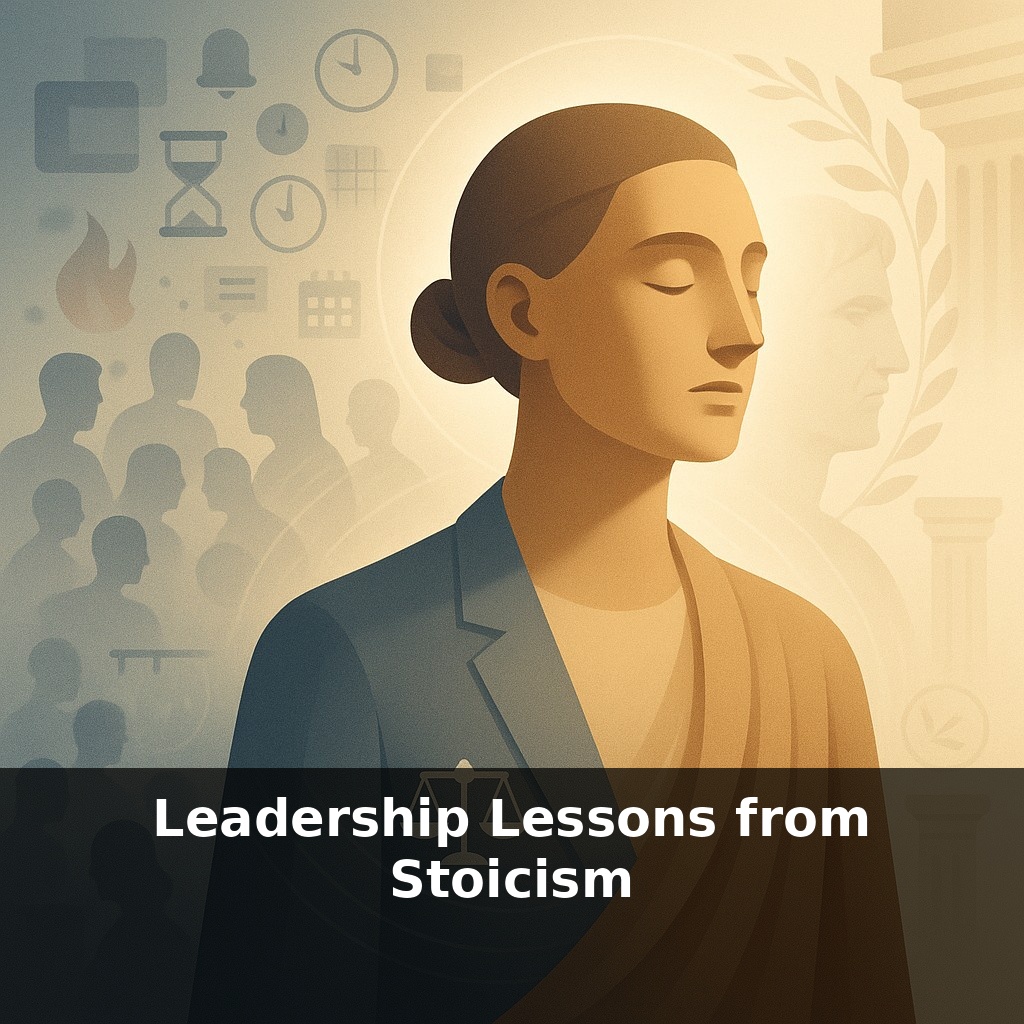
Seneca called anger “a brief insanity.” Modern research backs him up: leaders acting in anger are far more likely to cross ethical lines. So here’s the paradox: in moments everyone else speeds up and lashes out, the best leaders slow down—and say almost nothing.
Seneca would probably be baffled by our calendars: back‑to‑back meetings, constant notifications, decisions layered on decisions. Yet he knew this pressure in his own way—advising an emperor, navigating court intrigues, writing about staying sane while standing next to power. His answer wasn’t retreat; it was training the mind the way an athlete trains the body.
In modern terms, he was obsessed with what today we’d call “mental operations”: how you interpret events, how quickly you escalate a story in your head, how long you replay a slight or a setback. He believed that most inner chaos comes not from events themselves, but from the automatic “scripts” we let run unquestioned.
For a modern manager, founder, or executive, this isn’t abstract philosophy. It’s the difference between a team that mirrors your worst mental habits… and one that quietly absorbs your best.
Seneca’s twist is that he treats your mind less like a mystery and more like a system you can debug. Instead of asking, “How do I feel about this?” he’d push, “What *story* did I just auto‑load, and is it actually true?” That’s where Stoicism collides with modern leadership science: CBT‑style reframing, the circle of control, and the Stockdale Paradox all sit on this same hinge—what you do in the first few seconds after something hits. Those first seconds quietly determine whether you escalate, freeze, or respond with the kind of clarity other people instinctively trust.
Seneca’s Letters read, at times, like executive coaching notes smuggled out of a crisis.
He keeps returning to one practical move: slow the *interpretation*, not the action. Things happen fast; the story you attach to them doesn’t have to. Modern performance research quietly agrees: most costly decisions aren’t made under pure time pressure, but under *perceived* time pressure—when you’ve already decided “this is a disaster” or “this is an attack” and everything that follows is just execution on that first, sloppy draft.
So Seneca trains a different reflex: insert a thin wedge of awareness between event and explanation.
He gives himself prompts. Instead of, “Why is this happening *to* me?” he asks: - “What are the facts I’d agree on with a neutral observer?” - “What part of this is opinion I’ve layered on top?” - “What would this look like from the other person’s side?”
These aren’t philosophical decorations; they’re a repeatable mental protocol. You can almost hear the echo in modern data about stress and performance: reduce the number of internal alarms you trigger, and you reduce the biochemical storm that follows.
He also pushes for rehearsed calm, not improvised calm. Hence practices like *pre-meditatio malorum*: walking through potential obstacles *before* you’re in the room. Today’s equivalent isn’t just “contingency planning” in a slide deck; it’s rehearsing the *emotional* hits as seriously as the operational ones:
- The project gets cut after months of work. - A trusted colleague disagrees publicly. - A decision you championed fails, visibly.
Seneca’s question: “What will I choose to admire or protect in myself when that happens?” Not what outcome you’ll secure, but what quality you’ll refuse to trade away—fairness, steadiness, clarity, humility.
This is where his letters quietly become a values workshop. If you haven’t made those commitments in advance, the environment will make them for you—usually in favor of speed, appearances, and short-term relief.
Think of it like refactoring old code in a legacy system: you’re not rewriting your whole personality, but you *are* replacing fragile, crash-prone routines (“I must win this argument”) with more robust ones (“I must remain truthful and calm, even if I lose face here”). Over time, that invisible refactor changes what it feels like to work with you—and what it feels like to work *as* you.
A VP of product hears that the board wants “a radical shift in strategy.” The familiar inner monologue boots up: “Months of work—wasted. They don’t trust me. I’m on thin ice.” Seneca’s move would be to catch that script *mid‑load* and swap it for a cleaner query: “What, precisely, has changed—and what’s my best next move?” Notice he isn’t becoming passive; he’s stripping out drama so judgment can come back online.
Or take a founder walking into a tense quarterly review. Instead of hyping themselves with vague affirmations, they’ve done a quiet pre‑run: “If numbers disappoint, I’ll prioritize candor over defensiveness. If challenged hard, I’ll stay curious, not combative.” That rehearsal doesn’t guarantee a pleasant meeting, but it does upgrade the default behavior when emotion spikes.
One more case: a manager about to roll out an unpopular, but necessary, policy. Before the announcement, they jot two columns: “What I can clarify, support, and influence” vs. “How people initially feel.” Then they design their message entirely around the first column—and accept the second as weather.
Tools that once lived in philosophy seminars are quietly being wired into dashboards and workflows. Over the next decade, expect dashboards that don’t just show revenue, but prompt end‑of‑day reflection; performance reviews that ask how pressure was handled, not only what targets were hit. Think of culture like an operating system: organizations that embed these mental updates will run fewer “crashes” during shocks, while others keep rebooting the same brittle habits under new slogans.
Treat this as ongoing R&D on yourself, not a finished product. Seneca’s letters are less a rulebook than a lab manual: test, observe, refine. Over time, your calendar becomes a training ground; each tough meeting, a stress test. Like tuning an instrument between songs, you’re quietly adjusting so your next note rings clearer.
Start with this tiny habit: When you open your laptop in the morning, whisper to yourself, “I control my response, not the outcome,” and picture one stressful leadership situation you’re likely to face today (like a tense 1:1 or tough status meeting). Then, in your head, rehearse saying just one calm, Stoic-style question you’ll use in that moment, like “What’s in my control right now?” or “What’s the most rational next step?” Keep it under 20 seconds, then move on with your day.