Researchers found that people who wait just one day before clicking “buy now” end up spending noticeably less over time. So why do we still plan our vacations, but not our gadgets, outfits, or décor? Today, we’ll tap into that paradox and rethink how we plan our wants.
We plan big trips months ahead, yet most “small” wants sneak in during three-minute scrolls between emails. That gap between long-term planning and split-second buying is where your budget quietly leaks. Today, we’ll zoom out from single purchases and look at the system you use—on purpose or by default—to decide what gets your money.
Think of your income like an app store credit that refreshes every month: if you don’t decide ahead of time which downloads matter, the flashy ones grab it first. We’ll explore how people who succeed with money treat wants less like treats and more like projects: they match them to their values, fit them into a realistic cash-flow timeline, and give every dollar a specific “job” before payday hits.
By the end, you’ll be ready to sketch a simple, flexible plan so your favorite wants stop colliding with your future goals.
Instead of trying to control every impulse in the moment, smart spenders redesign the “environment” their money moves through. That’s where written plans and simple systems come in. A framework like 50/30/20, zero-based budgeting, or digital buckets works less like a strict diet and more like a calendar for your cash: it tells you *when* and *where* certain wants can land. Research backs this up—households using any written plan hit savings targets far more often. The goal isn’t perfection; it’s building rails so that even on busy, distracted days, your routine quietly protects the goals you care about.
Most people jump straight into spreadsheets; the better starting point is deciding *which* wants deserve a place in your life at all. A quick filter: if you woke up tomorrow with the same income but half the free time, which non-essentials would you fight hardest to keep? Those are “high-value wants”—they earn space in your plan before the forgettable stuff.
Next, translate that into numbers. Look back at the last 2–3 months of bank and card activity and pull out only non-essential purchases. Don’t judge them; just group them into 5–7 realistic categories: eating out, clothing, digital subscriptions, hobbies, beauty, home, random “scroll buys.” The goal is to reveal your actual pattern, not your ideal one.
Now, instead of asking, “Can I afford this?” every time, assign each category a *monthly lane*—a target amount that fits inside your broader budget framework. This is where systems differ:
- With a 50/30/20-style plan, you’re deciding how the “wants” slice gets divided. - With zero-based budgeting, each category becomes a specific line item. - With envelope or digital buckets, each lane turns into its own “container” that you fill on payday.
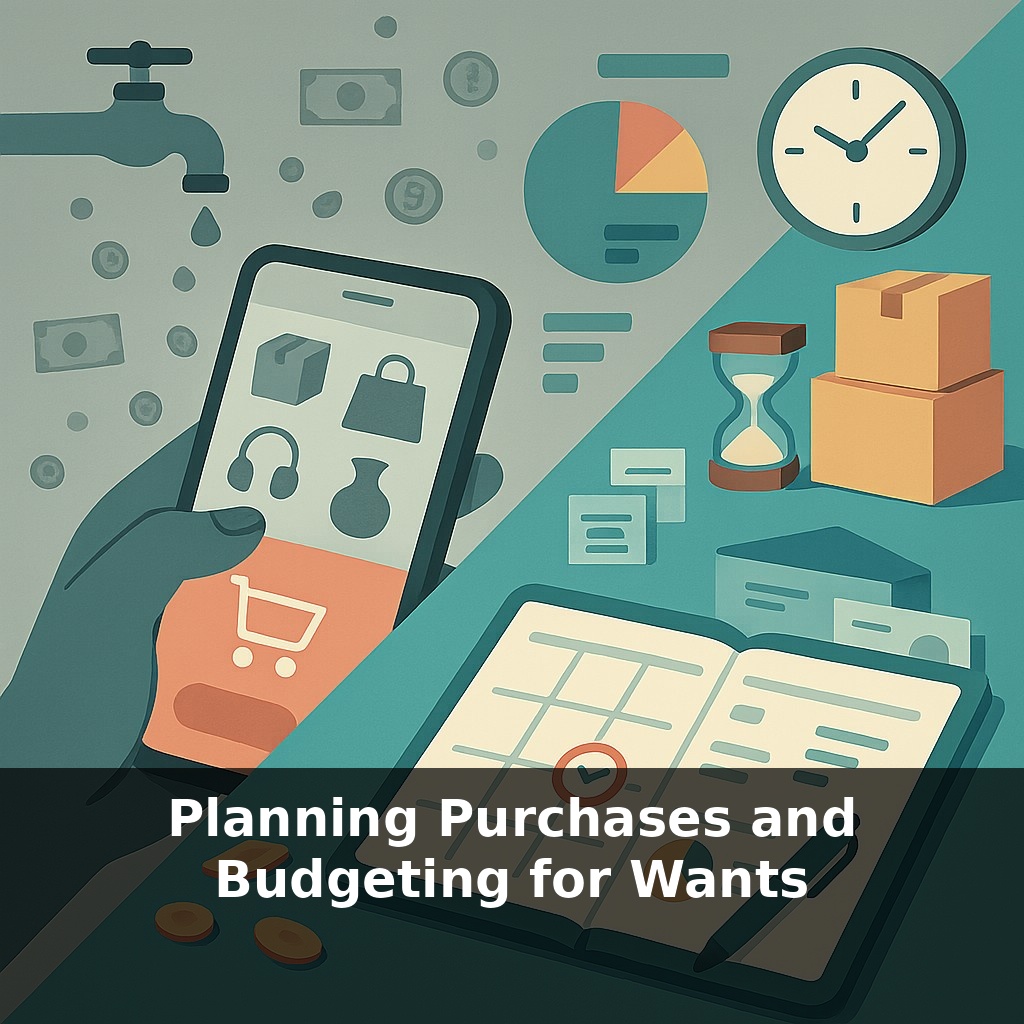
To make wants more deliberate, schedule them. Create a simple purchase calendar: weekly slots for small pleasures (coffee dates, rentals, in-game currency), monthly slots for mid-size buys (shirts, décor, a night out), and quarterly slots for bigger splurges (tech, furniture, event tickets). Assign rough price caps to each slot. When a new want pops up, your first question becomes, “Which slot does this belong in—and is that slot already taken?”
Pre-commitment tools then make these decisions automatic. Separate accounts for future fun, automated transfers into sinking funds for bigger wants, and retailer wishlists act like gates. If something isn’t in a lane or on the calendar, it doesn’t get fast-tracked—it waits for the next open slot.
Over time, this shifts your identity from “someone who resists temptation” to “someone who runs a system.” The system doesn’t forbid treats; it forces them to *compete* with each other, so only the most meaningful ones make the cut.
A “purchase calendar” sounds abstract until you see it in motion. Say Alex makes $3,500 after tax. Fixed costs and goals are covered, leaving $700 for flexible spending. Instead of letting that disappear, Alex divides it: $60/week for café meetups and takeout, $100/month for style upgrades, $200/quarter for one “headline” want.
In January, that headline is noise‑canceling headphones at $180. When a $95 flash‑sale jacket appears, it has to compete with the headphones *and* the existing style budget. Alex parks it on a wishlist and checks the calendar: the “headline” slot is already booked, but next quarter is open. If the jacket still feels worth it then, it moves to center stage; if not, it quietly dies in the wishlist graveyard.
This is where tools matter. Some people use a shared Google Calendar with color‑coded “fun” events and paydays. Others build a simple “Wants Roadmap” in a notes app: three columns labeled This Month, Next 3 Months, Later. New wants must find a spot on that roadmap before any money moves.
Smart budgeting will soon feel less like math and more like collaboration. Your purchase calendar could sync with AI that scans loyalty programs, weather, even your social plans—nudging you when a concert aligns with a low-spend week, or warning you that three “small treats” are clustering like buses. Instead of one big monthly decision, you’ll see tiny course corrections in real time, like a maps app quietly rerouting you around traffic before you even hit the jam.
As you test a purchase calendar, expect it to feel awkward—like switching from sprinting to running with a coach. That friction is data: which wants you defend, which you forget, and which only existed because an ad popped up. Over a few cycles, you’ll start to see patterns, and small tweaks—not heroic willpower—will quietly reshape your spending.
To go deeper, here are 3 next steps:
1. Plug your top 3 “wants” from this week into the free **EveryDollar** or **YNAB** app and actually assign a dollar amount + target month for each so you can see how they fit alongside your non-negotiable bills. 2. Open a “Fun Goals” savings space at your bank (or in **Ally/Capital One 360**), label separate buckets like “New TV,” “Weekend Trip,” or “Wardrobe Refresh,” and set up an automatic weekly transfer—even if it’s just $10—to each one. 3. Before your next big purchase, run it through **Ramsey’s Buy-Now vs. Save Calculator** or **NerdWallet’s Affordability Calculator** and decide: “Am I willing to delay this 30 days to pay cash?”—then put that exact amount into the matching savings bucket today.