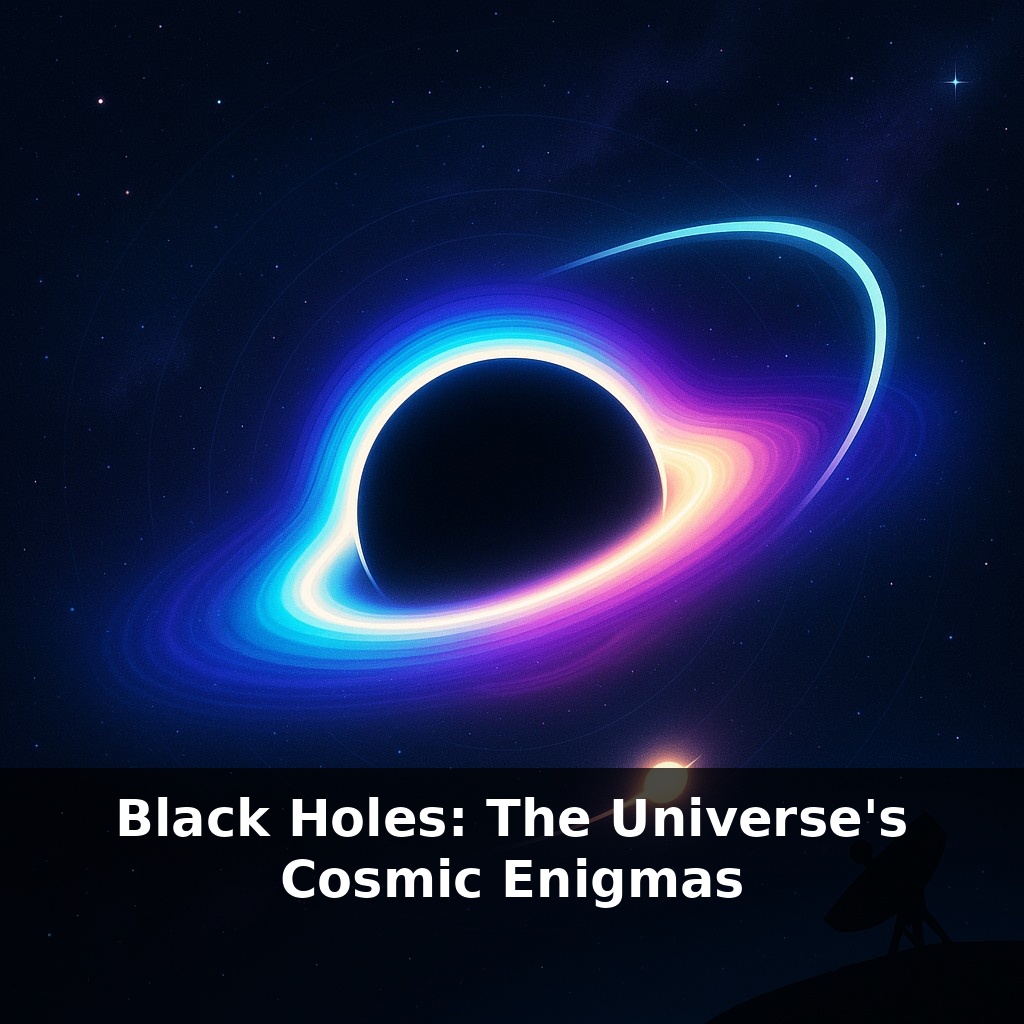
Black Holes: The Universe's Cosmic Enigmas
📝 Transcript
A place that traps light sounds like pure science fiction—yet our galaxy orbits one. You’re drifting through space, watching a star die. Instead of exploding outward, it collapses into a point so dense that space and time themselves buckle… and every escape route simply ends.
You might expect something that can trap light to be hyperactive and obvious—but most black holes are quiet, practically invisible neighbours. Astronomers don’t “see” them directly; they stalk them by their fingerprints. A star wobbling strangely, gas heated to extreme temperatures as it orbits a hidden centre, a sudden flare of X‑rays: these are the clues that betray a black hole’s presence, like steam hinting at a hidden pressure cooker in a kitchen. On much larger scales, entire galaxies seem to orbit gigantic, unseen anchors. At their cores, super‑massive black holes regulate how fast stars form, sometimes snuffing out stellar nurseries with powerful outflows. And when two black holes finally collide, they don’t just vanish—they ring the universe like a distant cosmic bell, sending out ripples we can now detect on Earth.
Some of the strangest black holes didn’t start as stars at all. At the centres of galaxies, super‑massive black holes sit where countless generations of gas clouds, stars, and smaller black holes have poured in over cosmic time. Around them, matter forms whirling disks, flinging out jets that can outshine the galaxy’s entire stellar population. Others may be even more exotic: “primordial” black holes, if they exist, could be ancient fossils from the universe’s first seconds, forged not by dying suns but by violent fluctuations in the newborn cosmos, like rare flaws frozen into rapidly cooling glass.
For all their mystery, black holes are shockingly simple on paper. Give physicists just three numbers—mass, spin, and electric charge—and general relativity says you’ve told them everything classical about a black hole. This “no‑hair” idea means all the messy details of what fell in are erased from the outside view. A collapsing star, a stream of gas, or a swarm of dark matter particles that end up inside the same horizon produce an indistinguishable object, as far as distant observers can tell.
Yet the environment around that horizon is anything but simple. Near fast‑spinning black holes, space itself is dragged around in a twisting swirl called frame‑dragging. Anything nearby is forced to co‑rotate, like a crowd caught in a slowly turning revolving door. In extreme cases, this effect is powerful enough that theoretical spacecraft could, in principle, steal a bit of rotational energy and slingshot away with more speed than they arrived.
Add magnetic fields and infalling plasma, and things become even more extreme. Chaotic turbulence in the surrounding disk can launch collimated jets that punch out of the galaxy, accelerating particles to energies our best accelerators can’t touch. Those particles emit high‑energy light that telescopes like Chandra and Fermi monitor, turning distant black‑hole systems into live feeds of physics under crushing conditions.
Then comes the quantum twist. Stephen Hawking showed that horizons themselves should glow faintly with “Hawking radiation,” because quantum fields near the boundary never quite stay quiet. Pairs of virtual particles can be torn apart so that one escapes while its partner falls in, making the black hole slowly lose mass. For stellar and super‑massive black holes this evaporation is glacially slow, but for hypothetical tiny ones it would be a brief, violent finale.
All this fuels a deeper puzzle: what happens to information about everything that falls in? Classical relativity seems to hide it forever; quantum theory insists information can’t just vanish. This “information paradox” has pushed researchers to propose holographic universes, quantum‑entangled horizons, and new kinds of spacetime foam, using black holes not as monsters at the edge of understanding, but as the very tools for sharpening it.
Think of the universe’s biggest observatories as a network of specialised “senses” tuned to these enigmas. The Event Horizon Telescope links radio dishes across Earth to map the glowing plasma skimming just outside horizons. LIGO and Virgo listen for tiny stretches and squeezes in spacetime when distant pairs spiral together. Soon, LISA—three spacecraft flying millions of kilometres apart—will trail Earth, tracing slow, deep gravitational notes from super‑massive encounters.
Even our own galaxy’s centre, Sagittarius A*, has become a test site: by tracking individual stars whipping around it, astronomers watch relativity in action over decades. On smaller scales, simulations running on supercomputers evolve swarms of particles and magnetic fields, checking whether our equations reproduce the flickers and flares we actually see. In finance terms, each observation is like a different market indicator; only by combining them do we glimpse the underlying “economy” of gravity and quantum fields.
Black holes may end up guiding technology as much as theory. As detectors improve, we’ll treat their signals like ultra‑precise clocks, probing tiny drifts that could flag new physics. Astronomers will use their growth histories to reverse‑engineer how the first galaxies assembled. Data scientists, meanwhile, treat messy telescope feeds like training sets, using AI to spot subtle patterns the way chefs refine a recipe—tweaking inputs until simulations “taste” like the cosmos itself.
In the end, these objects act less like villains and more like cosmic editors, trimming, revising, and sometimes redacting chapters of the universe’s story. Each new detection—whether a faint murmur in spacetime or a blurry ring of light—adds a sentence to a draft we’re still revising, inviting us to keep turning pages we haven’t written yet.
Here’s your challenge this week: pick one famous black hole from the episode (like Sagittarius A* at our galaxy’s center or Cygnus X-1) and spend 20 minutes digging into two recent observations or discoveries about it using NASA, ESA, or peer-reviewed sources. Then, create a single-page “cosmic wanted poster” for that black hole that includes its mass, distance from Earth, how it was detected (X-rays, gravitational waves, etc.), and one mind-blowing fact about its event horizon or accretion disk. Before the week ends, explain that black hole out loud to a friend or family member in under 2 minutes, aiming to make them say “wait, what?!” at least once.
From this course
Space Oddities: Uncommon Discoveries in the Cosmos
6 episodesUnlock all episodes
Full access to 6 episodes and everything on OwlUp.
Subscribe — $1.99/monthLess than a coffee ☕ · Cancel anytime