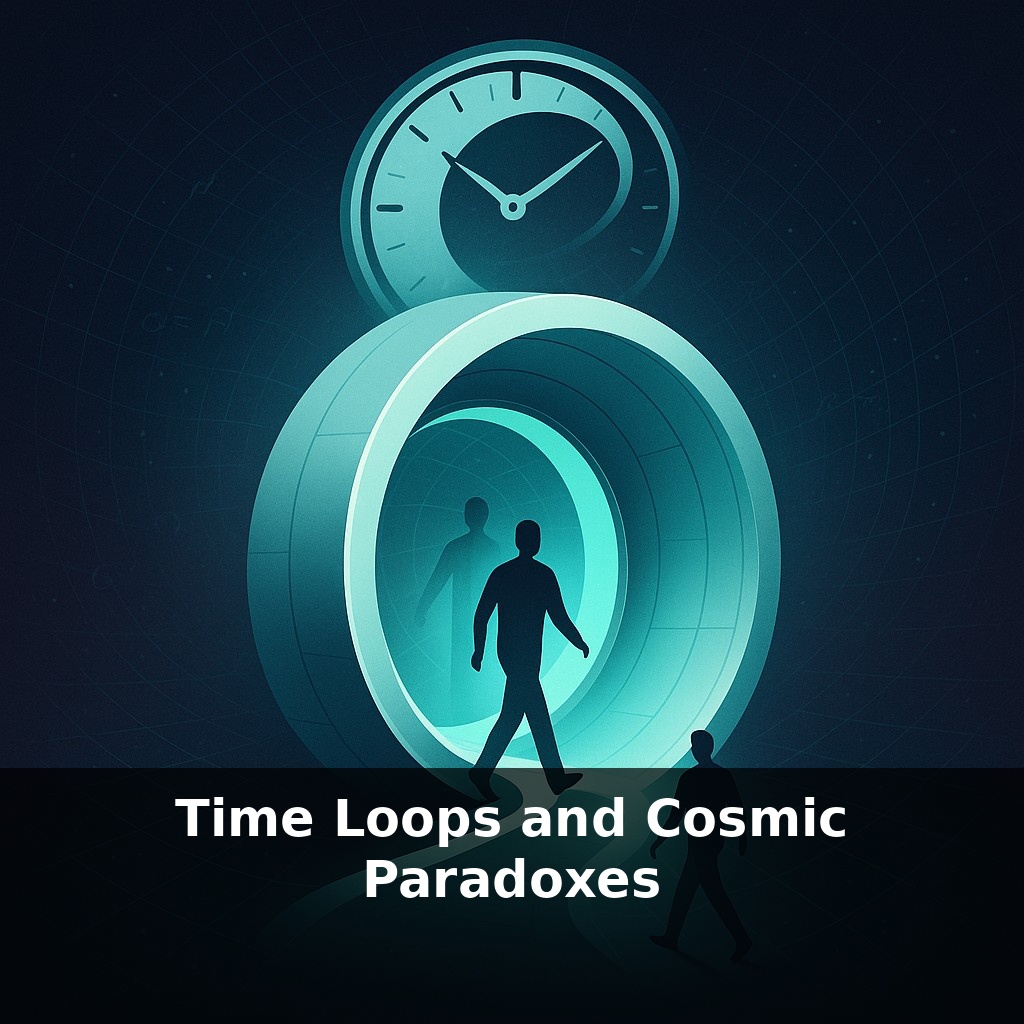
You step into a chamber, walk in a straight line, and burst out the door—right back into the moment you started. Same room, same clock on the wall… but you remember the walk. If you can return to your own past like that, here’s the puzzle: who decided what already happened?
Physicists have actually written down space-times where that chamber isn’t science fiction, but a precise solution of Einstein’s equations. These closed timelike curves aren’t “magic portals”; they’re legitimate paths through a warped universe where the straightest possible line happens to loop back on itself. The catch is, every recipe for such a universe demands ingredients our cosmos doesn’t obviously offer: infinitely long rotating cylinders, cosmic strings whipping by at absurd speeds, or matter with energy properties that break all the usual rules. And even if nature allowed one of these constructions, you’d slam into a deeper problem: logic itself. The infamous “grandfather paradox” isn’t about machinery or rockets—it’s about whether a universe with loops can host events that contradict their own prerequisites, like a story that erases the chapter that made it possible.
In real physics, that logical tangle shows up as a battle between two pillars: general relativity, which calmly writes down looping space-times, and quantum theory, which hates contradictions but loves probabilities. Some researchers propose a kind of cosmic “error-checking,” where only histories that never conflict are allowed to occur at all. Others lean on quantum branching: every risky decision in a loop might shatter into multiple consistent outcomes, none violating cause and effect. Instead of a single fragile storyline, the universe could behave more like a massively redundant backup system, where paradoxes are quietly routed around.
The next layer down is to ask how, in detail, a looped history could “choose” a consistent version of events. One camp takes the Novikov idea seriously and pushes it to the limit: every interaction in a loop must be arranged so that the outcome never conflicts with its own origin. Kill your younger self? Then something always goes wrong—the gun jams, you slip, or you change your mind. At first glance that sounds like the universe conspiring against you, but mathematically it just means that trajectories leading to contradictions are assigned probability zero. The only allowed timelines are ones that close neatly without logical loose ends.
A more radical camp treats loops as a new kind of quantum device. In several models, a system that travels around a loop is required to emerge in exactly the same quantum state it had when it entered. That consistency condition dramatically alters what’s possible. Tasks that are brutally hard for ordinary computers, like searching enormous databases, become almost trivial in these toy universes because “wrong” answers can’t survive the round trip: only self-consistent outcomes feed back into themselves. It’s like debugging code with a compiler that automatically refuses to output programs containing logical contradictions, no matter what you type.
Then there’s Hawking’s chronology protection idea, which attacks the loop itself rather than the logic inside it. As you squeeze space-time toward a configuration that would permit circling back in time, quantum fields riding on that geometry respond violently. Calculations suggest that fluctuations in those fields would pile up near the would‑be loop, blowing up the energy density and shredding the conditions you tried to create. In that picture, every attempt to engineer a loop triggers a runaway instability that slams the door shut just in time.
So far, the lab can only play with stand‑ins. Quantum optics experiments and small‑scale quantum computers simulate information traveling through a loop by cleverly reusing parts of a circuit, enforcing self‑consistency in software rather than space-time. These analogues can’t send messages to yesterday, but they do let physicists test whether the strange rules proposed for looped histories actually produce sensible, non‑paradoxical predictions—or whether an even deeper principle still waits to be uncovered.
In practice, the closest we get to these loops lives in carefully controlled devices. One family of quantum optics experiments sends photons through circuits where parts of the output are deliberately fed back as input, with constraints that mimic self‑consistent histories. Another line uses small quantum processors programmed so that certain qubits play the role of “looped” systems: their final state is forced to match an earlier one, and researchers watch how this alters what counts as a likely outcome. A time loop is like a feedback feature in financial trading software that refuses to execute any strategy whose simulated backtest would have prevented the strategy from existing in the first place; only internally consistent trades survive the filter. By tweaking the rules of these artificial loops—changing how strongly “consistency” is enforced, or how noise creeps in—physicists can map which kinds of paradox‑free behavior show up robustly, and which vanish the moment reality’s imperfections are allowed in.
If future theories rule out loops entirely, causality becomes a hard budget line in physics—no overdrafts, no creative accounting. But if some exotic corner of spacetime permits them, they become a resource to be managed like nuclear power: risky, tightly regulated, and transformative. Even partial hints—say, odd signatures near spinning black holes—could push engineers to design “causality‑aware” tech, algorithms, and even legal systems long before any literal time machine exists.
Your challenge this week: treat cause and effect like experimental knobs. When you plan anything—a message, a meeting, a meal—ask how tiny tweaks now might echo back as “impossible coincidences” later. Time loops may never be built, but thinking with causality as a design variable can reveal hidden options in how your future unfolds.