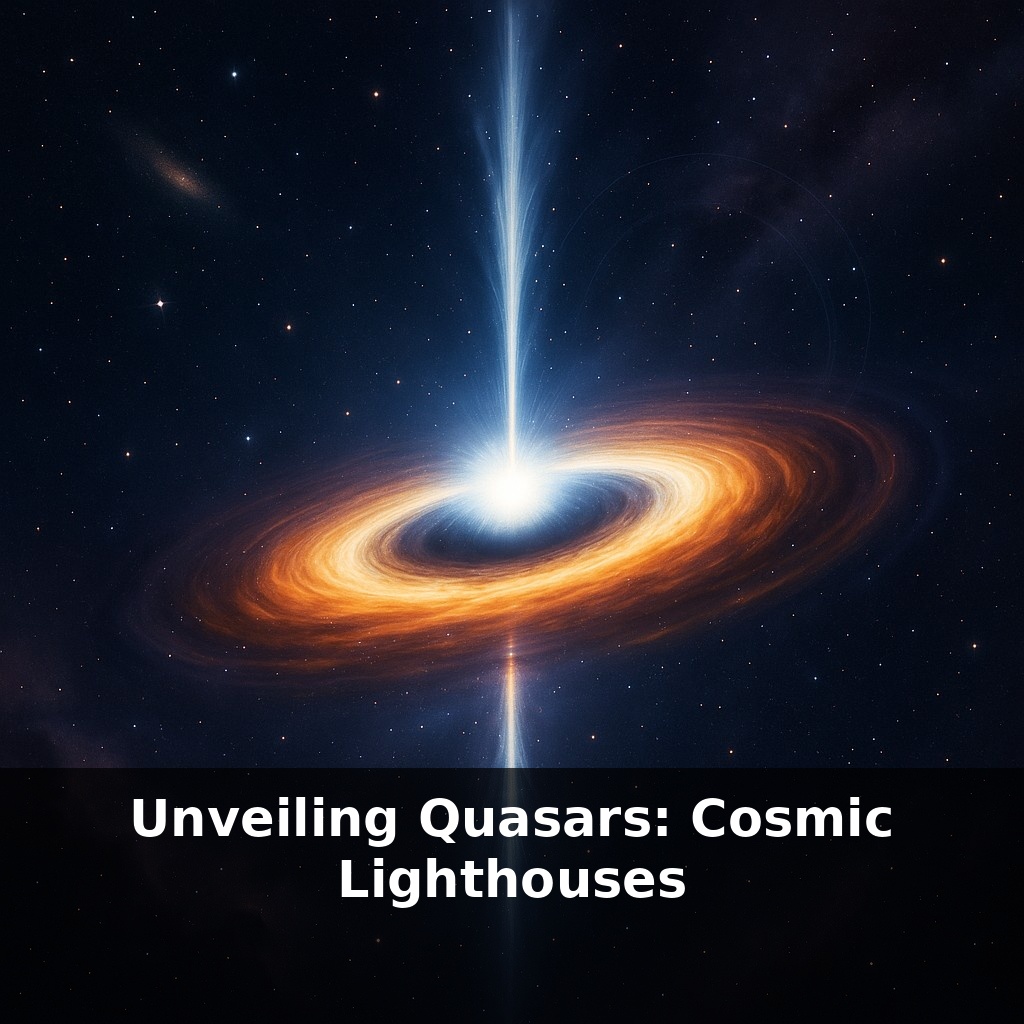
A single quasar can shine brighter than a thousand Milky Ways, yet it’s powered by something that lets no light escape. Tonight, we drop into the hearts of young galaxies, where invisible black holes turn falling gas into the loudest beacons in the cosmos.
At first glance, quasars look like cosmic mistakes: pinpricks of light so bright they masquerade as nearby stars, yet they sit billions of light‑years away. When astronomers first found them in the 1960s, their spectra were so stretched by cosmic expansion that no one recognized the fingerprints of familiar elements. Only after carefully “unscrambling” the pattern did it click: these weren’t strange new atoms, but ordinary hydrogen and helium, flung to extremes by distance and speed. That realization turned quasars into time machines. The most remote examples—like J0313‑1806 at redshift 7.64 and its newer rivals creeping past z ~ 7.8—show us the Universe as it was when it was under a billion years old. By mapping thousands of quasars, astronomers now trace invisible filaments of dark matter, testing how the first massive structures assembled and how they lit up surrounding space.
Astronomers don’t just admire quasars—they use them as tools. Because these objects are so far away yet incredibly bright, their light crosses vast stretches of space, slipping through clouds of primordial gas and faint galaxies along the way. Each obstacle leaves a tiny “bite” in the spectrum, a bit like transaction records on a bank statement. Reading those imprints, researchers reconstruct when the first stars flooded space with ultraviolet light, how quickly heavier elements spread, and how violently young galaxies grew, merged, and sometimes snuffed out their own future star‑forming fuel.
For all their blinding output, quasars are surprisingly compact. The regions doing most of the shining are roughly the size of our Solar System, wrapped around black holes tens of millions to billions of times the Sun’s mass. Matter spirals inward through an accretion disk, heating until atoms are stripped bare and radiation pressure becomes fierce enough to shove material back out. That tug‑of‑war carves the environment into distinct zones: a hot, bright inner disk; a surrounding “broad‑line” region of fast‑moving gas clouds; and farther out, cooler, dusty structures that absorb and reradiate light in the infrared.
This structure means astronomers can treat quasars like laboratories for extreme physics. By watching how their brightness flickers over hours to years, they infer the size of emitting regions—light can’t vary faster than it can cross the source. Rapid X‑ray and ultraviolet changes point to activity very close to the event horizon, where gravity mangles space and time. Slightly slower optical echoes from more distant gas let researchers “reverberation map” the layout in three dimensions and weigh the central mass.
Jets are another clue. In about 10% of cases, twisted magnetic fields funnel some infalling matter into narrow beams moving at near‑light speed. These jets punch far beyond the host galaxy, inflating giant radio lobes that seed intergalactic space with magnetic fields and freshly forged elements. Observations of systems like 3C 273 reveal knots racing outward so quickly they appear to move faster than light—a relativistic illusion that encodes their true speed and orientation.
Quasars also act as backlights for the “cosmic web.” When their rays pass through intervening galaxies, gravity bends and splits the paths, creating multiple images—gravitational lenses like the Einstein Cross. Timing tiny delays between images as the quasar flickers lets astronomers measure cosmic expansion in a completely different way from supernovae or the cosmic microwave background.
Your challenge this week: track every news story or social post you see about black holes or “brightest objects in the Universe.” For each one, ask: is this really about a quasar, a jet, or something else—and what, if anything, is it being used to measure rather than merely describe?
Astronomers sometimes treat especially steady quasars as “standard candles,” not because they’re identical, but because patterns in their X‑ray and ultraviolet output can be calibrated—hinting at a future distance‑measuring tool that could rival supernovae. Others serve as “standard pencils”: razor‑thin background beacons used to sketch the density and temperature of otherwise invisible gas between galaxies. One striking example lies behind the “Lyman‑alpha forest,” where hundreds of tiny absorption nicks along a quasar’s spectrum map out clumps of hydrogen over billions of light‑years. Surveys exploiting this effect, like BOSS and eBOSS, stack tens of thousands of such sightlines to chart the subtle ripples of baryon acoustic oscillations and refine measurements of dark energy. In a few rare systems, pairs of quasars caught mid‑merger betray looming collisions of super‑massive black holes—prime targets for future space‑based gravitational‑wave observatories that will listen for low‑frequency “heartbeats” from the early universe.
Quasar surveys are quietly reshaping our cosmic forecast. As telescopes like JWST and the ELT dissect their host galaxies, we’ll see whether central engines act more like urban planners or wrecking balls for star‑forming neighborhoods. Radio maps from arrays such as SKA will stack millions of distant beacons, tightening constraints on how gravity, dark energy, and even exotic ideas like early‑Universe primordial black holes have steered structure growth over time.
Soon, surveys will track millions of these beacons at once, like city lights switching on across a continent at night. Patterns in when and where they ignite could expose shifts in cosmic chemistry, hidden populations of faint cousins, even slow drifts in fundamental constants—clues that the “laws” of physics might have a deeper, evolving story.
To go deeper, here are 3 next steps: (1) Pull up the free Sloan Digital Sky Survey SkyServer (skyserver.sdss.org) and use the Navigate tool to visually hunt for a few real quasars, then cross-check their redshift and brightness in the Object Explorer. (2) Read the first two chapters on active galactic nuclei and quasars in *An Introduction to Active Galactic Nuclei* by Bradley M. Peterson, and pause to compare his diagrams of accretion disks and jets with the mental picture you formed from the episode. (3) Open NASA’s Exoplanet & Cosmic “NED” database (ned.ipac.caltech.edu), search for a famous quasar like 3C 273, and explore its distance, luminosity, and multiwavelength observations while you keep the podcast’s “cosmic lighthouse” metaphor in mind.