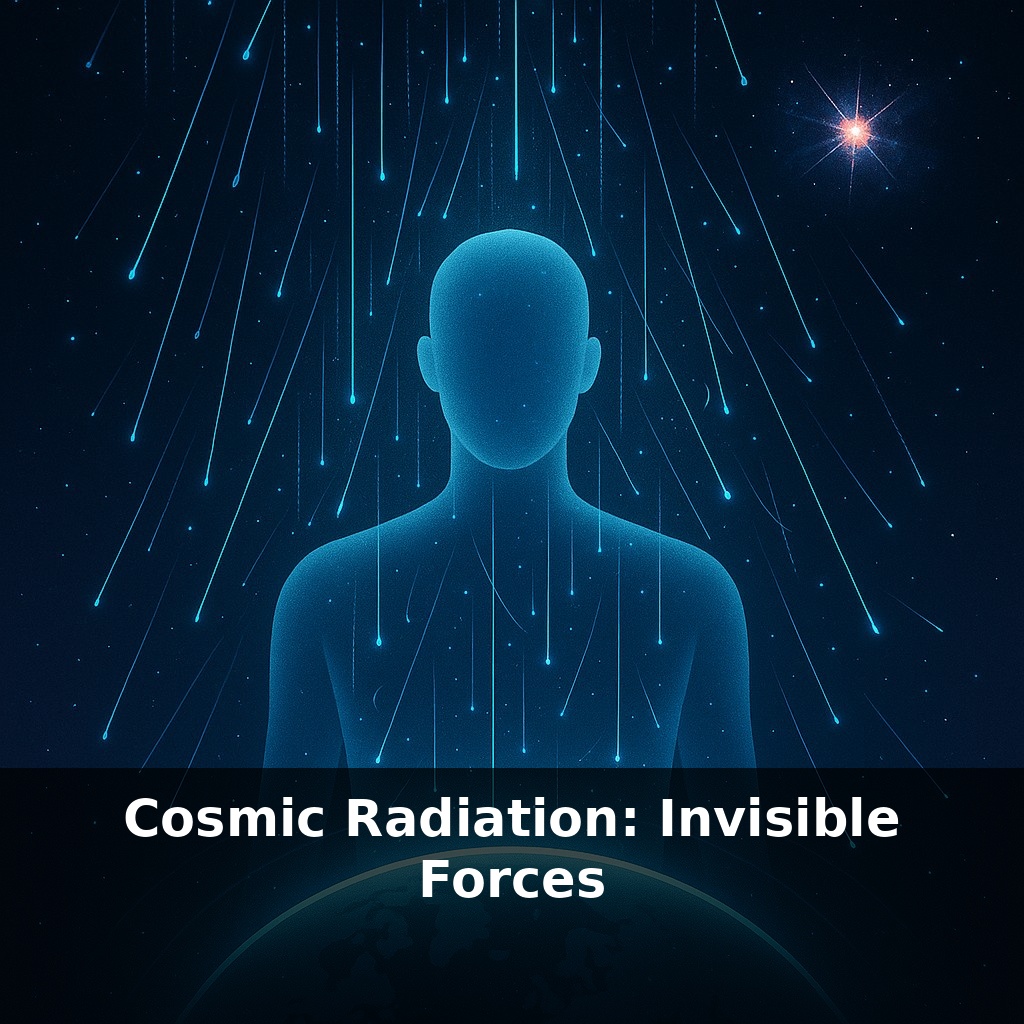
Right now, as you listen, subatomic bullets are passing through your body—hundreds every second—without you feeling a thing. On a flight, that invisible drizzle quietly intensifies. On the way to Mars, it becomes a storm. Today, we’re stepping into that unseen weather.
Most of that “weather” doesn’t come from nearby—it’s mail from violent events scattered across the universe. Some particles started their journey before humans existed, flung out by exploding stars, smashed together in the shock fronts of supernova remnants, or accelerated in the magnetic maelstroms around black holes. Others arrive from our own Sun, riding gusts from solar flares and coronal mass ejections. Together they form a restless background that engineers have to treat like a finicky, invisible customer: one that can flip a bit in a memory chip, blur a telescope’s image, or quietly add to an astronaut’s lifetime cancer risk. Scientists read their energies and directions the way economists read market charts, looking for spikes that signal rare, high‑stakes events in the cosmos.
We’ve learned who sends this cosmic “mail”; now we ask what it does when it’s finally delivered. Those high‑energy visitors don’t just pass by politely. When they slam into the upper atmosphere, they trigger showers of secondary particles that cascade downward, briefly turning a patch of sky into a natural particle accelerator. At ground level, most of the drama is over, but traces remain: they can flip bits in bank servers, fog medical images, or complicate climate records. In orbit or on the way to Mars, far less is filtered out, so hardware design and mission planning start to resemble high‑stakes risk management.
Far from Earth, that “background risk” becomes a design constraint as real as mass and fuel. One of the first puzzles mission planners face is: how much invisible damage can a human body—or a spacecraft—absorb before the mission stops being worth it?
On the human side, space agencies track dose in millisieverts, and the numbers escalate quickly once you leave low Earth orbit. A typical six‑month trip to Mars would already eat a large fraction of some agencies’ recommended career limit. The danger isn’t just cancer decades later. There’s growing evidence that long exposure can subtly affect the brain’s wiring, cardiovascular health, and even the immune system—problems you don’t want on a crew that can’t turn around.
Engineers fight back with geometry and materials. Sleeping quarters get tucked into better‑shielded parts of a spacecraft. Tanks of water or fuel may double as protective walls. Hydrogen‑rich plastics and composites are favored over big slabs of heavy metals, because those can “splinter” an incoming ion into a spray of extra neutrons. It’s a quiet trade‑off game: every kilogram devoted to shielding can’t be used for food, instruments, or propellant.
Electronics face their own invisible gauntlet. A single charged particle can flip a bit in a memory cell, crash a processor, or slowly erode a sensor’s performance. That’s why deep‑space probes fly “radiation‑hardened” chips that are years behind your phone in raw speed. Redundant computers vote on answers, error‑correcting codes clean up corrupted data, and critical instruments are powered down when passing through harsh regions like the South Atlantic Anomaly.
Researchers on Earth exploit this same phenomenon. Cosmic‑ray muons help scan the interiors of volcanoes, pyramids, and even damaged nuclear reactors, revealing hidden cavities or melted fuel without sending in a camera. One analogy from technology: like using ambient Wi‑Fi signals to map where walls must be, scientists use the way muons are absorbed and scattered to infer structures we can’t directly see.
And then there are the outliers: ultra‑high‑energy events so rare that entire observatories sprawl across deserts just to catch a handful per year, each one a clue that somewhere out there, nature is running an accelerator far more powerful than anything we can build.
On the ground, you mostly meet cosmic radiation through its fingerprints, not its full force. One example: chip manufacturers deliberately expose prototype electronics to intense beams that mimic years in orbit, then watch which memory cells misbehave. It’s like stress‑testing a banking app by hurling random transactions at it until something breaks, then redesigning the weak spots. Hospitals do something similar for space medicine—irradiating cell cultures or organoids to see which drugs blunt the most subtle damage. Climate scientists, meanwhile, track how variations in cosmic‑ray rates may tweak cloud formation, quietly nudging weather patterns over decades. And high‑altitude balloon experiments chase the edge of space, hoisting compact detectors into regions where airline pilots log their careers, turning routine flight levels into natural laboratories. Each of these efforts treats the “background” as a tool: a free, relentless probe of matter, machines, and biology.
Cosmic rays are quietly turning our whole planet into a sensor network. Variations in their flux can hint at brewing solar tantrums long before satellites fail, much like subtle tremors foreshadow quakes. Farmers may one day check “space weather” alongside rainfall, as flight planners reroute polar paths and grid operators preemptively rebalance power. Your challenge this week: whenever you see a flawless gadget or smooth flight, ask what unseen safeguards space radiation has already shaped.
In the end, cosmic radiation is less a villain than an unruly collaborator, etching tiny signatures into everything from GPS timing to cancer therapies. Lab beams now copy its wildest blows to tune new drugs, harden quantum chips, even test materials for fusion reactors—like taste‑testing extreme recipes before serving them in the harshest kitchen.
Here’s your challenge this week: Build a one-page “cosmic radiation risk snapshot” of your daily life. Using an online flight radiation calculator, plug in one recent or upcoming flight you’re taking and record the estimated dose, then compare it to a dental X‑ray and a year of natural background radiation (numbers are usually in microsieverts or millisieverts). Next, check your city’s average annual background radiation level from a reputable source (like your national radiation protection agency) and add that to your snapshot. By the end of the week, share this snapshot with one person and explain, in plain language, whether your current cosmic radiation exposure is low, moderate, or high based on what you learned in the episode.