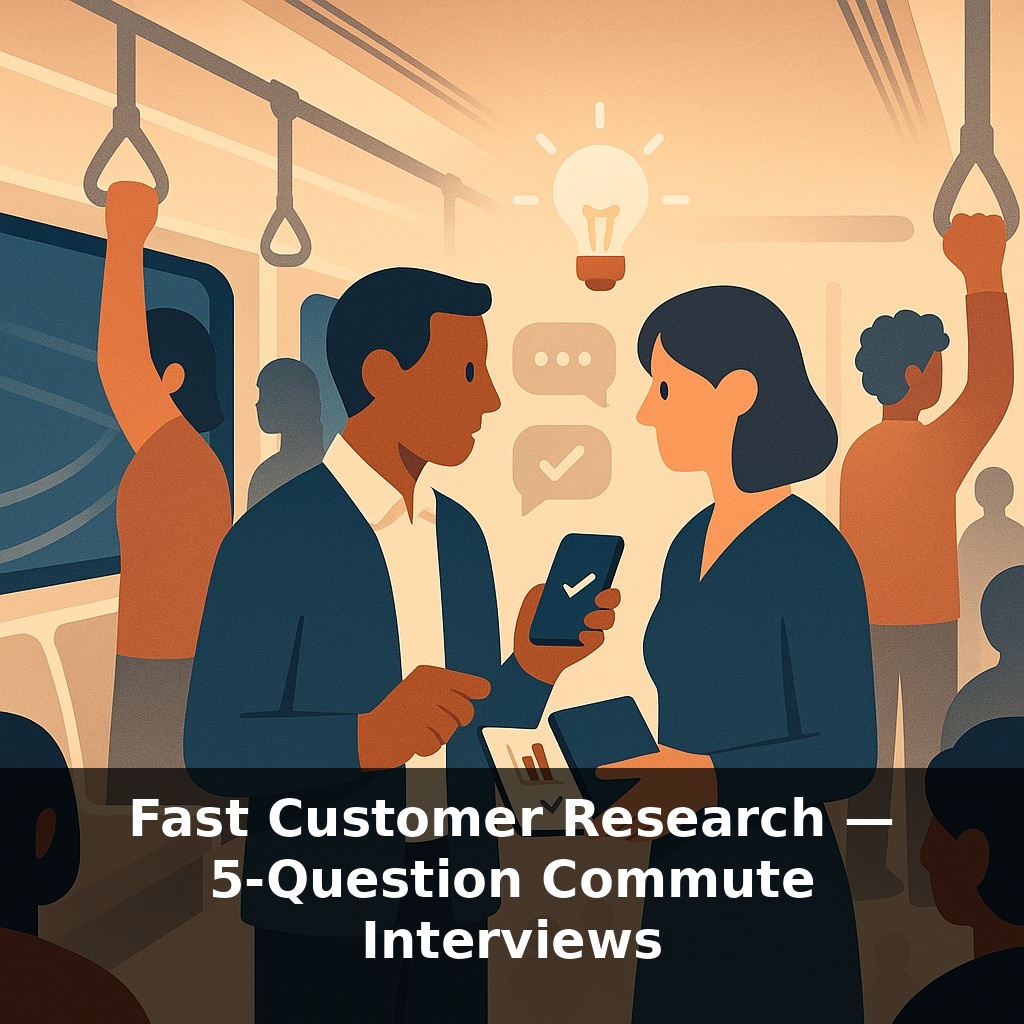
About half of failed startups die for one simple reason: nobody actually wanted what they built. Picture this: You're standing in a crowded subway, watching the world rush by. In that brief, fleeting moment, you can quietly find out if your idea is worth anything.
Here’s the strange part: you can be “sure” your idea is good, your friends can love it, your spreadsheet can look amazing—and ten short conversations with strangers can still flip your confidence upside down. In this episode, we’ll zoom in on a tiny but powerful tool: a five‑question conversation you can run in the time it takes to get from one subway stop to the next. No surveys, no pitch decks, no begging people to “support your dream.” Just a structured way to listen. You’ll learn how to uncover what people *already* do, what annoys them enough to pay to fix, and which parts of your idea actually land. Think of it as stepping into a studio with a blank canvas: each person you talk to adds a brushstroke until the real picture of your business opportunity appears—clearer, sharper, and sometimes completely different from what you expected.
Most people rush to build the “thing” and treat talking to customers as a nice‑to‑have. In this episode, we’re flipping that. Those five questions become your portable lab: something you can run on a bus, between meetings, even while waiting for takeout. We’ll look at how to pick who to talk to, how to open the conversation without sounding weird or salesy, and how to dig one layer deeper without turning it into an interrogation. You’ll also learn what to listen *for*—the phrases, patterns, and little hesitations that signal a real problem hiding in their everyday routine.
Here’s where the commute interview gets powerful: the *order* and *shape* of your five questions matter more than the exact wording. Think of them as five stepping‑stones that move someone from “normal day” to “I’d pay to fix this.”
**Question 1: Daily reality.** Start wide. Ask about a slice of their day that touches your idea, without mentioning your idea at all. “Walk me through how you handled [X] this week.” You’re looking for routines, tools, and workarounds. The more specific the story (“Yesterday I…”) the better.
**Question 2: Friction.** Once they’re walking through their routine, gently zoom in on the annoying parts. “Where does this usually get frustrating?” or “What tends to fall through the cracks?” Stay curious, not leading. If they shrug and say “it’s fine,” that’s a signal too.
**Question 3: Current fixes.** Now, move to how they cope. “What do you do when that happens?” or “How have you tried to solve that?” This reveals competitors you didn’t know you had—Excel, a notebook, a friend, a coffee at 10 p.m. Because they’re already “paying” with time, stress, or money, you’re seeing real behavior, not wishful thinking.
**Question 4: Cost of the pain.** Here you’re quietly quantifying. “How often does this happen?” “What does it cost you when it does?” You’re listening for impact: lost hours, missed revenue, embarrassment in front of a boss, tension at home. Bigger, frequent pain usually equals more willingness to pay.
**Question 5: Value test.** Only now do you introduce a *lightweight* version of your concept: “If there were a way to [outcome] without [pain], what would that be worth to you per month?” Don’t defend, don’t pitch. If they jump to specifics (“I’d pay $30 if it did X”), that’s a strong signal. If they waffle, ask, “What would make it a no‑brainer?”
Run the same five questions with 5–7 people from the same rough profile. Patterns will start to appear in their words—common frustrations, repeated tools, similar “I wish…” moments. Capture their exact phrases; these become raw material for offers and landing pages later. When different people start telling almost the same story, you’re no longer chasing a fantasy problem—you’ve found a living, breathing one.
You’ll feel this most when you test it on something concrete. Say your side hustle idea is a done‑for‑you weekly meal plan for busy nurses. One evening, you’re on a late bus and strike up a chat with a nurse still in scrubs. As you walk through their week, they mention grabbing vending‑machine dinners, skipping meals, crashing on days off. When you ask what they’ve tried, they talk about half‑finished HelloFresh boxes and grocery apps they forget to open.
Now, two nights later, an ER tech on the train gives you almost the same storyline—different hospital, same scramble, same “I just eat whatever’s there.” By the fifth conversation, you’re hearing the same phrases: “no brainspace,” “too exhausted to decide,” “I’ll just snack.” Distinct people, shared language.
This is where the method earns its keep: you’re not guessing what matters, you’re tracing the outline of a very specific job your offer could do for them. Like a doctor hearing the same cluster of symptoms, you start to see the underlying condition you might actually be treating, not just the surface complaint.
Commute interviews quietly train your instinct. After ten or twenty, you start hearing patterns the way a musician hears rhythm—off‑hand comments become signals, silence becomes data. As AI transcription and tools get cheaper, you’ll be able to tag moments of surprise, hesitation, or excitement right on your phone and adjust your offer the same day. Over time, this habit turns every bus, rideshare, or airport line into a live radar for side‑hustle opportunities.
Your challenge this week: Run three commute‑length interviews using the five‑question arc—but with one twist. After each conversation, force yourself to write a one‑sentence “diagnosis” that finishes this line: “It sounds like the real wound underneath all of this is…” Don’t show it to them. At the end of the week, lay those sentences side by side and look for recurring “wounds.” That overlap is where your next test offer should focus.
Treat these tiny interviews like street photography: quick, unposed snapshots of real life. As your collection grows, you’ll notice recurring scenes—same hassles, same workarounds—showing you where to zoom in next. You’re not chasing “perfect answers”; you’re training your eye. Keep asking, keep catching details, and let the pattern, not your hunch, lead you.
Try this experiment: Tomorrow morning or evening, during your actual commute (or a 20-minute walk), ask 3 people who fit your target customer profile the same 5 questions about the problem your product tries to solve (e.g., “When was the last time this happened?”, “What did you do instead?”, “What was most frustrating?”, “What have you tried so far?”, “If a magic solution existed, what would it do for you?”). Don’t pitch—just stay curious, keep each chat to 5–7 minutes, and jot down only direct quotes right after each conversation. When you’re done, circle the 3 phrases you heard more than once and use those exact words to rewrite one headline, email subject line, or value prop on your site today. Then watch over the next week whether clicks, replies, or signups on that updated piece improve compared to last week’s numbers.