About three out of four apps built on Bubble are made by people who can’t code. This weekend, that could be you. You wake up Saturday with only an idea; by Sunday night, you’ve got a simple site, a real payment link, and your first stranger clicking “buy.”
That’s not a fantasy build schedule. Median setup time for a Glide mobile app is 2.5 hours, Stripe can generate a payment link in under 10 minutes, and a basic Carrd + Typeform + Zapier + Airtable stack for your first 100 users runs about $35/month. In a single weekend, that’s enough to move from “I think people might want this” to, “Five strangers just paid me $29.”
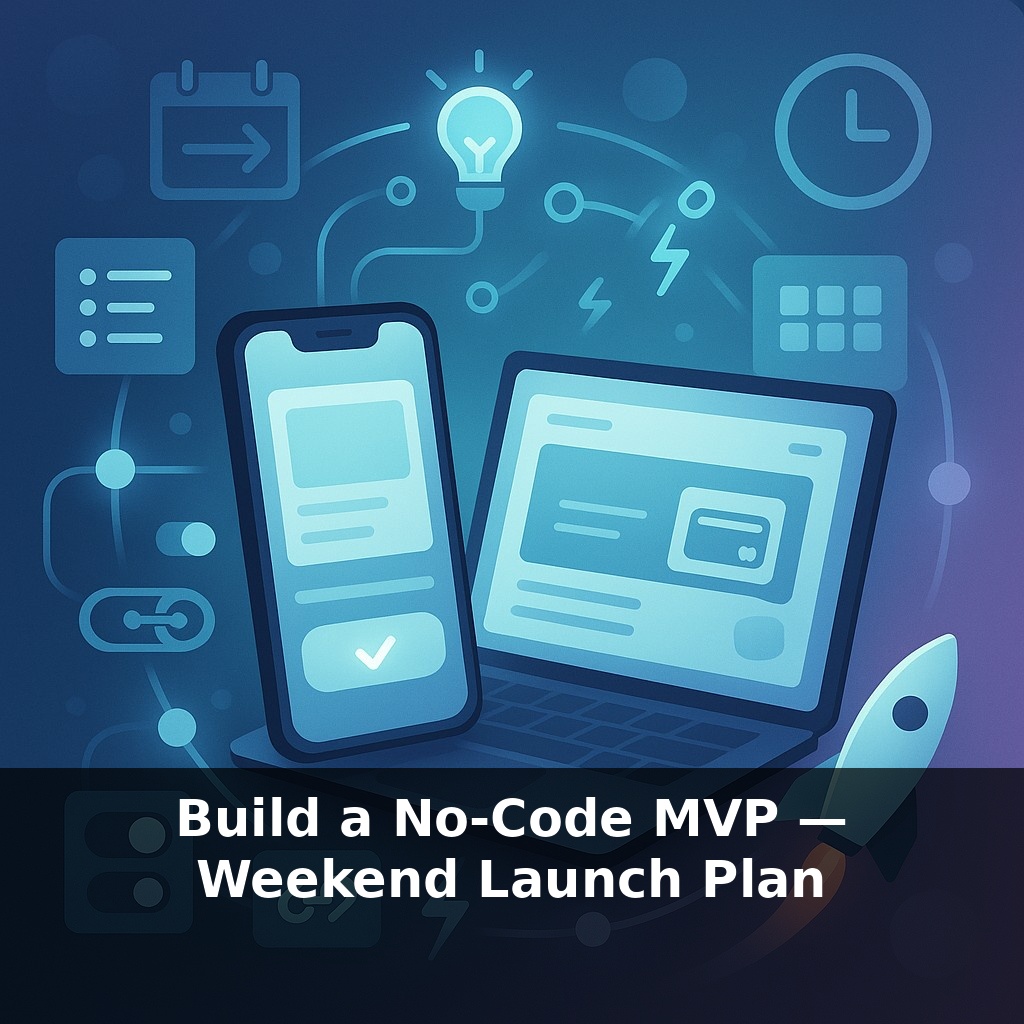
This episode is about launching something testable in 48–72 hours, not architecting your dream product. You’ll strip your idea down to one core promise from your value proposition, wrap it in a simple landing page, connect a form, and wire payments so you can charge from day one. The goal: hard data. Clicks, sign‑ups, replies, and—ideally—revenue that proves your side hustle deserves more of your time next week.
Think of this weekend as a focused experiment, not a forever build. You’re taking the offer and price you shaped earlier and stress‑testing them with real people. Your only job: prove or disprove one clear hypothesis like, “10 people will pre‑order this $39 mini‑course in 72 hours.” To do that, you’ll stack simple tools with ruthless constraints: one page, one call‑to‑action, one audience. You’ll timebox setup (e.g., 2 hours for the page, 1 hour for the form, 30 minutes for automations) and spend the rest driving traffic and measuring behavior—clicks, opt‑ins, replies, and paid signups.
Step 1: Strip your idea to one outcome and one action Take your offer from earlier episodes and reduce it to a specific, measurable outcome. Not “productivity coaching” but “Plan your next 7 days in 30 minutes.” Convert that into one primary action: “Book a 30‑minute plan‑with‑you call” or “Buy the 7‑day email sprint.” If you can’t say what the customer gets in 1 sentence under 120 characters, you’re not ready to build yet—keep tightening.
Step 2: Pick a format that matches effort, not dreams You’re shipping in a weekend, so pick the lowest‑complexity format that can still deliver the outcome:
- Info/education idea → PDF, Notion doc, or 5‑email sequence - Service offer → Calendly + Zoom + checklist you follow - Simple SaaS‑like tool → Airtable base or shared Google Sheet with templates - Community → Private Slack/Discord with a short kickoff guide
Each of these can be “delivered” to a paying user with tools you already know. You’re not building a platform; you’re packaging a result.
Step 3: Design the bare‑bones user journey Write the exact path from first click to value delivered:
1) They land on your page 2) They enter email / pay 3) They receive confirmation 4) They access what they bought or book a slot 5) You fulfill and follow up
Force yourself to keep this journey under 7 steps. If you need more, your MVP is too big.
Step 4: Decide your 48–72 hour success metric Pick one number that will decide if you iterate or kill:
- 30 visitors, 3 purchases → continue - 50 visitors, 0 purchases but 5 replies with objections → revise and relaunch - 20 booked calls, even if free, with your target audience → strong signal
Assign thresholds now so you don’t “move the goalposts” after seeing weak data.
Step 5: Bake learning into delivery Plan to ask 2–3 questions once someone buys or books:
- “What almost stopped you from signing up?” - “What made you say yes today?” - “If I improved one thing for next week, what should it be?”
Treat your first 5–10 users as co‑designers; adjust your materials the same day you hear feedback.
A practical way to think about “weekend‑build scope” is to reverse from what you can realistically deliver next week, not what would look impressive in a portfolio. Say your idea is “help junior designers build a portfolio that lands interviews.” In 72 hours, you could: set up a one‑page description of a “3‑day Portfolio Fix,” add a checkout for a $39 offer, then promise three concrete deliverables: a rewritten case study, a tightened homepage, and a 15‑minute Loom review. Fulfillment is capped at 60 minutes per client, so taking 5 clients means 5 hours of work. That ceiling matters: it stops you from silently committing to 20 hours per user.
Or take a mini “tool” idea. Instead of a full dashboard, ship one tightly scoped template: “Weekly Client Tracker for Freelance Writers.” Price it at $19, cap support to a 10‑minute loom walkthrough, and limit yourself to three tiny improvements based on the first 10 users’ feedback. Your numbers stay simple: if 100 visitors turn into 10 buyers, you’ve made $190 and earned explicit guidance on what a v2 should include.
As AI quietly seeps into builders, your “weekend stack” becomes a prototype lab. Tools that draft page copy, suggest flows, or auto‑generate workflows mean a solo creator can test 3–5 variations of a funnel in one weekend, not just one. Treat this as version control for ideas: label each variant, track visits, signups, and replies separately, and retire losers fast. Over a quarter, even 6–8 small launches at this pace can reveal one idea worth real code or bigger ad spend.
Your challenge this week: commit to one 72‑hour launch window. Block 3×3‑hour build sessions and 3×30‑minute “talk to users” slots. Aim for at least 60 visits, 6 signups, or 3 sales—pick one target. When the window closes, you must either: 1) double down with a v2, or 2) kill it and queue the next idea within 24 hours.