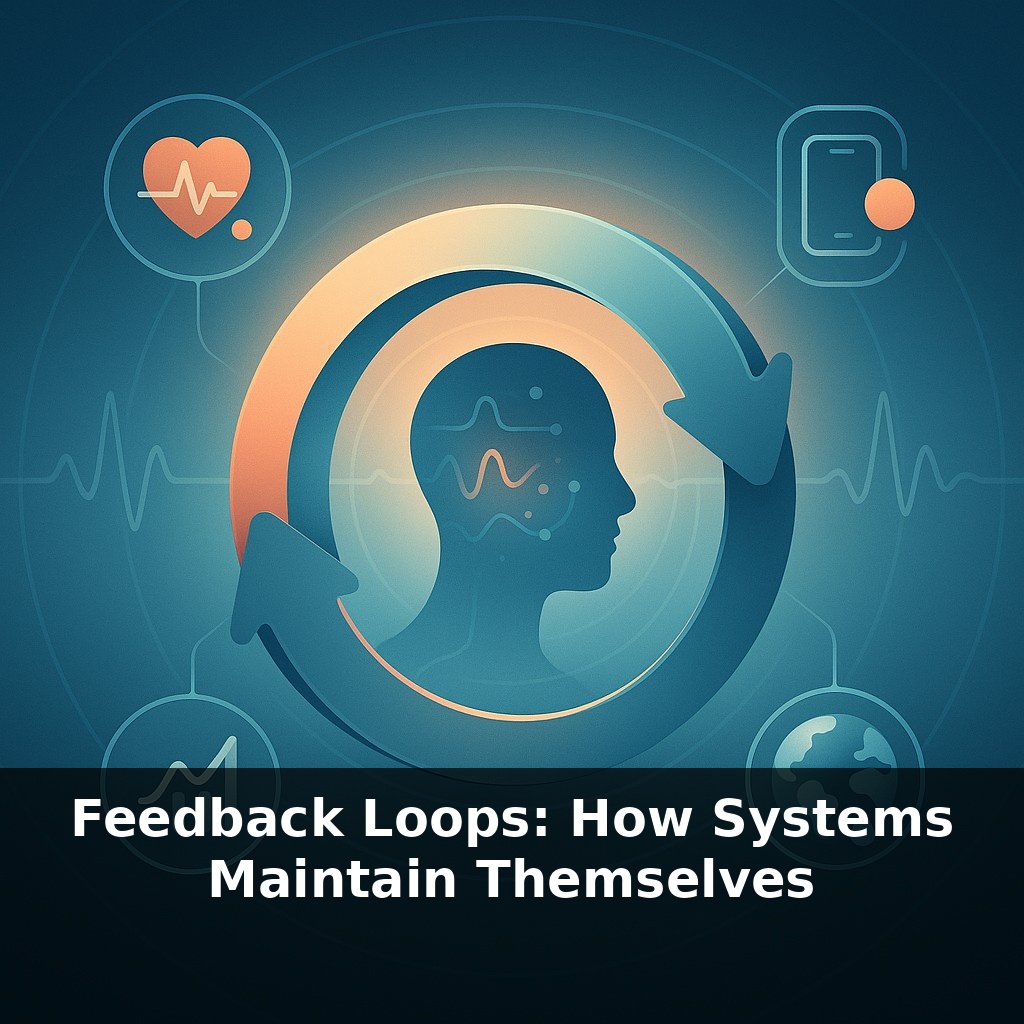
Right now, as you’re listening, your body is quietly running thousands of tiny control systems—keeping your temperature steady, your blood sugar in check, your heart on beat. But here’s the twist: the very same kind of loops that keep you alive can also crash economies and melt ice caps.
Pull back from biology and global crises for a moment and zoom in on everyday life. Feedback loops are quietly steering your day in places you rarely notice. Open a social app: every tap, pause, and share is recorded, routed back, and used to shape what you see next. Miss a deadline at work: suddenly the calendar fills with status meetings and reminder emails—each response becoming the next “input” that changes how the whole team operates.
Even your habits are loop-driven. Stay up late once, wake up groggy, grab extra caffeine, feel wired at night, repeat. Over a week, that small deviation can harden into a new “normal.” The important shift in thinking is this: systems don’t just respond to the world; they rewrite their own rules over time as feedback accumulates. And that’s where things get interesting—because small nudges can, under the right loops, scale into outsized consequences.
Watch what happens when feedback shows up in groups. A product team ships a rushed feature, support tickets spike, managers demand faster fixes, engineers cut more corners—and suddenly “move fast” has looped into “break everything.” Or consider online communities: a few low-effort posts get lots of engagement, so the platform boosts them, creators copy them, and before long the overall quality tilts toward whatever the algorithm rewards. These patterns aren’t accidents; they’re the natural result of outputs being fed back into the rules of the game.
Your challenge this week: pick a single recurring outcome in your daily life that you’re unhappy with—perhaps constant last-minute rushes at work, a recurring conflict with a colleague or family member, or a task that always gets postponed until it becomes urgent. For seven days, don’t try to fix it directly. Instead, map what typically happens right after the outcome appears—who reacts, what they do, how you respond, and what that sets up next. By the end of the week, you’re looking for one surprising place where a small, earlier change could quietly bend the whole loop.
When people first hear “feedback loop,” they often picture a single, clean circle: A causes B, B causes C, C comes back to A. Reality is usually messier. Most situations that matter to you are sitting at the intersection of several loops tugging in different directions—some pushing toward stability, others toward runaway change.
In the body, that might mean one loop working to bring a hormone level down while another tries to push it up in response to a different signal. In organizations, one loop might reward speed (“ship more, faster”), while another punishes defects (“no bugs allowed”). The result isn’t determined by any one loop in isolation, but by which loops are strongest, fastest, and activated most often.
This mix matters because balancing and reinforcing loops feel very different from the inside. A strong balancing loop shows up as resistance: projects that slow down no matter how hard you push, diets that snap back to the old weight, teams that “default” to the same behavior after every new initiative. It can feel like stubbornness or fate, but often it’s just a loop doing its job too well.
Reinforcing loops, on the other hand, feel like momentum. A small success turns into more resources, which fuel more success. Or a minor mistake erodes trust, leading to less communication, which creates bigger mistakes. They’re behind exponential-looking charts in both directions: startling growth, sudden collapse.
The tricky part is that loops can switch roles as conditions change. A hiring process that once protected quality (balancing) can, at a different scale, lock a company into groupthink (reinforcing sameness). A loan that smooths a rough patch can, if renewed repeatedly, start amplifying debt instead of buffering shocks.
This is why interventions so often backfire. We push on a symptom—more rules, more incentives, more discipline—without noticing which loops we’re strengthening or weakening. Are we calming an overactive stabilizer, or supercharging a spiral?
In cooking terms, it’s the difference between gently adjusting the seasoning as you taste versus blindly doubling the salt every time someone reaches for the shaker at the table. One approach keeps you near “just right.” The other can quietly turn dinner into something nobody wants to eat.
Consider how this plays out in three everyday arenas. In teams, performance reviews often form a loop: praise leads to visible opportunities, which create more chances to excel and be seen; lukewarm reviews quietly route people away from stretch work, shrinking their future evidence of “high performance.” The system amplifies early impressions, not just actual contribution.
Online, recommendation engines learn from what people click and linger on. A slightly edgy post draws attention; the system boosts it; creators notice and edge further—until the “normal” tone of the space has shifted without anyone explicitly deciding it should.
In personal finance, a small automatic transfer into savings each payday reduces how rich your checking account looks. That constraint feeds back into what feels “affordable,” trimming impulse purchases. Over months, the loop doesn’t just grow a balance; it reshapes your sense of what’s normal to spend, and how urgent it feels to protect that new stability.
Notice how many loops now run faster than you can think: tap a video, the feed reshapes; share a take, your notifications nudge your mood; accept a calendar invite, your week quietly rewires itself. As AI agents chain these loops together—tracking health, trading assets, routing traffic—they’ll start “playing” systems on your behalf. Your leverage grows, but so does the risk of blind spirals. The practical skill becomes loop literacy: spotting when to slow, cap, or cut a loop before it rewrites your baseline.
Treat this as a craft, not a theory. Start tracing loops in places you care about: which comments change a colleague’s tone, which purchases shift next month’s options, which posts subtly steer your mood. Your challenge this week: pick one loop you uncover and tweak just a single “knob”—a response, rule, or routine—and watch how the pattern reshapes itself.