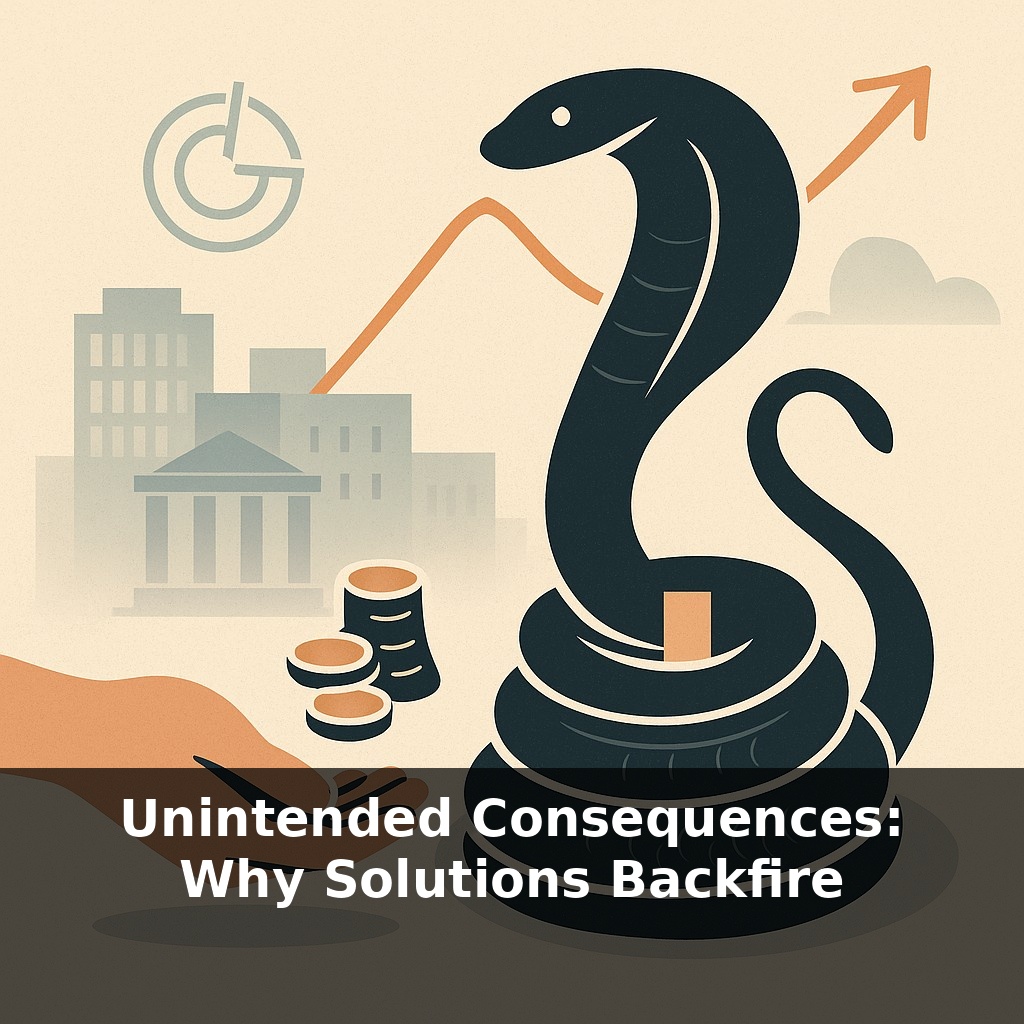
A city pays people for every cobra tail they bring in. At first, it works—until farms quietly start breeding cobras for cash, and the “solution” makes the problem worse. Why do clever fixes in business, policy, even our own lives so often turn into traps?
“When a measure becomes a target, it ceases to be a good measure.” Goodhart’s Law doesn’t just haunt colonial bounty schemes; it quietly shapes modern policies, workplaces, and even your personal goals. Turn “reduce pollution” into “hit this emissions number,” and suddenly the game shifts from cleaning the air to gaming the metric. The same dynamic shows up when social platforms chase “engagement,” and end up boosting outrage because it clicks better than nuance.
In real systems, every fix is more like tugging a knot than pressing a button. You pull one strand—biofuel subsidies, school test scores, content moderation rules—and the tension simply pops up somewhere else. Feedback loops, delays, and hidden incentives rearrange the pressure. Sometimes the system adapts; other times it retaliates, quietly reorganizing itself to defend the very problem you tried to solve.
Policy failures often look obvious in hindsight, but from the inside they feel like progress. The biofuel push that helped raze Indonesian forests began as climate-friendly innovation, not a plot to burn peatlands. London’s sewers were hailed as modern triumphs before anyone tallied the upstream disease. That’s the trap: we see the direct line from action to intended benefit, but overlook the side paths where costs quietly accumulate. Like tightening one screw on a wobbly table, we stabilize one leg while the others shift—sometimes enough to flip the whole thing over.
In complex systems, the “backfire” doesn’t appear as a single dramatic event. It creeps in through side doors: delays, misaligned timelines, and actors responding to each other rather than to the original goal.
Start with time. Many interventions give you an early “win” that masks longer-term damage. Forest clearing for oil‑palm brought quick export revenue and jobs; the real price—flood risk, haze, carbon loss—unfolded years later, on different political cycles and balance sheets. Short horizons reward whoever can show immediate improvement, even if they’re quietly loading risk into the future for someone else to pay.
Then there are hidden players. London’s sewer upgrade redirected waste away from the rich core, but the costs surfaced where people had the least leverage: overcrowded upstream neighborhoods. The engineering “success” and the public‑health setback showed up in different populations, so the trade‑off was easy to miss—or ignore. When those who benefit and those who bear the side‑effects aren’t the same people, backfires are more likely and slower to correct.
Adaptation makes this even trickier. People, firms, and governments don’t sit still while rules change; they probe, learn, and adjust. Set up a content moderation rule and users experiment at the edges, rephrasing, migrating to new platforms, or weaponizing reports against rivals. The formal policy is only half the story; the informal workarounds quickly become the real system.
Notice also how partial fixes invite dependence. A subsidy that props up a struggling industry can turn from bridge to crutch, making it politically harder to remove even when it blocks better alternatives. Safety regulations can prompt “risk compensation,” where people feel protected and push boundaries elsewhere—like drivers cornering harder once they wear seat belts. The point isn’t that safety or support are bad, but that systems tend to “restore” a familiar level of risk or advantage unless incentives are redesigned, not just patched.
One useful way to think about this: launching an intervention is less like issuing a command and more like deploying a new software update into a sprawling, messy tech stack. Legacy code, undocumented scripts, and user hacks all interact with your neat new feature—and sometimes crash it in ways no unit test predicted.
A tech team rolls out an AI filter to catch “toxic” comments. At first, dashboards glow green: flagged-post counts rise, reported complaints dip. But within weeks, users learn the edges of the model. Harassment moves into sarcasm, coded language, dog whistles. Meanwhile, marginalized users find their posts disproportionately flagged because the training data reflected old biases. On paper, “toxicity” drops. On the ground, many feel less safe and less heard.
You can see similar dynamics in well-meant productivity tools. A company installs time-tracking software to “reduce burnout.” Hours look better, but people start working off the clock, answering emails on personal devices to avoid red bars on a report. Stress doesn’t vanish; it just goes off-ledger.
Think of it like over-optimizing a personal budget app: you might hit your “daily spending” target by deferring necessary car maintenance, quietly setting up a far more expensive breakdown later.
As systems entangle, simple fixes behave more like stock trades in a volatile market: every move re-prices something else. Dynamic risk audits and sandbox regulations hint at a shift from “approve and forget” to “launch and monitor.” Foresight literacy could become as basic as spreadsheet skills—leaders routinely asking, “Who adapts? Who pays later?” The deeper change is cultural: rewarding those who surface awkward side‑effects early, not those who hide them to protect a clean success story.
Treat every fix less like a silver bullet and more like a recipe revision: change the salt and the whole dish shifts. The skill to cultivate isn’t avoiding mistakes, but updating fast—asking, “What did this nudge downstream?” and “Who’s adjusting in response?” Systems thinking starts when curiosity outlasts the satisfaction of the first apparent win.
To go deeper, here are 3 next steps: 1) Grab a systems-mapping tool like Miro or Kinopio and sketch a quick causal loop diagram of one “fix” from your own work that backfired, using *Thinking in Systems* by Donella Meadows (ch. 1–3) as a guide to label reinforcing and balancing loops. 2) Watch the 20-minute MIT Sloan talk “The Beer Game: Understanding System Dynamics” on YouTube, then run the free online Beer Distribution Game simulation to feel how well‑intended decisions create wild side effects in a simple supply chain. 3) Pick one current initiative you’re leading and run it through the “unintended consequences” checklist from the podcast show notes, then stress‑test it with a free pre‑mortem template from Notion or FigJam, explicitly listing 5 ways your solution could backfire and what safeguard you’ll add for each.