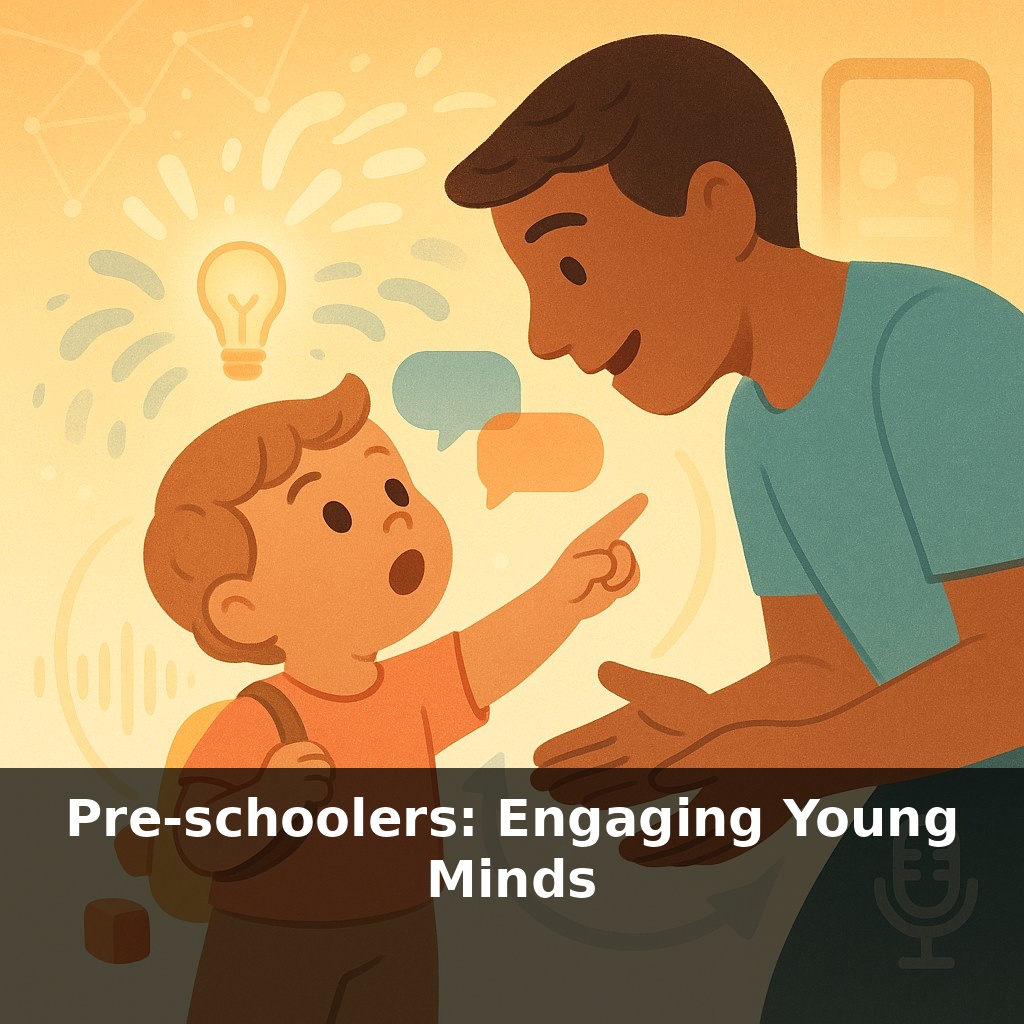
By the time most kids start kindergarten, some have heard over a million more words than others. Now zoom in: a three-year-old tugs your sleeve, saying, “Look!” In that tiny moment, your reply can quietly reshape their curiosity, their focus, even their future friendships.
“Again!” If you spend time with preschoolers, you hear that word a lot—again for the song, again for the book, again for the silly face. Underneath that repetition is a powerful learning engine: each “again” is a request for another turn in the interaction, another chance to test ideas, sounds and stories with you as their guide.
So far, we’ve looked at how everyday talk can quietly expand your child’s world. Now we’ll zoom in on the kinds of interactions that supercharge those ordinary moments: the follow-up questions that turn “truck!” into a mini science chat, the shared gaze that turns a passing dog into a micro-lesson on feelings, the playful “mistakes” that invite your child to correct you and take the lead.
These aren’t extra tasks to bolt onto your day; they’re small shifts in how you respond during routines you already do—getting dressed, buckling seatbelts, rinsing dishes.
Some of the richest of these moments pop up when things *don’t* go smoothly. A sock won’t go on, juice spills, the tablet freezes—your preschooler looks to you, and suddenly you’re not just fixing a problem, you’re co-authoring a tiny story about “what we do next.” These are chances to stretch more than vocabulary: you’re helping them practise planning, memory and self-control in bite-sized pieces. With the right kind of talk, even a two-minute delay at a red light can become a mini lab where your child tests ideas, narrates feelings and learns that their thoughts are worth hearing.
A red light, a stuck zipper, a toddler refusing the “blue bowl, not the green one!”—these aren’t just hassles; they’re entry points into the kind of talk that wires up self-control and flexible thinking.
One of the strongest tools you have is *serve-and-return* conversation: noticing whatever your child “serves” (a word, a gesture, a frown) and returning something that keeps the turn-taking going. You don’t need speeches; you need short, responsive nudges that say, “I see what you’re doing—let’s build on it.”
Three simple moves do a lot of the heavy lifting:
**1. Label the *process*, not just the thing.** Instead of only naming objects, narrate what your child is *doing with* them and how they’re thinking:
- “You’re sorting all the big blocks in one pile and the tiny ones here.” - “You changed your mind—you tried the puzzle this way and then flipped the piece.”
This kind of talk shines a light on strategies and persistence, not just correct answers.
**2. Ask “next-step” questions.** You’ve already seen how open questions spark more talking. For preschoolers, narrowing those questions to *what happens next* helps them plan and shift gears:
- “The tower wobbled. What could we try now?” - “If the park is closed, where’s another place we can run fast?”
You’re not fixing the problem for them; you’re nudging their thinking forward one step at a time.
**3. Invite them to be the “expert.”** Let them teach, correct or direct you:
- “I forget—how do *you* like to feed your teddy at bedtime?” - “Show me the tricky part of this game. What do I have to watch out for?”
When children explain rules or routines, they practise holding information in mind and switching perspectives—key ingredients of self-regulation and social ease.
All of this works especially well in play. Guided play means *you* set up the space and basic goal (“Let’s make a restaurant in the living room”), then follow your child’s lead inside that frame. You might add gentle prompts—“Who’s coming to eat?” “Uh-oh, we’re out of soup”—but you resist steering every move. Think of it as jazz rather than a marching band: there’s a loose structure, and within it, your child improvises while you support the rhythm.
Over time, these tiny verbal tweaks during ordinary messes and games add up. You’re not only building language; you’re giving your child a voice inside their own head that can plan, pause and choose what to do next.
“Why does the moon follow our car?” “Can dogs talk to each other?” When preschoolers toss you these curveball questions, they’re opening doors to rich back-and-forth that goes far beyond naming things. You can use those moments to stretch how they think, not just what they know.
Try shifting from quick answers to little thought-journeys together: “Hmm, how could we find out?” “What do you think first?” Then add just one new idea they can chew on—“Some people think…” “In this story, the character tried…” You’re modelling how to explore, compare and wonder.
Everyday routines work too. While cooking, you might say, “You choose: should we taste, smell or squish this next?” You’re inviting experiments, not quizzing. During cleanup, turn decisions into mini design challenges: “We need to fit all these cars on the shelf like a puzzle. Where could the longest one go?”
Your role isn’t to be a walking encyclopedia; it’s to be a curious partner who keeps the questions alive just a little longer.
Preschool talk is also a quiet justice issue. The more we embed rich, back‑and‑forth language into parks, buses and clinics, the less a child’s future depends on their postcode. Cities are already piloting “conversational nudge” signs and story trails, turning sidewalks into low‑key learning labs. As AI toys arrive, the real test won’t be how “smart” they sound, but whether they leave space for human voices to weave around them, like harmonies around a steady drumbeat.
When today’s talk feels small—narrating breakfast, swapping “why”s in traffic—remember you’re sketching blueprints for how your child will tackle group projects, negotiate rules on the playground, and listen in class. Like planting mixed seeds in a tiny window box, these varied, responsive chats can one day spill over into a whole balcony of ideas.
Before next week, ask yourself: “When my preschooler is most curious (like during bath time, snack prep, or outdoor play), how could I turn that exact moment into a tiny ‘learning lab’—for example, by counting, comparing, or asking ‘what do you think will happen next?’ instead of giving answers?” “Looking at our day, where could I swap 10 minutes of passive screen time for a simple, hands-on activity—like sorting toys by color, ‘reading’ pictures in a wordless book together, or letting them help measure ingredients in the kitchen?” “The next time my child asks a ‘why’ question, how can I respond with one more open-ended question back—such as ‘Hmm, what do you think?’ or ‘How could we find out together?’—and then actually follow their lead, even if it gets a bit messy or takes extra time?”