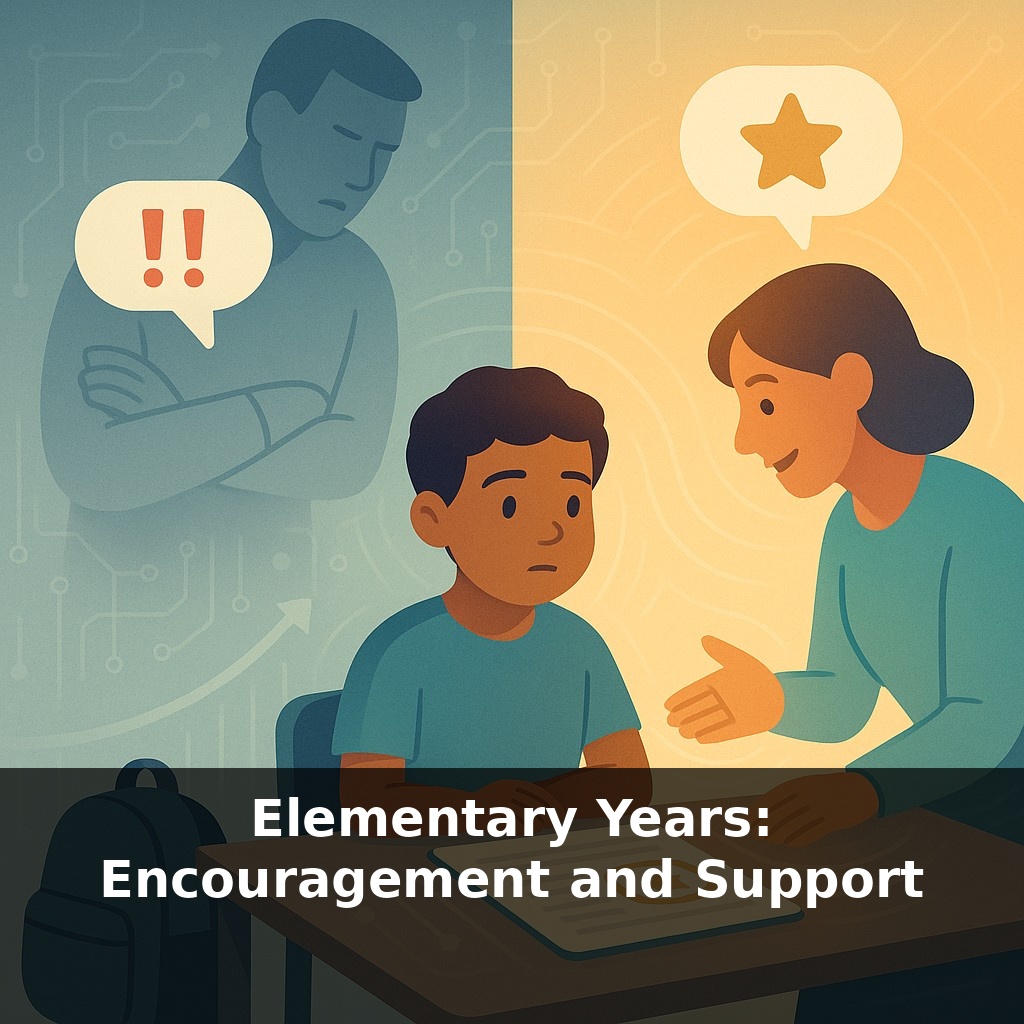
“Most kids in elementary school hear far more ‘don’t’ and ‘stop’ than ‘nice job’ in a typical day. Now listen in on two after‑school moments: one parent sighs, ‘You missed three words.’ Another leans in and says, ‘Show me the part you felt proud of.’ Same child. Very different future.”
“Most kids in elementary school hear far more ‘don’t’ and ‘stop’ than ‘nice job’ in a typical day. Now listen in on two after‑school moments: one parent sighs, ‘You missed three words.’ Another leans in and says, ‘Show me the part you felt proud of.’ Same child. Very different future.”
By the elementary years, kids are collecting thousands of tiny messages about who they are: “I’m the messy one,” “I’m bad at math,” “I only get noticed when I’m in trouble.” Our words start to feel like labels printed on their backpacks. Research shows that how we *respond* in ordinary moments—homework hiccups, sibling squabbles, video‑game meltdowns—shapes what they dare to try next. Warmth alone isn’t enough, and rules alone backfire. The magic is in pairing clear expectations with specific, useful feedback: not “good job,” but “you kept going even when that problem was confusing—that’s what mathematicians do.”
By 3rd grade, many kids can already tell you which table is the “smart group” and which kid is “always in trouble.” School, sports, and even group chats start adding their own sticky notes to the ones kids collect at home. Now, encouragement has to do double duty: it needs to cut through outside noise *and* help kids handle bigger challenges—tough tests, social drama, losses on the field. Research shows what matters most here isn’t cheering from the sidelines, but how we talk in the messy middle: when they’re frustrated, tempted to quit, or scared they’ll look “dumb” for trying.
Think about the moments when kids are *between* success and failure—that wobbly middle where they’re not sure which way things will go. That’s where encouragement and support do their most important work in the elementary years.
Researchers see a pattern: when adults jump in with either constant cheerleading (“You’re amazing!”) or quick fixes (“Here, I’ll just do it”), kids become *observers* of their own lives instead of active problem‑solvers. But when adults respond like curious coaches—interested, calm, and a little strategic—kids start to experiment, adjust, and try again.
Three ingredients matter here:
**1. Process‑spotting in real time.** Instead of noticing only outcomes, you zoom in on *moves* they’re making: the way they reread directions, ask a friend for clarification, or take a breath before answering. A simple, “I noticed you paused to think before you circled that—walk me through what you checked,” helps their brain tag that move as useful. Over time, kids build a menu of “things I can try when it’s hard,” not just “ways I can win.”
**2. Questions that hand the steering wheel back.** When a child groans, “I messed up the whole thing,” it’s tempting to reassure or correct. A different path is to ask small, concrete questions that shrink the problem to a workable size: - “Show me one part that went closer to how you wanted.” - “If you had ten more minutes, what’s the first change you’d make?” - “Where did it start to feel confusing?” These questions do two things at once: they steady emotions *and* nudge the brain into problem‑solving mode.
**3. Calm structure around big feelings.** Elementary‑age kids often know the “right” words about effort, but in the moment, disappointment still hits hard. Support means staying present *without* letting the storm run the show: - Naming what you see: “Your hands are in fists; this really matters to you.” - Re‑anchoring to a simple next step: “Let’s pick one thing to tackle now, then we’ll take a break.” - Keeping boundaries clear: “It’s okay to be mad. It’s not okay to throw the controller. Let’s figure out another way to cool down.”
Across homework, friendships, and hobbies, this mix of noticing, questioning, and calm limits teaches a quiet but powerful message: “Struggle is a signal to adjust, not a verdict on who you are.”
On a rainy Tuesday, a 9‑year‑old slams her notebook shut: “I’m just bad at writing.” Instead of pep talks or fixing the paragraph for her, you might say, “Circle one sentence that feels ‘less bad’ than the others,” then, “What tiny change would make that one stronger?” Now you’re not rescuing or judging; you’re co‑investigating. She starts to see revision as tinkering, not proof she failed.
With a 7‑year‑old who lost a board game and is ready to flip it, you could quietly slide the pieces back and ask, “Pick one move you liked from your game. How did you spot it?” You’re steering attention toward patterns they can reuse next time, even in defeat.
Think of it like coaching a kid learning to sketch a tree. You’re not grading the drawing or grabbing the pencil; you’re asking, “Which line feels closest to what you pictured?” and “Where might you add one more detail?” The paper may stay messy, but their sense of “I can adjust this” grows sharper with each small, curious question.
Future classrooms may feel more like studios than factories: kids testing ideas, getting tailored nudges from teachers, peers, and even gentle AI tools. Used well, tech might act like a spotlight, highlighting tiny moments of persistence adults might miss. Used poorly, it risks turning growth into a points chase. The deeper shift is cultural: schools and families treating mistakes like drafts in a sketchbook—expected, revisitable, and worth looking at together—rather than permanent marks on a report card.
As kids grow, they start giving *themselves* the kind of comments they’ve heard from you. Gentle, specific words now can echo later when a test goes badly or a friend says something sharp. Over time, your steady questions and calm tone become like a trusted teammate in their head, helping them reset, take a breath, and try the next small move forward.
Before next week, ask yourself: When my child talks about school, do I mostly praise results (like grades and scores), or do I call out specific efforts they made—such as how they kept trying on a tough math problem or practiced that reading passage again even when it was frustrating? How could I turn one daily routine—like homework time, the ride home from school, or bedtime—into a predictable moment of encouragement where I ask, “What felt hard today, and how did you handle it?” This week, when my child makes a mistake (for example, forgetting their folder or missing a question), how can I respond in a way that calmly normalizes mistakes and guides them to a next step, instead of jumping in to fix it for them?