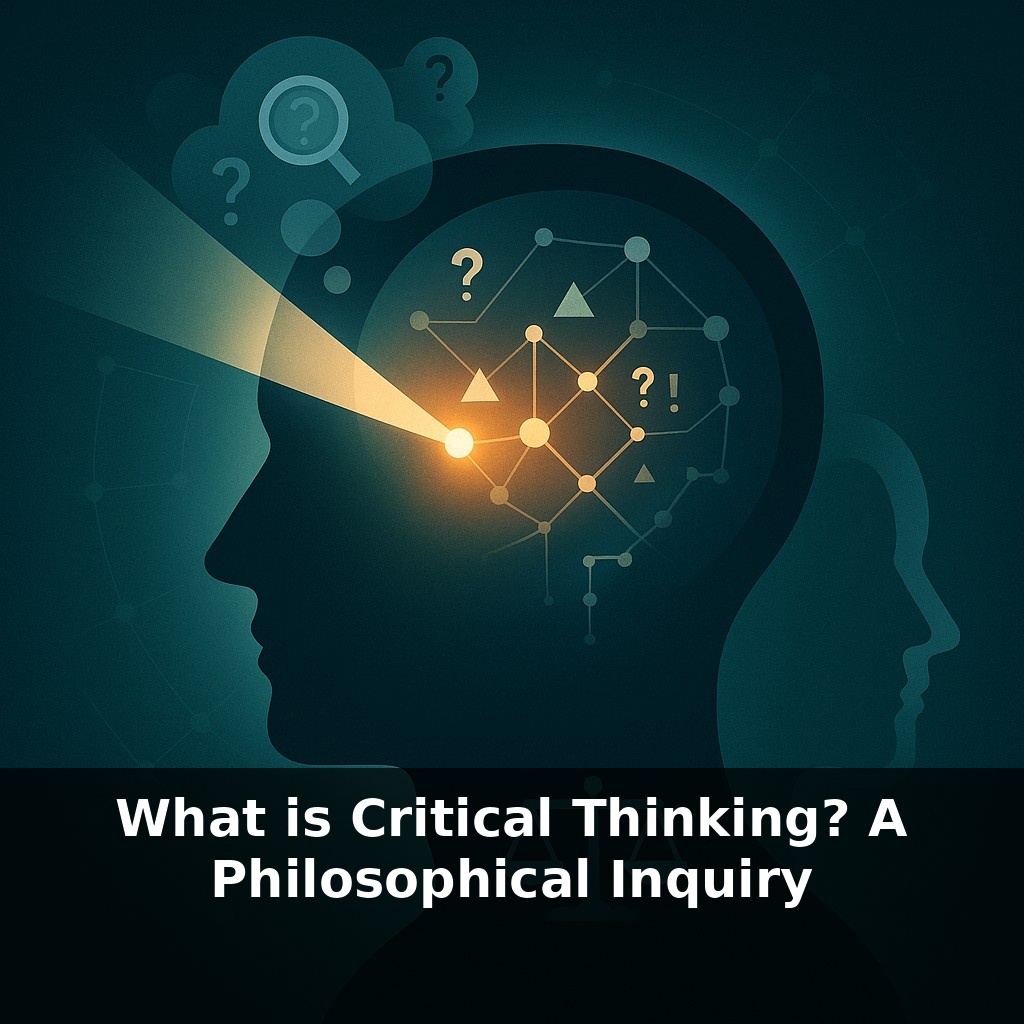
What is Critical Thinking? A Philosophical Inquiry
📝 Transcript
“Most people think they’re good thinkers—yet studies show we’re wrong far more often than we realize. You’re scrolling headlines, arguing in a group chat, making a big life decision. In each moment, one silent question decides everything: *do my reasons actually deserve my trust?*
Critical thinking is where philosophy stops being abstract and starts interfering—usefully—with your everyday decisions. It asks uncomfortable questions, not just about *what* you believe, but about *why* you give certain reasons more weight than others. Philosophers break this down into three intertwined territories: logic, epistemology, and ethics. Logic studies how conclusions are supposed to follow from premises; epistemology examines what turns mere opinion into knowledge; ethics asks what we owe each other when we argue, teach, or persuade. Together they reveal that thinking isn’t just a private mental habit—it’s a public responsibility. When you share a post, defend a policy, or comfort a friend, you’re not only expressing yourself; you’re shaping what others may come to accept as reasonable or true.
Scroll through a comment section during a heated controversy and you’ll see something striking: people rarely lack *reasons*; they lack *examined* reasons. Philosophers call this gap between “having thoughts” and “thinking well” the space where error, bias, and even manipulation thrive. In that space live loaded questions, cherry‑picked studies, confident pundits, and your own snap judgments. The goal of this series is not to turn you into a walking logic textbook, but to help you navigate that contested space with more clarity, fewer illusions, and a sharper sense of what you—and others—are actually doing when you argue.
If we move closer to the workshop of critical thinking, the first thing we notice is that it’s not a single tool, but a bench full of different instruments—each suited to a different kind of intellectual task. Philosophers often group them into three families: skills, dispositions, and standards.
Skills are the “can you actually do this?” side. They include being able to tease apart complex claims, spot hidden assumptions, and follow an argument step by step. When you recognize structures like modus ponens or modus tollens in an op‑ed or policy paper, you’re using one such skill: you’re not just reacting to the conclusion, you’re tracking how it is supposed to follow. Tests like the California Critical Thinking Skills Test try to measure these abilities in a standardized way across universities. The results keep revealing something uncomfortable: education alone doesn’t reliably produce careful reasoners.
Dispositions are different. They answer “what kind of thinker are you inclined to be?” You might recognize in yourself a quick defensive streak when challenged, or a habit of dismissing views that sound unfamiliar. Philosophers emphasize traits like intellectual humility, fairness to opposing views, and the willingness to say “I don’t know” as central to thinking well. Without these, even sharp skills become weapons: you end up using clever arguments mainly to protect what you already believe.
Standards are the often‑invisible criteria we use when we decide whether a belief is justified “enough.” How much evidence is required before you share a health claim? Which sources do you treat as serious, and why? In an age where cognitive biases are catalogued by the hundred and systems like GPT‑4 can generate fluent but sometimes false arguments, being explicit about your standards is no longer optional. It’s a form of intellectual self‑defence.
One more twist: critical thinking is *reflective*. It turns back on itself. You not only inspect the reasons for your belief; you also inspect the way you inspected them. That second‑order move—questioning your own methods and habits—is where philosophy enters as an ongoing inquiry rather than a finished toolkit.
Consider a very ordinary scene: you’re planning a weekend trip with friends. One person insists on a beach town because “it’s always sunny there,” another pushes for a mountain cabin “since it’s obviously cheaper,” and someone else quietly opens a spreadsheet with actual prices, weather data, and transport options. All three are reasoning, but only one is actively checking how strong each claim really is and what would change their mind. That’s skills in motion, guided by a disposition toward fairness, aiming at a standard of “good enough to decide.”
Now shift to a public example. A city debates installing facial‑recognition cameras. Supporters appeal to safety statistics; critics warn about wrongful arrests and surveillance creep. A reflective thinker in this debate doesn’t just pick a side; they ask: what evidence would actually count here, whose experience is missing, and what risks are we quietly accepting as “normal”? That turn toward examining the *quality* of our justifications, not just their volume, is where this philosophical approach starts to reshape real choices.
As AI tools begin drafting laws, screening job applicants, and tailoring news feeds, the pressure on our own judgment will quietly intensify. The habits we bring to everyday choices—how we weigh testimony, handle disagreement, and react to doubt—will scale into our institutions. Critical reflection may become less a specialized academic virtue and more a shared civic craft, like basic literacy once was: expected, taught early, and continually refined in public life.
Treat this less as a shield and more as a lifelong craft. Each question you sharpen, each source you probe, slightly rewires how you choose friends, jobs, and news. Like learning a new instrument, the early notes are awkward—but over time your “ear” for bad arguments and lazy evidence improves, and your decisions start to sound more like your considered self.
To go deeper, here are 3 next steps: (1) Read Nigel Warburton’s *Thinking from A to Z* and, as you go, pause at each fallacy (like straw man or ad hominem) and apply it to a recent news article from BBC or Reuters to see whether the argument really holds up. (2) Watch one Philosophy Bites episode (e.g., their critical thinking–related interviews) and then open the Stanford Encyclopedia of Philosophy entry on “Critical Thinking” to compare how each defines skills like inference, justification, and open-mindedness. (3) Install the browser extension “Rbutr” or a fact-checking tool like “NewsGuard,” then pick a controversial op‑ed you’ve recently read and actively trace at least two linked counterarguments, asking yourself which side uses better reasons rather than just stronger rhetoric.
From this course
The Art of Critical Thinking Through Philosophy
8 episodesUnlock all episodes
Full access to 8 episodes and everything on OwlUp.
Subscribe — $1.99/monthLess than a coffee ☕ · Cancel anytime