About a quarter of people say they “rarely” fall for bad arguments—yet studies show most of us miss basic logical errors every single day. You’re scrolling headlines, debating a friend, or reading a work email…and the flaw slips by, quietly shaping what you believe next.
That quiet slip is the real problem: flawed arguments rarely arrive wearing a warning label. They show up dressed as confident TED talks, sharp tweets, passionate rants, or polished boardroom decks. And because they sound familiar, urgent, or emotionally right, they often pass straight through our defenses.
Some play on our loyalties: “Are you really on *their* side?” Others lean on authority: “All the experts agree…” Some hijack our fears: “If we allow this, society will collapse next.” Notice the pattern? The more an argument tugs on identity, emotion, or speed—*decide now*—the less time we give ourselves to inspect its wiring.
In this series, we’ll slow that moment down. Not to win debates, but to notice when persuasion quietly replaces proof.
So where do fallacies enter this picture? Often, they show up right where we feel most certain. A thread that “destroys” an opponent, a comment that feels *obviously* right because it matches our politics, a meeting argument that everyone nods along to because the speaker sounds confident. Our minds like shortcuts: we lean on authority, group consensus, and our own prior beliefs. Those shortcuts aren’t always bad—but they create blind spots where systematic errors in reasoning can hide, especially when the topic feels urgent, tribal, or morally charged.
Think of this step as learning the *landscape* of bad arguments rather than memorizing a dictionary of names. Yes, philosophers have catalogued hundreds of distinct fallacies, but you’ll meet the same small cast of characters again and again—especially when stakes or emotions run high.
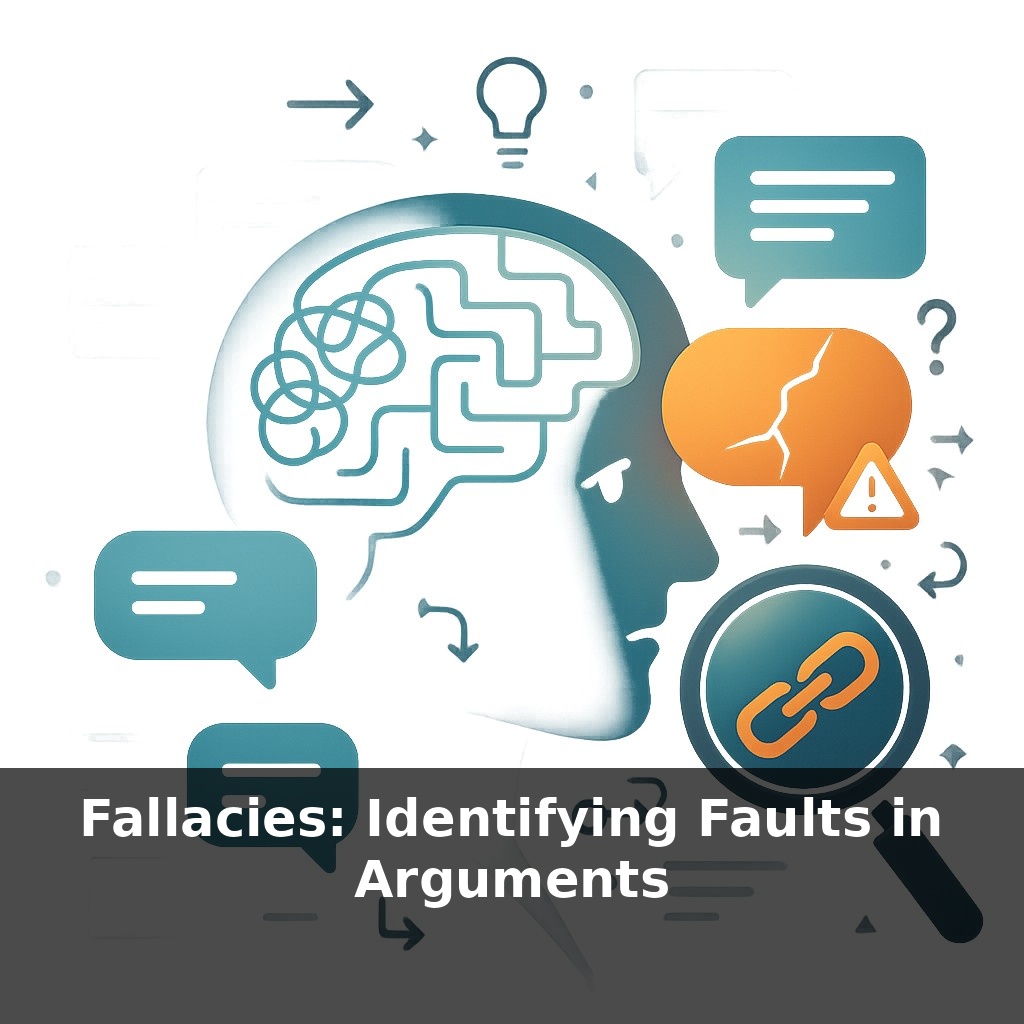
Four show up so often they’re worth putting on speed‑dial:
- **Ad hominem** – Instead of engaging the claim, the speaker goes after the person. A politician’s policy is dismissed because of a past mistake; a colleague’s data is brushed off because “you’re always negative.” The target shifts from *what was said* to *who said it*.
- **Straw man** – A position gets replaced with a weaker, distorted version that’s easier to attack. “You want to reduce the budget” becomes “you don’t care if the company survives.” The real view is still standing somewhere offstage, but the audience only sees the scarecrow.
- **False cause** – Two things happen near each other in time, and one is quickly blamed for the other. Sales rise after a logo change, and the rebrand is crowned a genius move—ignoring seasonality, pricing, or broader trends. Correlation quietly masquerades as causation.
- **Slippery slope** – A relatively small step is said to *inevitably* trigger a dramatic chain reaction: “If we allow remote work two days a week, no one will ever come to the office again, and our culture will die.” Possible futures are presented as guaranteed outcomes.
Notice what these moves have in common: they often *feel* powerful. They’re punchy, dramatic, satisfying to say. They simplify messy reality into something emotionally clear: good vs. bad, safe vs. dangerous, us vs. them.
That’s part of why they spread so easily in headlines, viral threads, and high‑pressure meetings. They reward speed and certainty. They flatter our existing views. They rarely sound like formal logic; they sound like common sense.
Yet there’s another layer: many of these patterns are amplified by cognitive biases you didn’t choose. Confirmation bias makes hostile caricatures of “the other side” feel accurate. Our tendency to see patterns even in noise nudges us toward false causes. Fear of loss makes slippery‑slope stories unusually vivid.
The encouraging part: these habits are trainable. In controlled studies, people who practice spotting specific fallacies become noticeably harder to sway with them later—not by becoming cynical, but by becoming more curious about *how* a claim is built before deciding *whether* to accept it.
Notice how these patterns sneak into very ordinary moments. A friend posts, “Only an idiot would support this policy,” and the comments cheer—not because anyone checked the policy details, but because the insult feels emotionally satisfying. A podcast host summarizes an opponent’s view in one mocking sentence, then spends an hour dismantling that caricature. A manager claims, “Ever since we hired more juniors, quality has dropped,” and the room nods before anyone looks at timelines, workload, or training. A local debate over a modest zoning change suddenly turns into predictions about your entire neighborhood “turning into a dystopian maze of luxury towers.”
When you zoom out across news, marketing, internal memos, and family chats, you’ll see the same few moves repainted in different colors. Like walking a forest trail and slowly learning to distinguish four or five recurring leaf shapes, you start to notice: this argument *feels* new, but its structure is oddly familiar.
In the near future, your news feed may come with “argument labels,” the way packaged food lists sugar and salt. AI systems are already learning to flag shaky reasoning in real time, nudging you to pause before you share or vote. Classrooms are beginning to treat argument analysis like basic literacy, not an optional extra. The shift is quiet but radical: instead of rewarding loudest voices, we may start rewarding the cleanest chains of thought, like valuing clear water over flashy bottles.
As you start noticing these patterns, don’t rush to label every disagreement a fallacy hunt. Use them more like trail markers than weapons: signals to slow down, ask a clarifying question, or request better evidence. Over time, you’re not just “calling out” bad moves—you’re quietly refining your own, like revising a draft until the sentences finally land.
Here’s your challenge this week: Pick three real arguments you encounter (a social media post, a news article, and a conversation) and spot at least one specific fallacy in each—like ad hominem, straw man, false dilemma, or slippery slope. For each one, rewrite the argument in one sentence so it still makes a point but drops the fallacy (e.g., replace a straw man with a fair summary of the other side). By Sunday night, share one “before and after” version with a friend or online and ask them which version feels more persuasive and why.